
Compact Muon Solenoid
LHC, CERN
 Visit us: CMS Public Website, CMS Physics ;
Contact us: CMS Publications Committee
Visit us: CMS Public Website, CMS Physics ;
Contact us: CMS Publications Committee
| CMS-PAS-HIG-24-015 | ||
| Search for triple Higgs production in Run 2 data of CMS using 4 $ b 2\gamma $ final state | ||
| CMS Collaboration | ||
| 2025-07-07 | ||
| Abstract: A search for triple Higgs boson production using the Run 2 data collected by the CMS experiment in the final state of four b jets and two photons is presented. The search is performed with proton-proton collision data at $ \sqrt{s}= $ 13 TeV, corresponding to an integrated luminosity of 138 fb$ ^{-1} $. The observed (expected) upper limit on the inclusive HHH production cross section is found to be 244 (152) fb at 95% confidence level. The results are interpreted in the $ \kappa $-framework and are parameterized as limits on the scaling coefficients of the trilinear ($ \lambda_3 $) and quartic ($ \lambda_4 $) Higgs boson self-coupling. | ||
| Links: CDS record (PDF) ; CADI line (restricted) ; | ||
| Figures | |
png pdf |
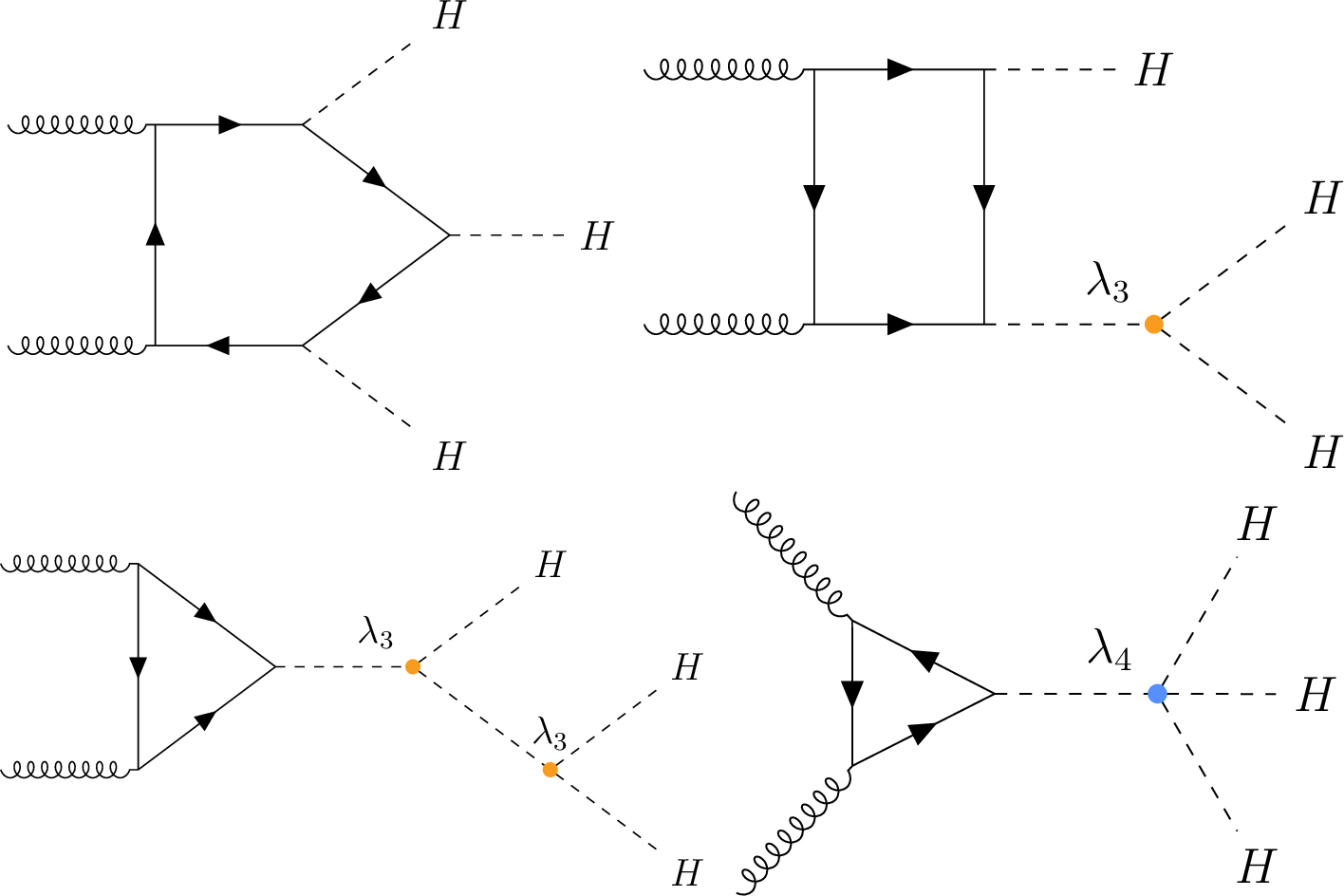
Figure 1:
Representative Feynman diagrams for HHH production via gluon-gluon fusion mode at LO. The vertices having contributions for $ \lambda_3 $ and $ \lambda_4 $ are marked in orange and blue, respectively. |
png pdf |
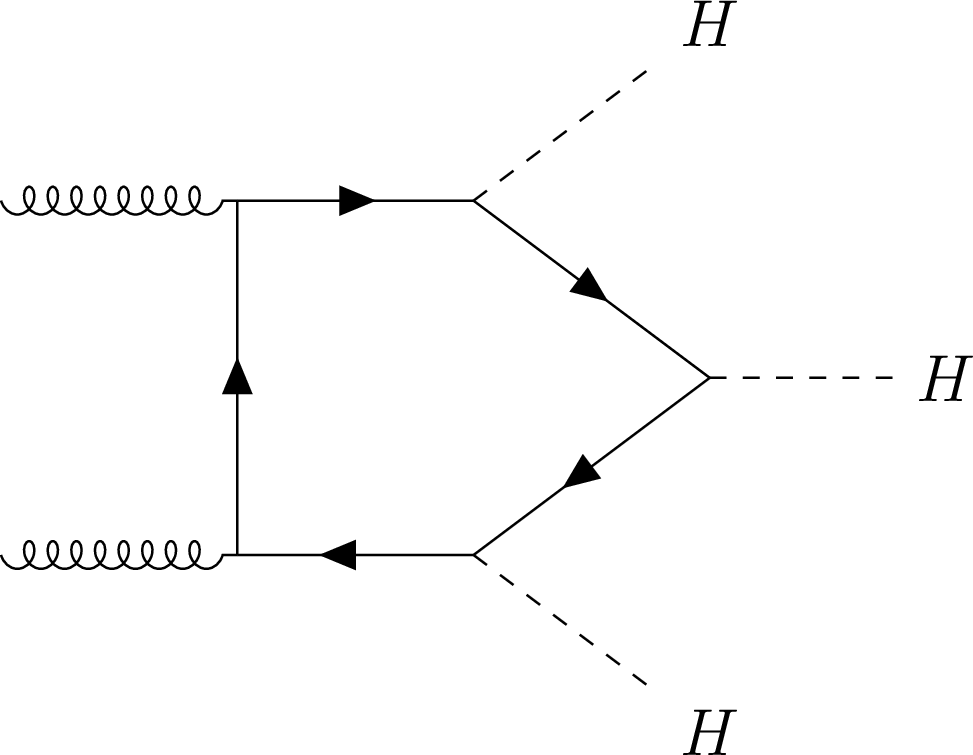
Figure 1-a:
Representative Feynman diagrams for HHH production via gluon-gluon fusion mode at LO. The vertices having contributions for $ \lambda_3 $ and $ \lambda_4 $ are marked in orange and blue, respectively. |
png pdf |
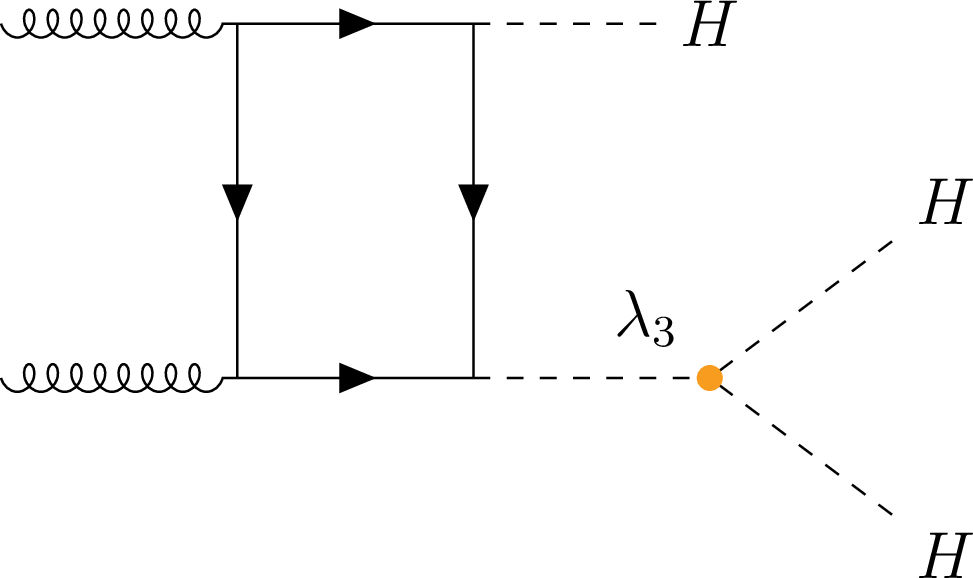
Figure 1-b:
Representative Feynman diagrams for HHH production via gluon-gluon fusion mode at LO. The vertices having contributions for $ \lambda_3 $ and $ \lambda_4 $ are marked in orange and blue, respectively. |
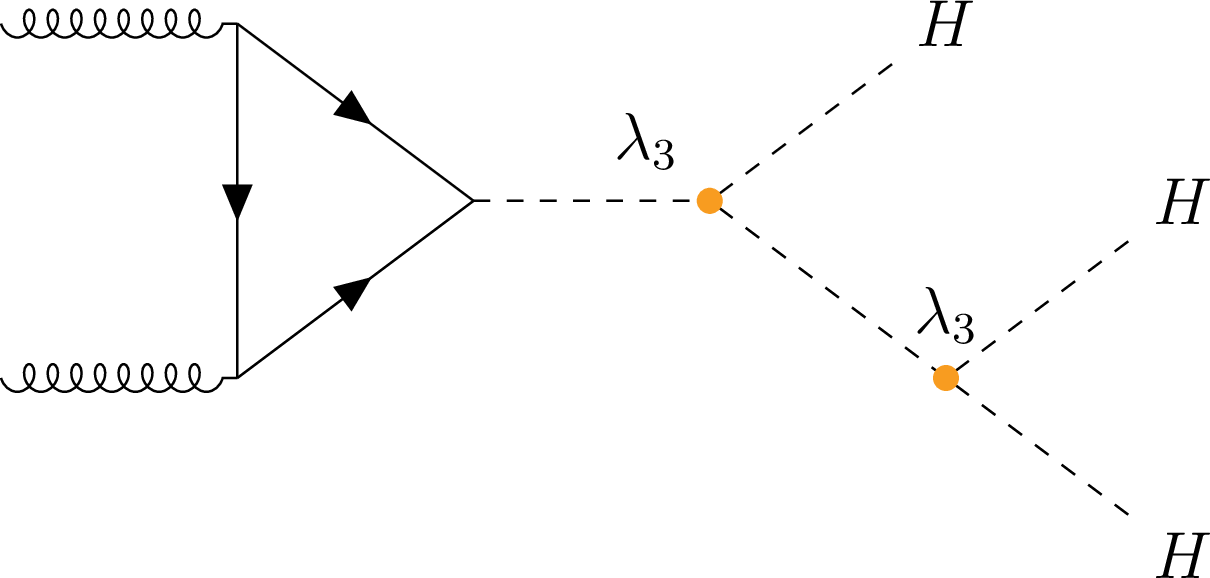
png pdf |
Figure 1-c:
Representative Feynman diagrams for HHH production via gluon-gluon fusion mode at LO. The vertices having contributions for $ \lambda_3 $ and $ \lambda_4 $ are marked in orange and blue, respectively. |
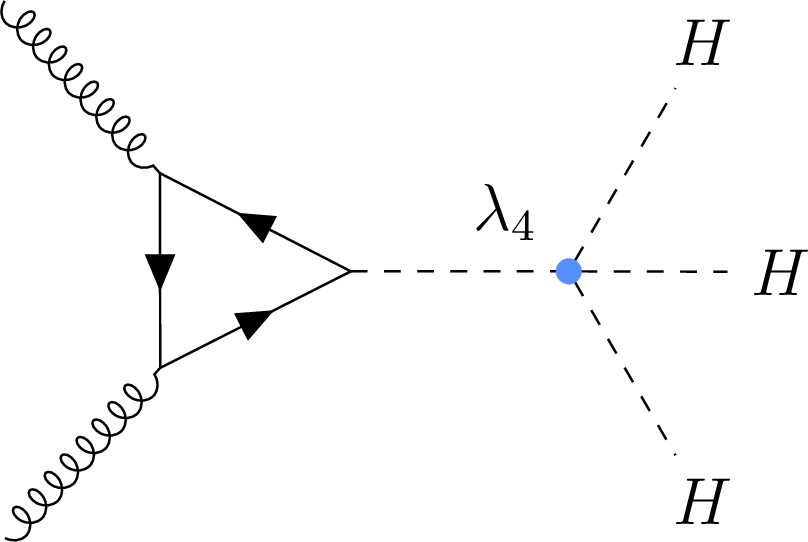
png pdf |
Figure 1-d:
Representative Feynman diagrams for HHH production via gluon-gluon fusion mode at LO. The vertices having contributions for $ \lambda_3 $ and $ \lambda_4 $ are marked in orange and blue, respectively. |
png pdf |
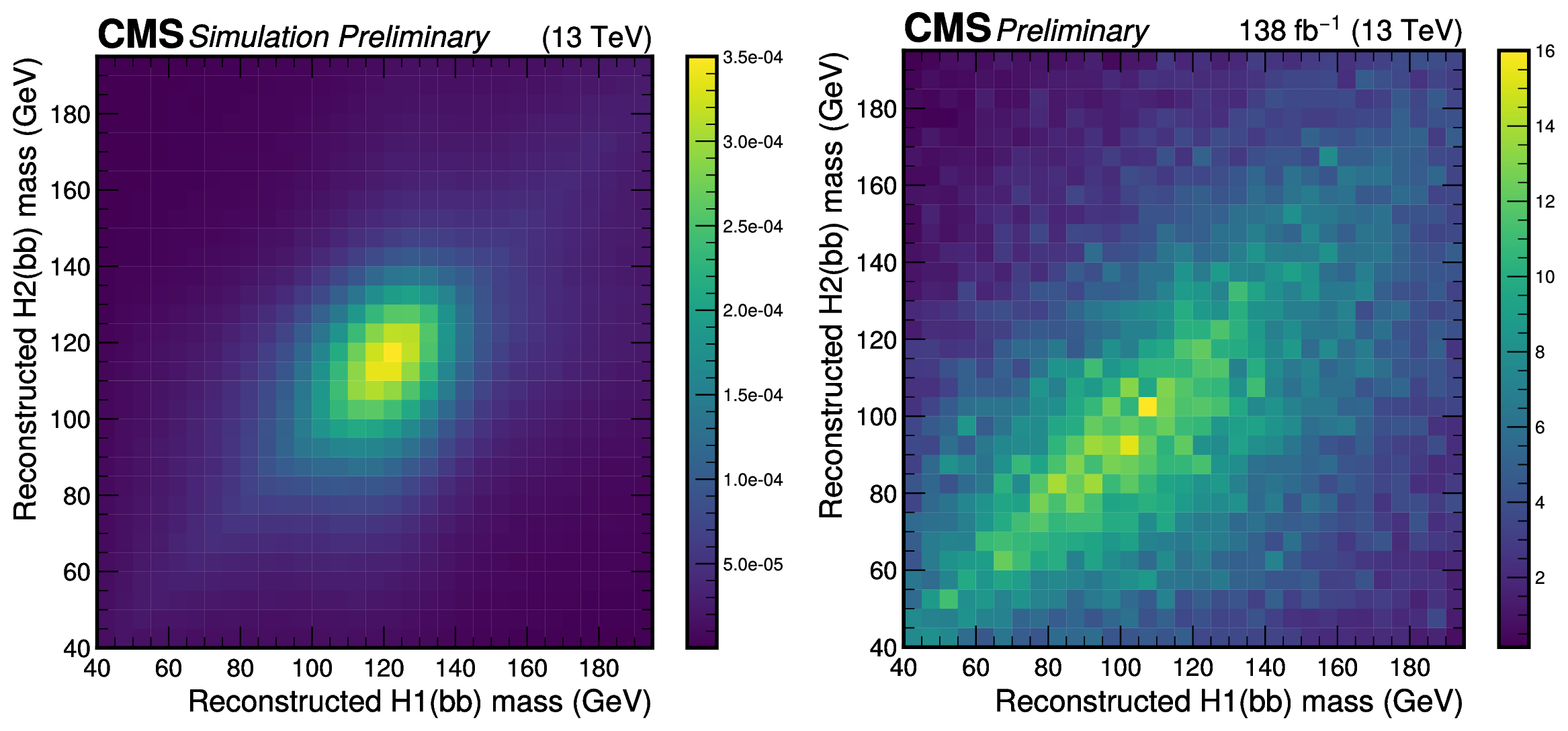
Figure 2:
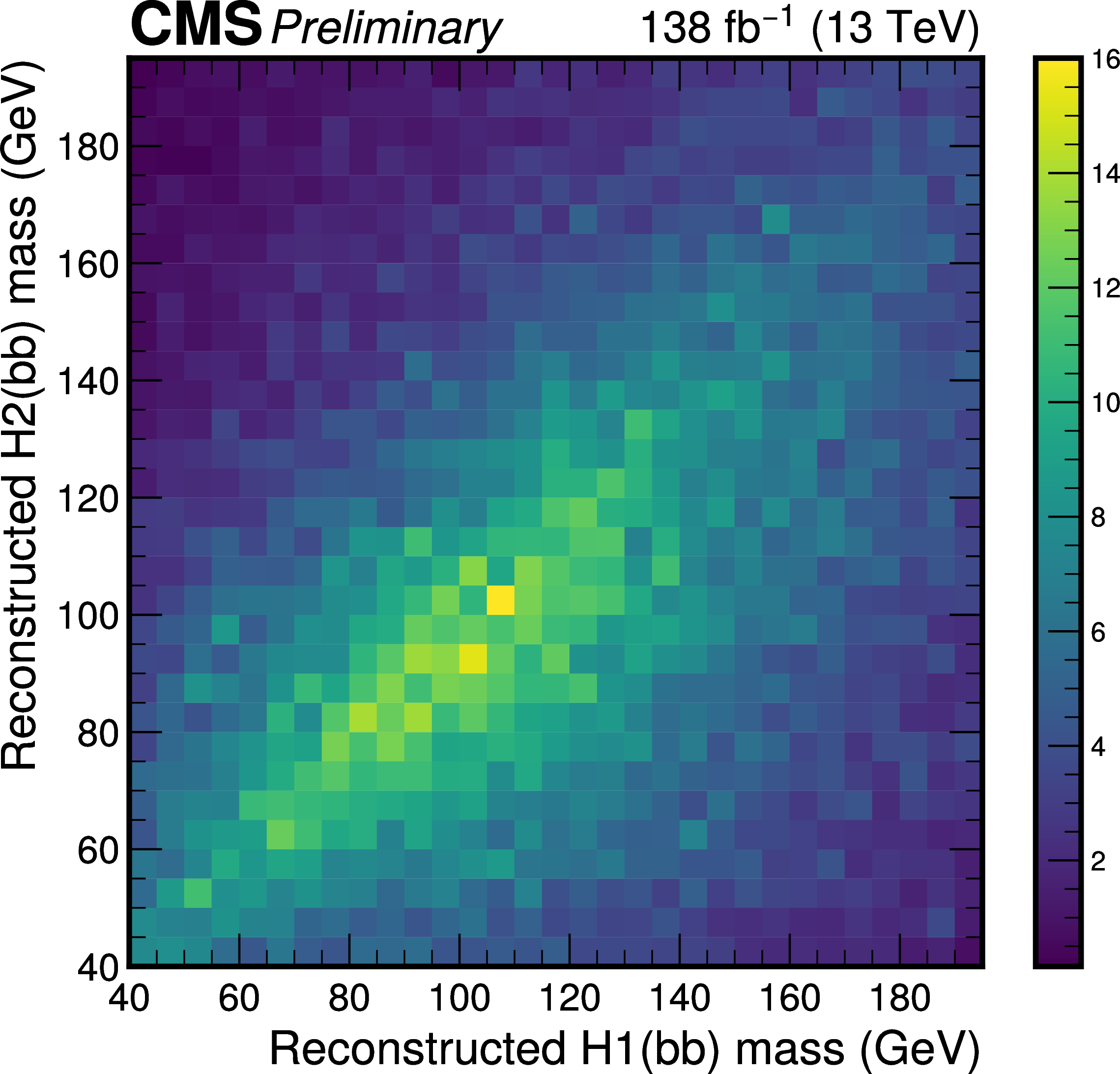
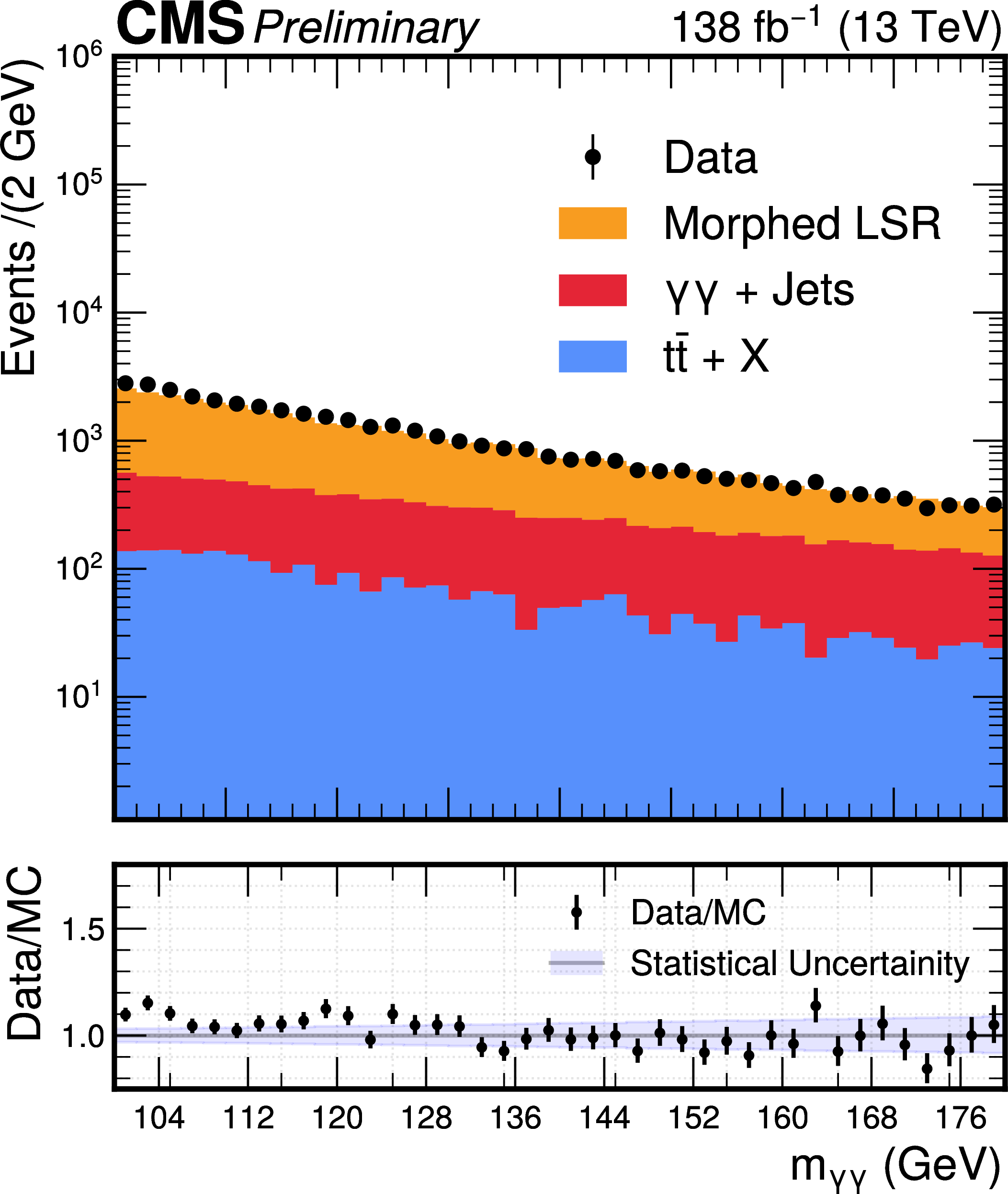
Distributions of the reconstructed masses of the leading (H1) and subleading (H2) $ \mathrm{H}\to\mathrm{b}\overline{\mathrm{b}} $ candidates for signal events (left) and non-resonant backgrounds (right). |
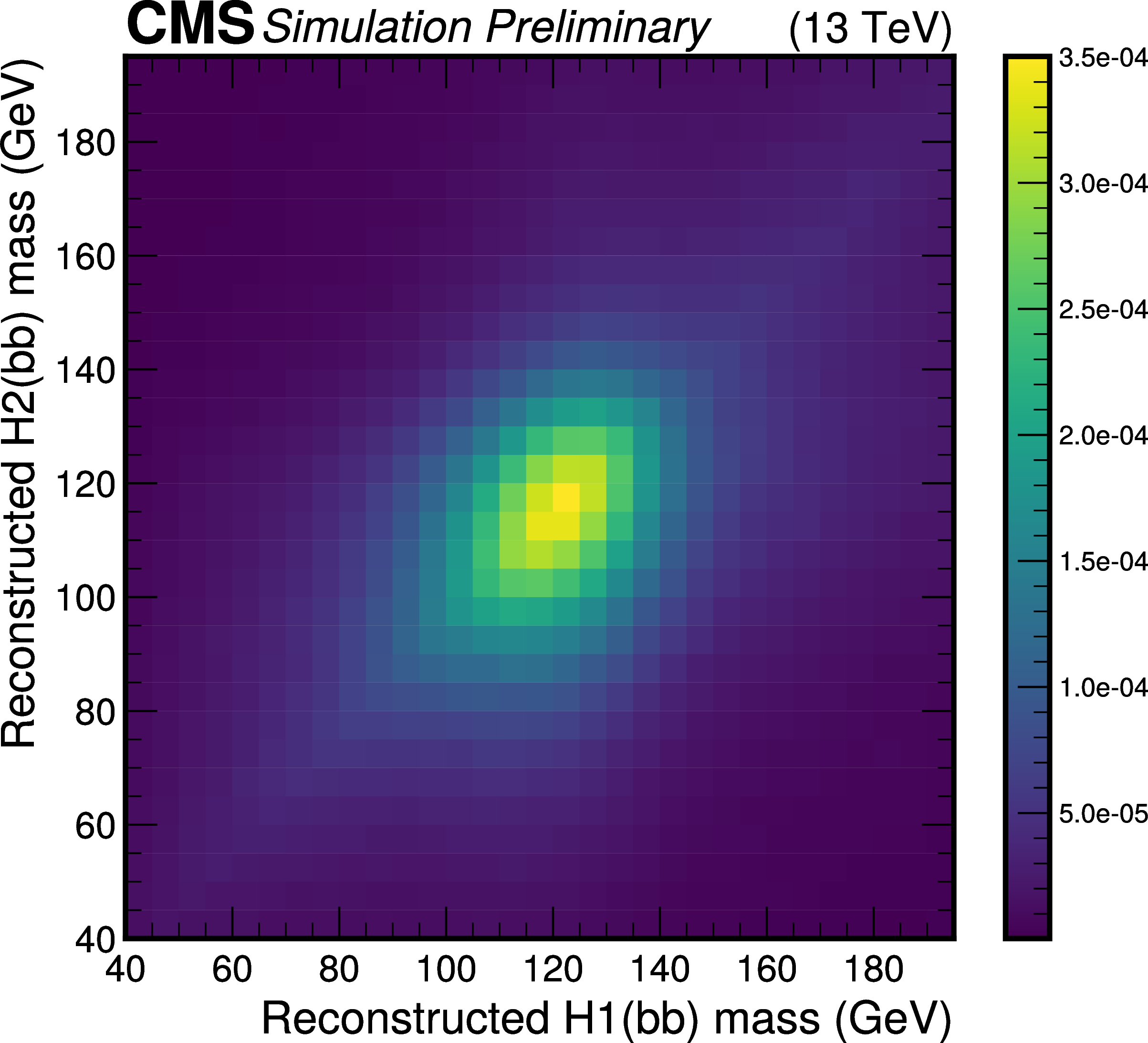
png pdf |
Figure 2-a:
Distributions of the reconstructed masses of the leading (H1) and subleading (H2) $ \mathrm{H}\to\mathrm{b}\overline{\mathrm{b}} $ candidates for signal events (left) and non-resonant backgrounds (right). |
png pdf |
Figure 2-b:
Distributions of the reconstructed masses of the leading (H1) and subleading (H2) $ \mathrm{H}\to\mathrm{b}\overline{\mathrm{b}} $ candidates for signal events (left) and non-resonant backgrounds (right). |
png pdf |
Figure 3:
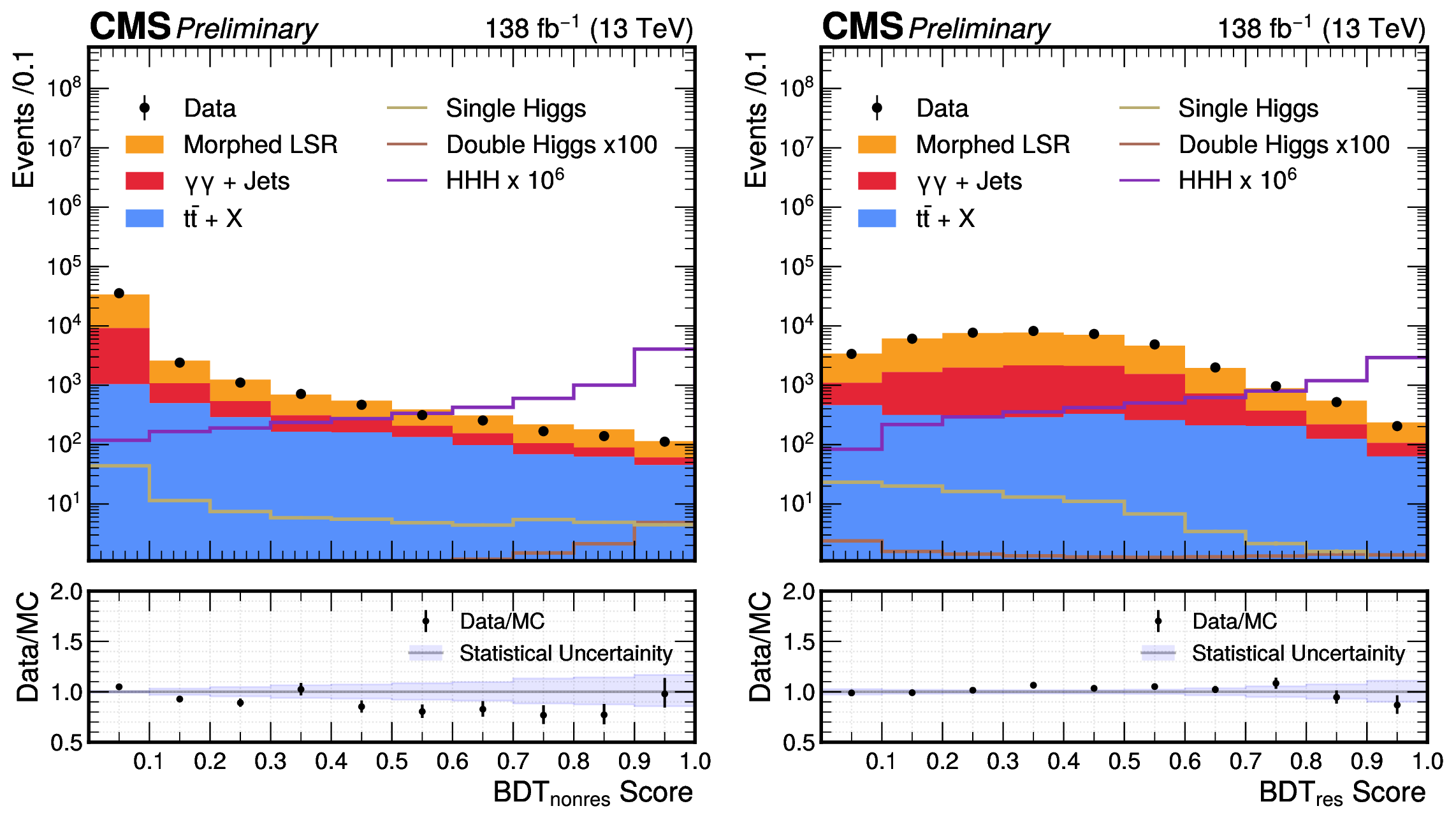
Distribution of the reconstructed diphoton invariant mass in data (black points) and the predicted backgrounds (colored histograms) after event morphing. The vertical bars on the data points represent the statistical uncertainties associated with the data. The lower panel shows the ratio of data to the sum of background predictions. The light blue band in the lower panel represents the statistical uncertainty in the background predictions. |
png pdf |
Figure 4:
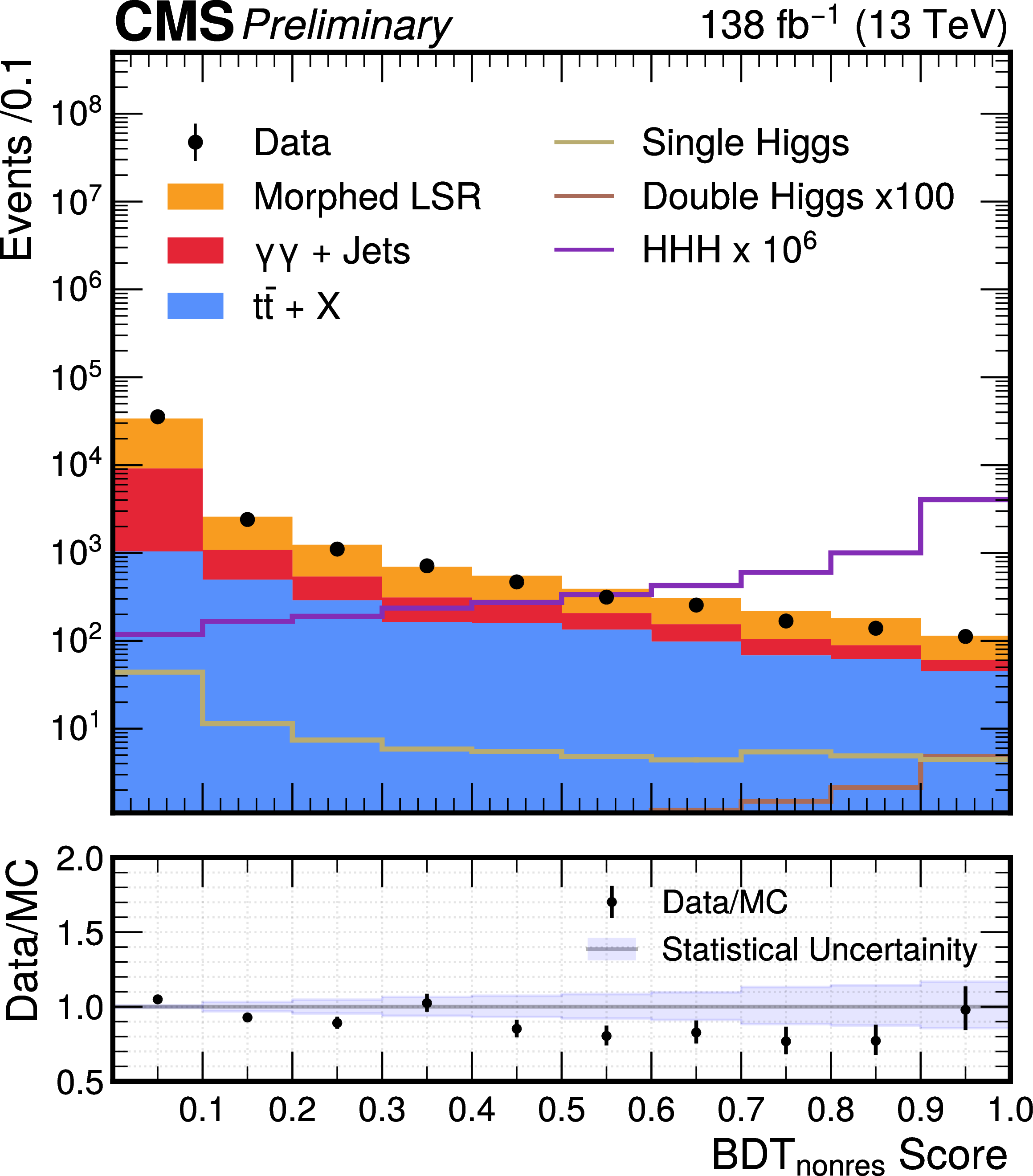
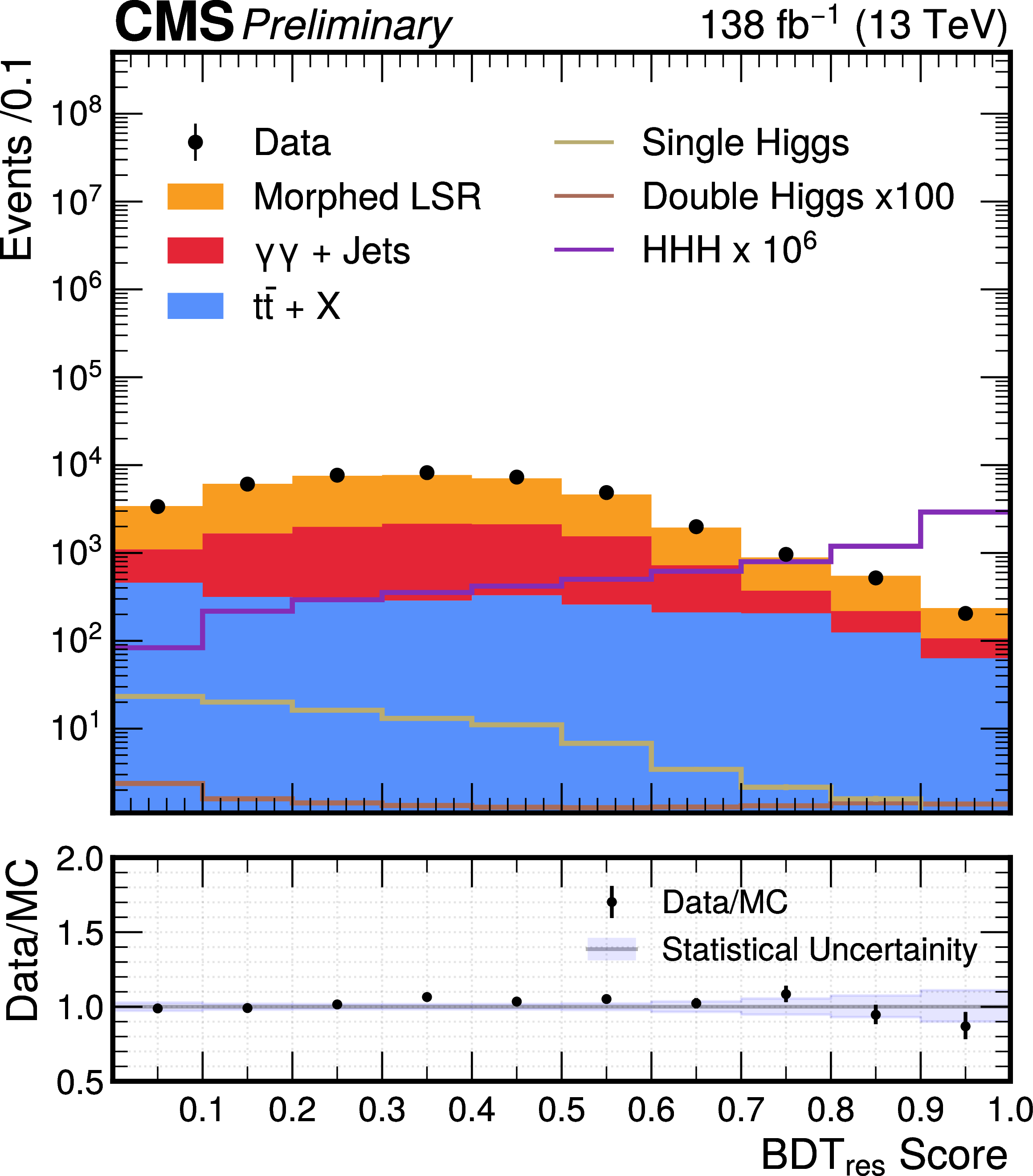
Distribution of the BDT$ _{\text{nonres}} $ (left) and BDT$ _{\text{res}} $ (right) scores in data (black points) and predicted signal and backgrounds (colored histograms) after event morphing. The vertical error bars on the data points represent the statistical uncertainties in data. The violet line represents the expected distribution of signal HHH events, scaled by a factor of 10$ ^6 $. The lower panel shows the ratio of data to the sum of background predictions. The light blue band in the lower panel represents the statistical uncertainty in the background predictions. The imperfect description of the data by the simulation is not a concern in this context, as the scores from simulation are used solely for optimizing selections. The final background model for the non-resonant component is derived directly from the data. A highly magnified distribution due to the HH signal has been superposed for illustration. |
png pdf |
Figure 4-a:
Distribution of the BDT$ _{\text{nonres}} $ (left) and BDT$ _{\text{res}} $ (right) scores in data (black points) and predicted signal and backgrounds (colored histograms) after event morphing. The vertical error bars on the data points represent the statistical uncertainties in data. The violet line represents the expected distribution of signal HHH events, scaled by a factor of 10$ ^6 $. The lower panel shows the ratio of data to the sum of background predictions. The light blue band in the lower panel represents the statistical uncertainty in the background predictions. The imperfect description of the data by the simulation is not a concern in this context, as the scores from simulation are used solely for optimizing selections. The final background model for the non-resonant component is derived directly from the data. A highly magnified distribution due to the HH signal has been superposed for illustration. |
png pdf |
Figure 4-b:
Distribution of the BDT$ _{\text{nonres}} $ (left) and BDT$ _{\text{res}} $ (right) scores in data (black points) and predicted signal and backgrounds (colored histograms) after event morphing. The vertical error bars on the data points represent the statistical uncertainties in data. The violet line represents the expected distribution of signal HHH events, scaled by a factor of 10$ ^6 $. The lower panel shows the ratio of data to the sum of background predictions. The light blue band in the lower panel represents the statistical uncertainty in the background predictions. The imperfect description of the data by the simulation is not a concern in this context, as the scores from simulation are used solely for optimizing selections. The final background model for the non-resonant component is derived directly from the data. A highly magnified distribution due to the HH signal has been superposed for illustration. |
png pdf |
Figure 5:
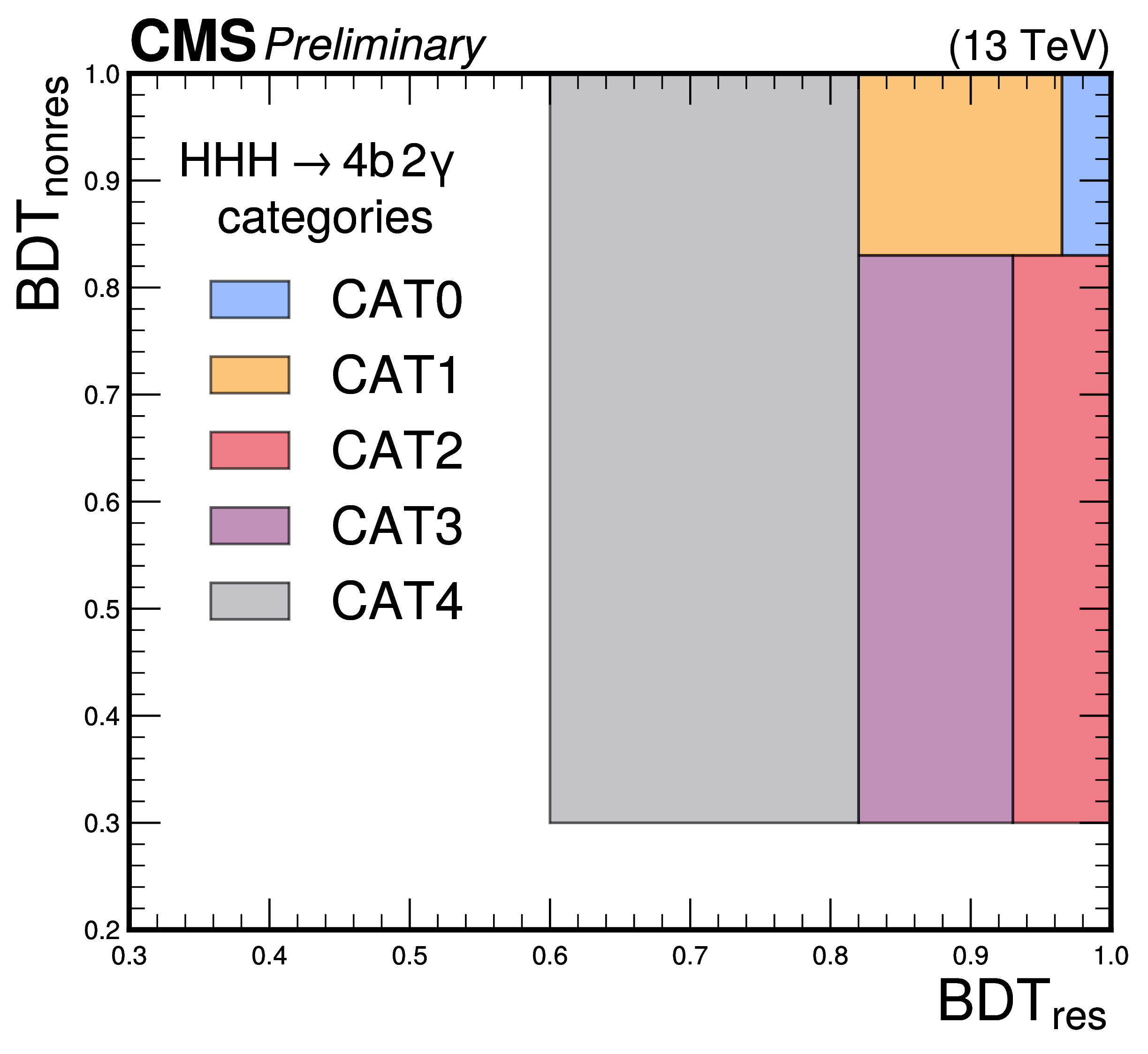
Schematic representation of the analysis category definition in the two-dimensional plane of BDT$ _{\text{nonres}} $ and BDT$ _{\text{res}} $. |
png pdf |
Figure 6:
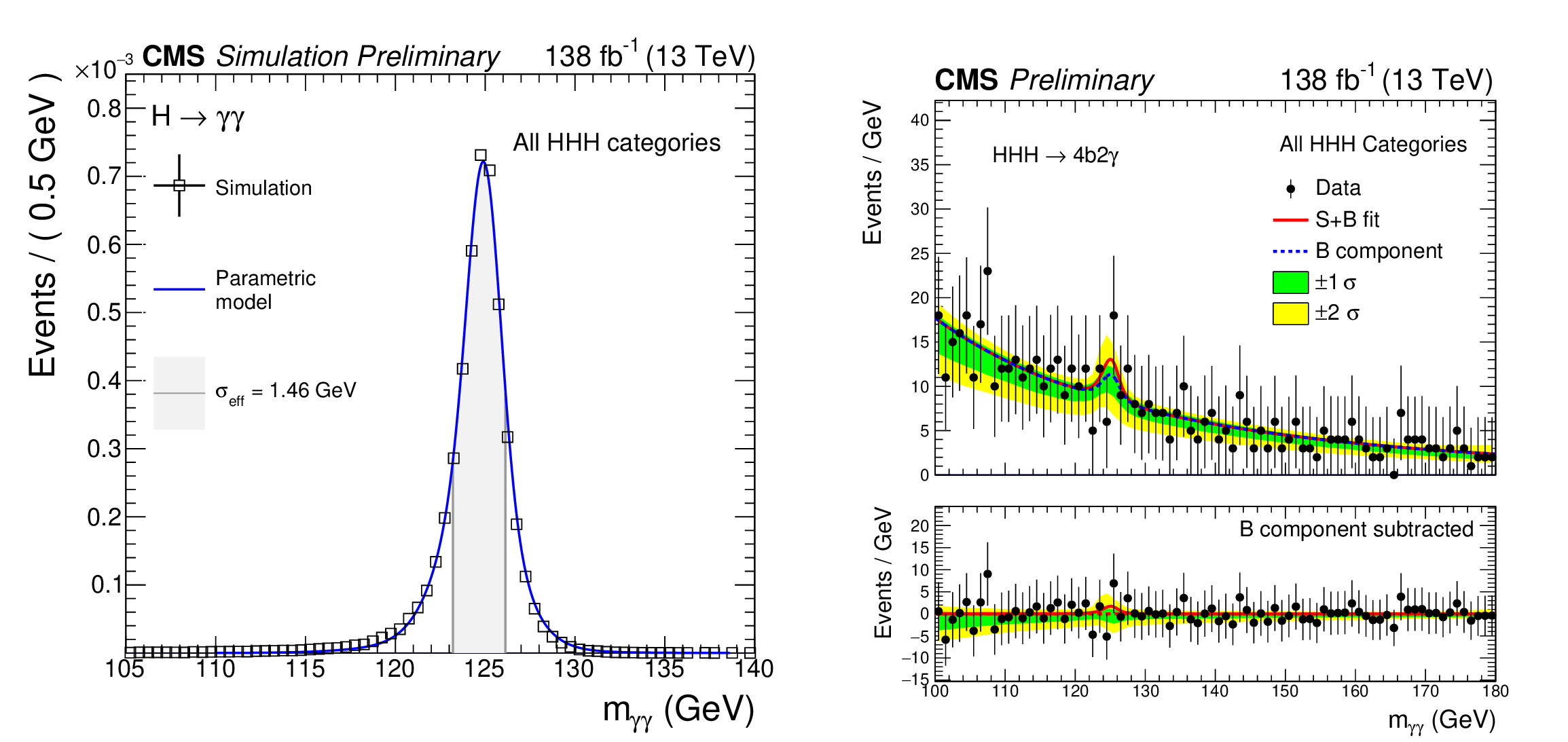
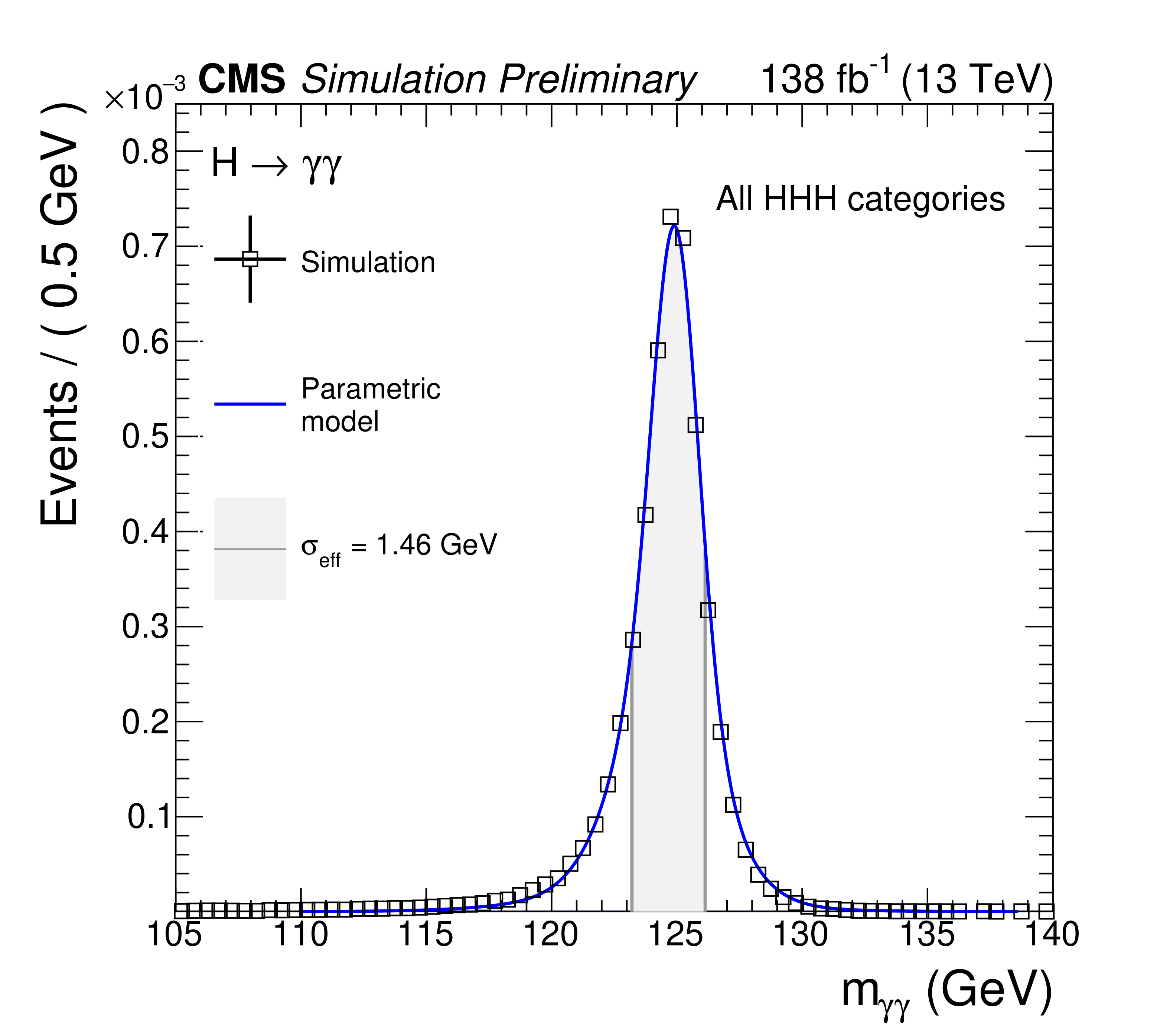
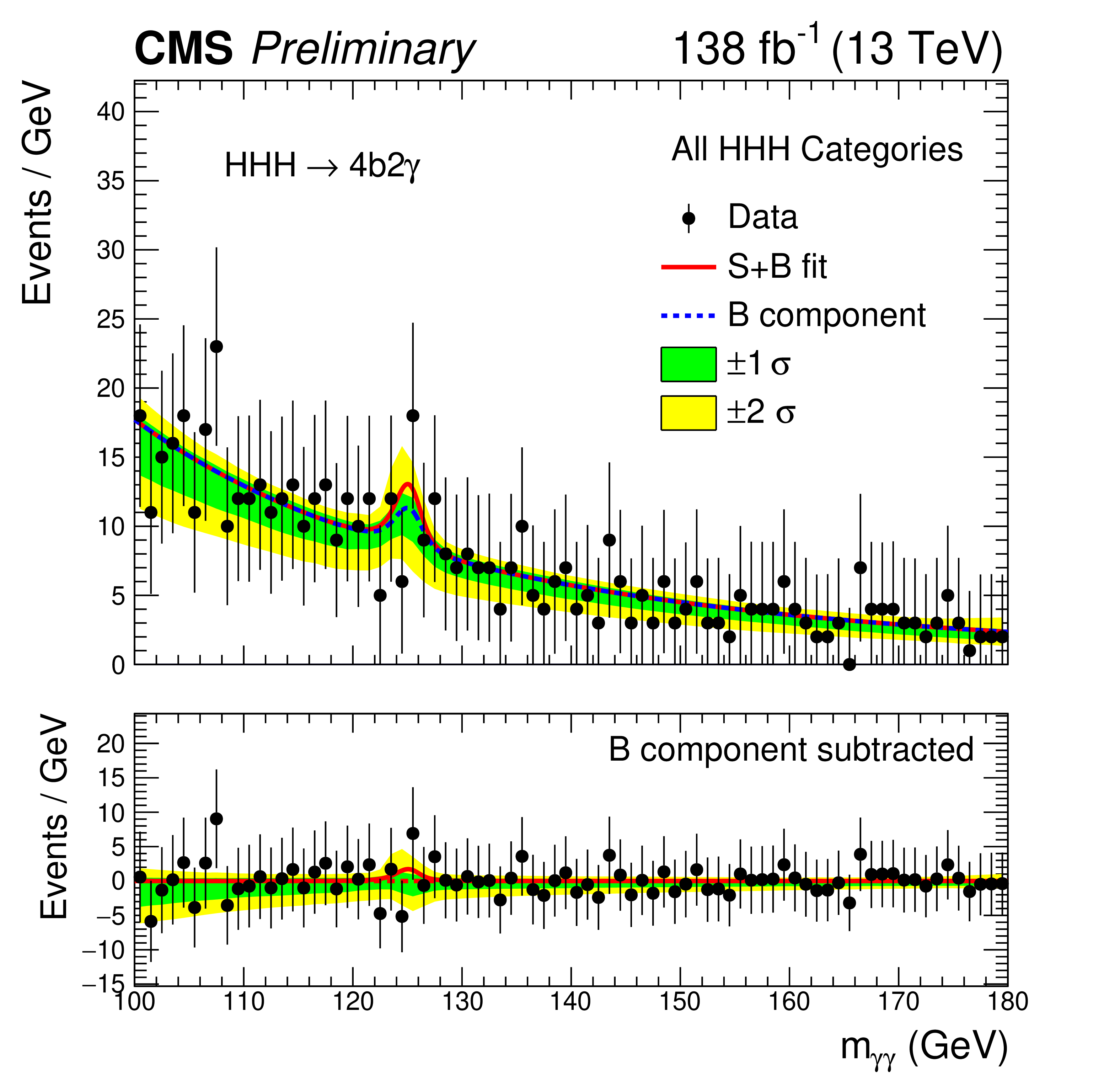
Left: Parameterized signal shape for $ m_{\gamma\gamma} $. The open squares represent the simulated events and the blue lines are corresponding models. The corresponding interval as a gray band shows the $ \sigma_{\text{eff}} $ value (half the width of the narrowest interval containing 68.3% of the invariant mass distribution). Right: Invariant mass distribution of $ m_{\gamma\gamma} $ for the selected events in data (black points) from all analysis categories. The solid red lines demonstrates the fitted signal plus background model and the blue dotted line shows the background component. The lower panel shows the residual post fit signal yield after the background subtraction from data. |
png pdf |
Figure 6-a:
Left: Parameterized signal shape for $ m_{\gamma\gamma} $. The open squares represent the simulated events and the blue lines are corresponding models. The corresponding interval as a gray band shows the $ \sigma_{\text{eff}} $ value (half the width of the narrowest interval containing 68.3% of the invariant mass distribution). Right: Invariant mass distribution of $ m_{\gamma\gamma} $ for the selected events in data (black points) from all analysis categories. The solid red lines demonstrates the fitted signal plus background model and the blue dotted line shows the background component. The lower panel shows the residual post fit signal yield after the background subtraction from data. |
png pdf |
Figure 6-b:
Left: Parameterized signal shape for $ m_{\gamma\gamma} $. The open squares represent the simulated events and the blue lines are corresponding models. The corresponding interval as a gray band shows the $ \sigma_{\text{eff}} $ value (half the width of the narrowest interval containing 68.3% of the invariant mass distribution). Right: Invariant mass distribution of $ m_{\gamma\gamma} $ for the selected events in data (black points) from all analysis categories. The solid red lines demonstrates the fitted signal plus background model and the blue dotted line shows the background component. The lower panel shows the residual post fit signal yield after the background subtraction from data. |
png pdf |
Figure 7:
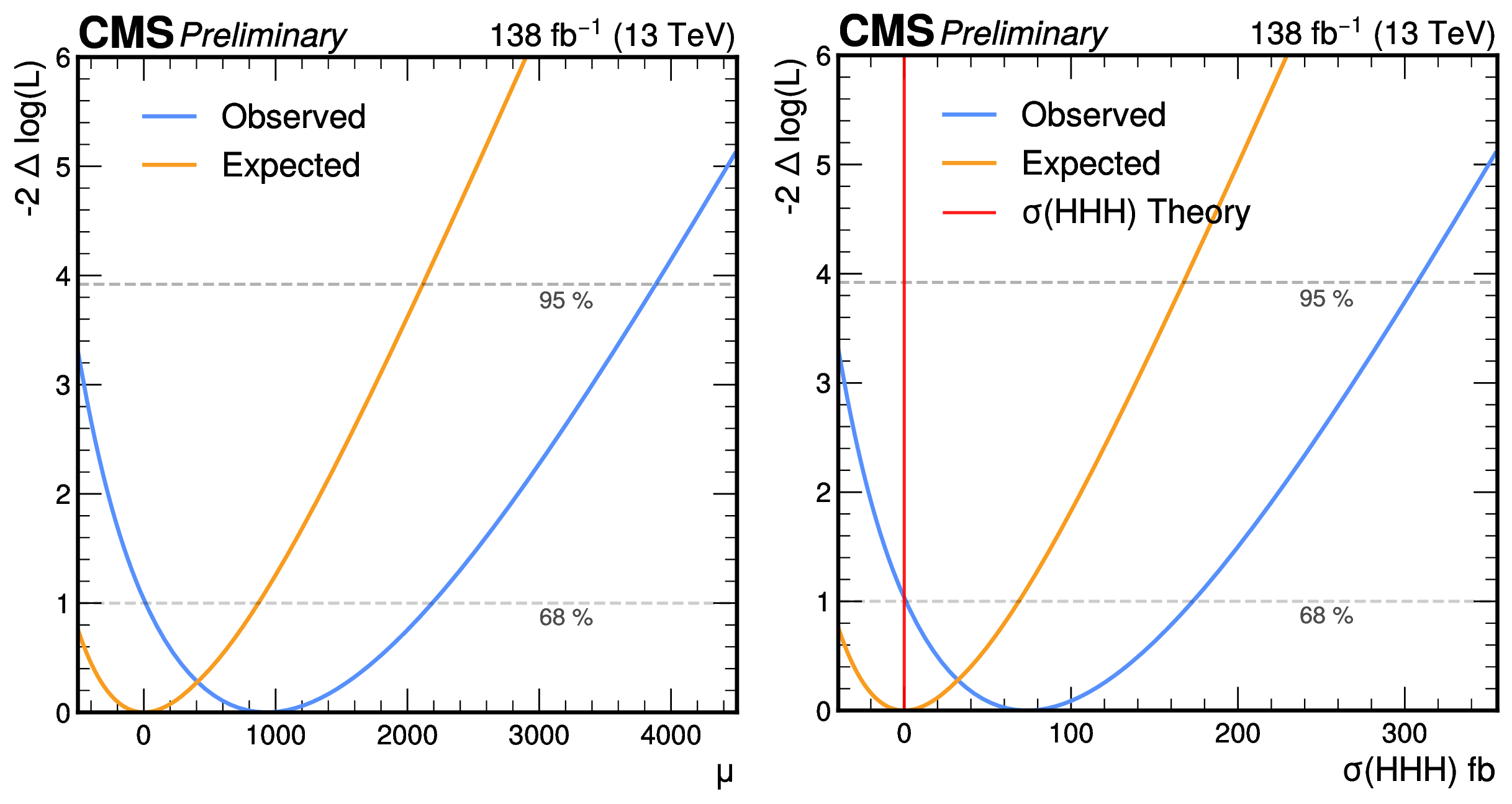
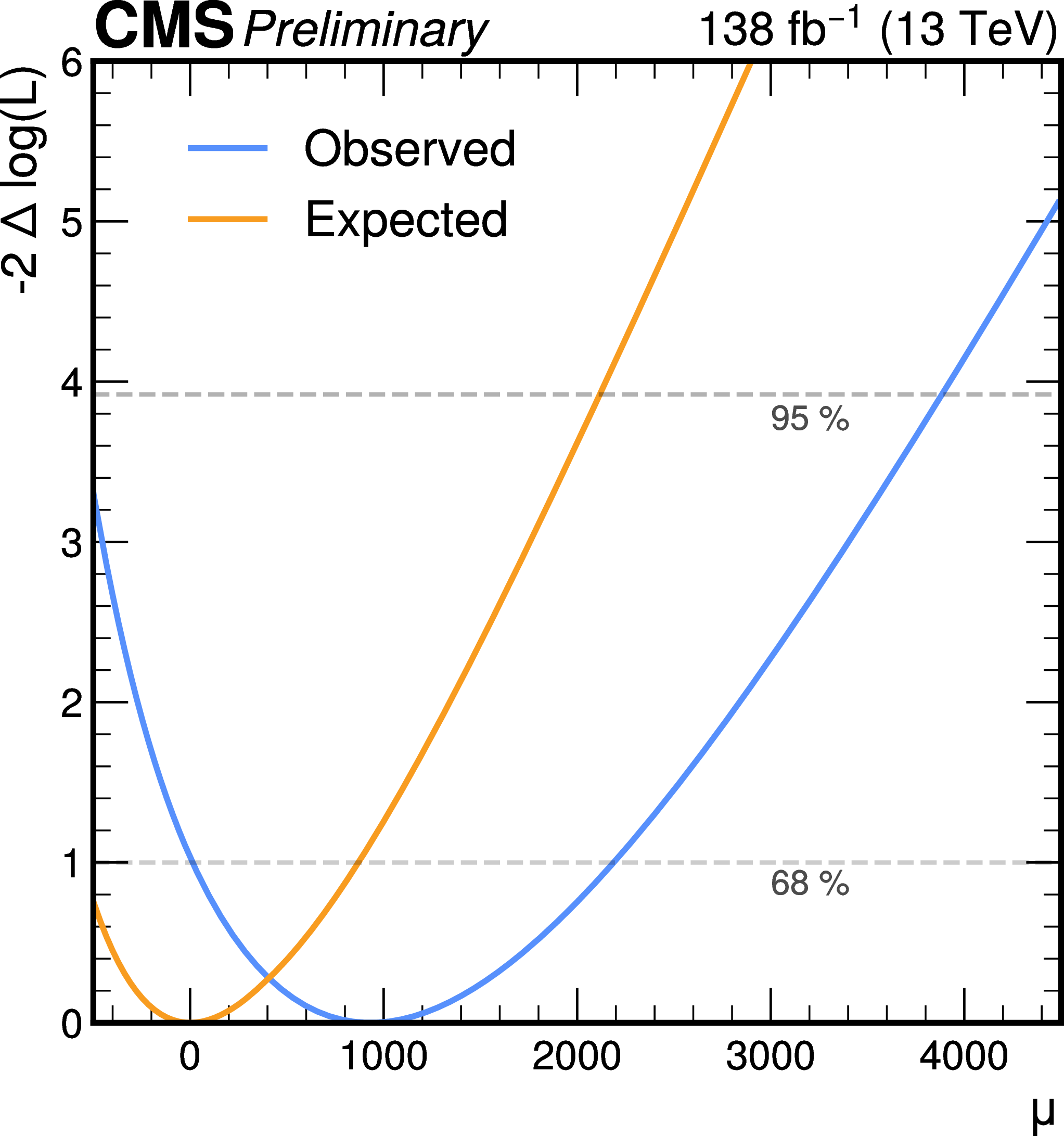
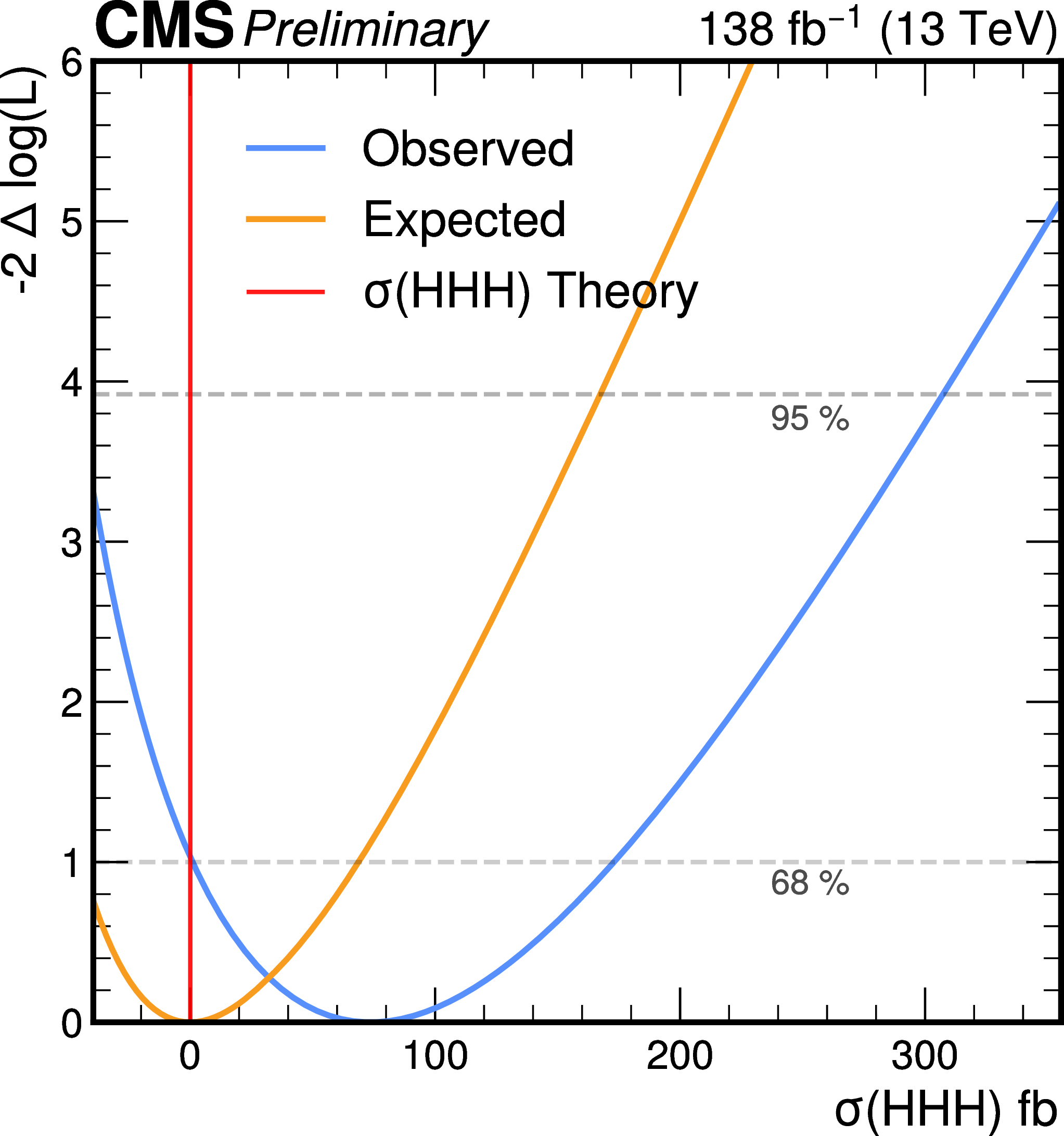
Likelihood scan for the signal strength (left) and inclusive HHH crosssection (right). The blue and orange shows the observed and expected results respectively. The red line on the right plot shows the theoretical HHH crossection of 0.079 fb [11]. |
png pdf |
Figure 7-a:
Likelihood scan for the signal strength (left) and inclusive HHH crosssection (right). The blue and orange shows the observed and expected results respectively. The red line on the right plot shows the theoretical HHH crossection of 0.079 fb [11]. |
png pdf |
Figure 7-b:
Likelihood scan for the signal strength (left) and inclusive HHH crosssection (right). The blue and orange shows the observed and expected results respectively. The red line on the right plot shows the theoretical HHH crossection of 0.079 fb [11]. |
png pdf |
Figure 8:
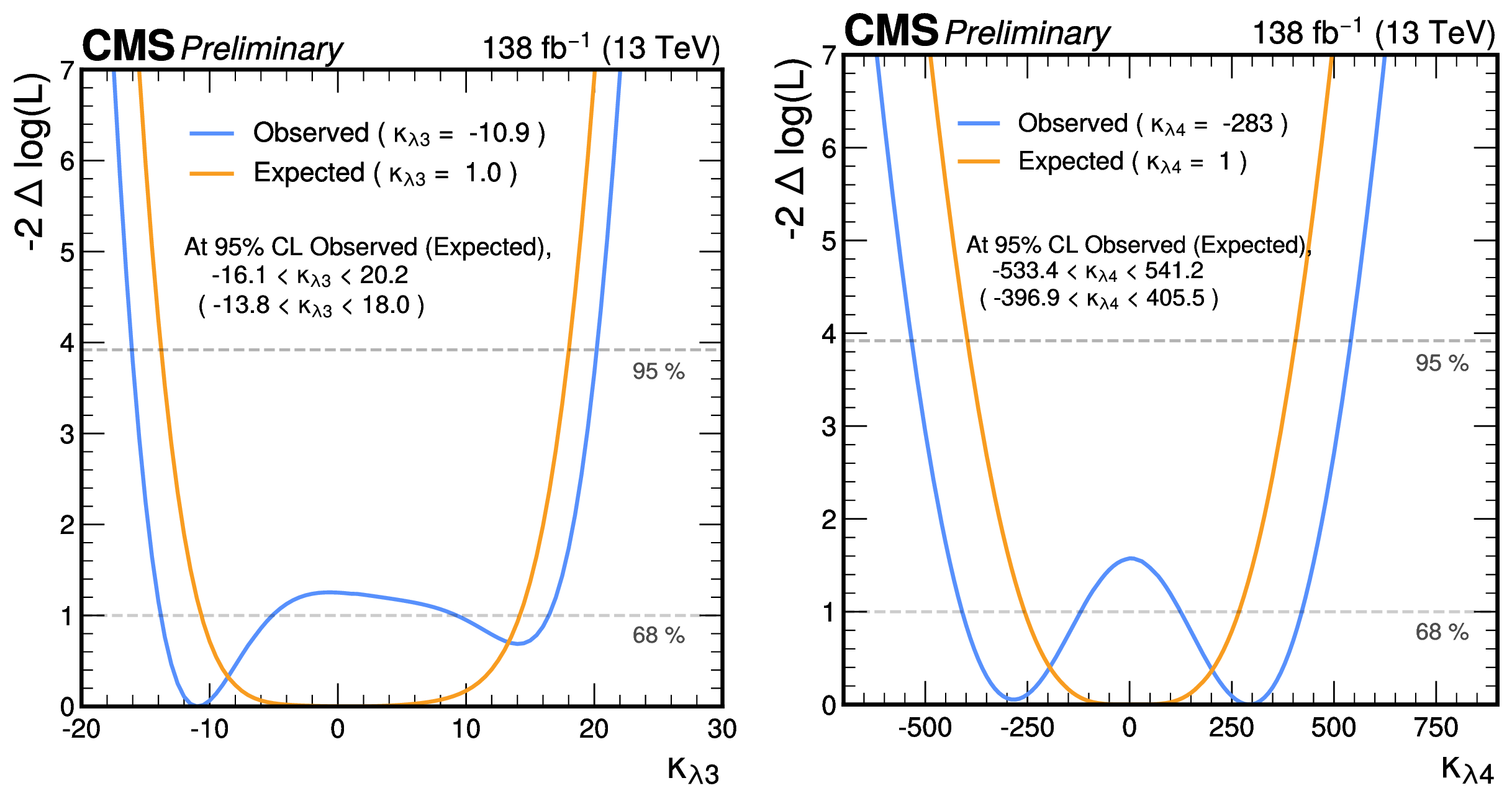
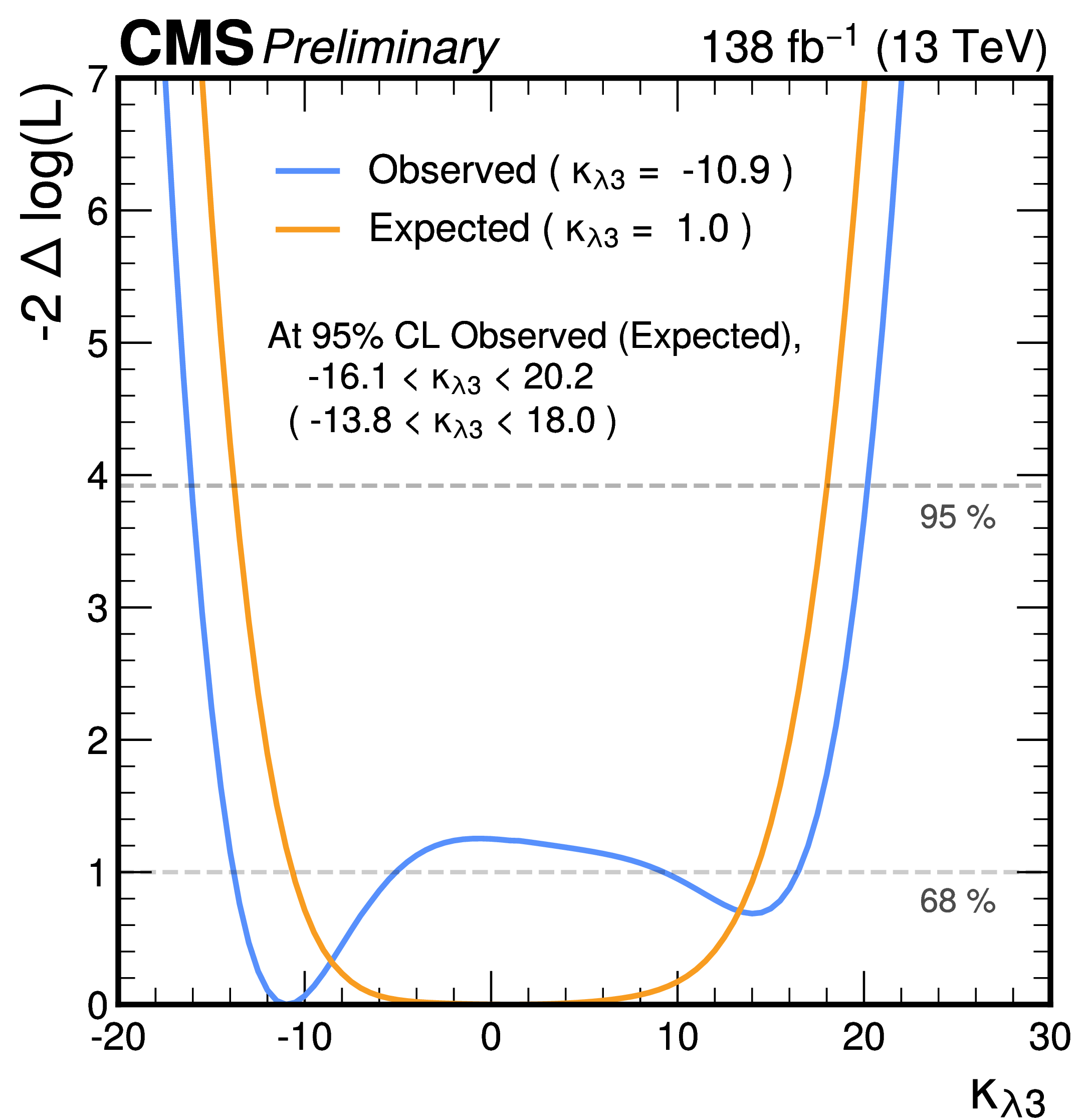
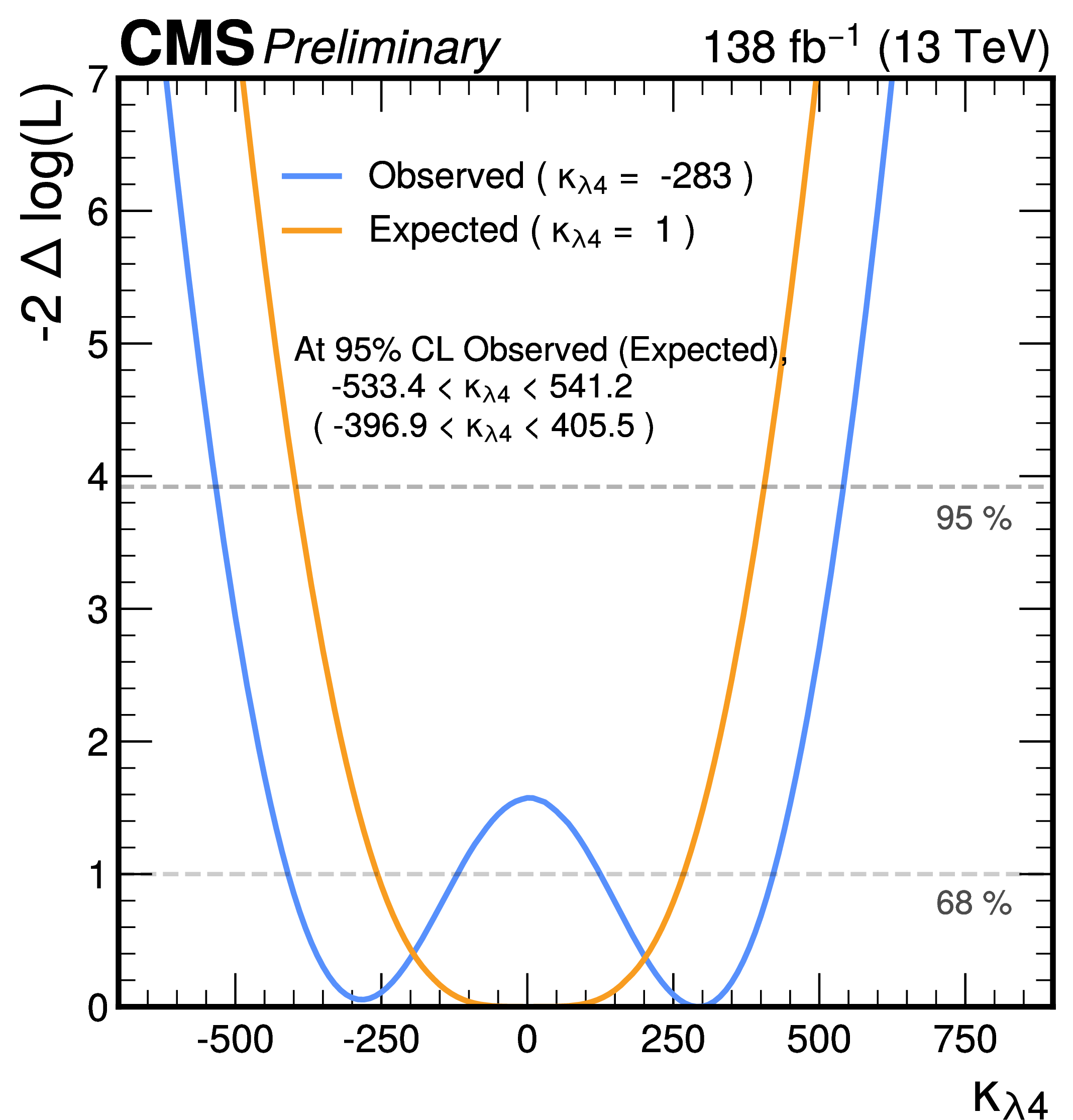
Likelihood scan, as a function of $ \kappa_{\lambda 3} $ (left) and $ \kappa_{\lambda 4} $ (right). The blue and orange curves show the observed and expected results respectively. The 68% and 95% CL intervals are indicated by the horizontal dashed lines. |
png pdf |
Figure 8-a:
Likelihood scan, as a function of $ \kappa_{\lambda 3} $ (left) and $ \kappa_{\lambda 4} $ (right). The blue and orange curves show the observed and expected results respectively. The 68% and 95% CL intervals are indicated by the horizontal dashed lines. |
png pdf |
Figure 8-b:
Likelihood scan, as a function of $ \kappa_{\lambda 3} $ (left) and $ \kappa_{\lambda 4} $ (right). The blue and orange curves show the observed and expected results respectively. The 68% and 95% CL intervals are indicated by the horizontal dashed lines. |
png pdf |
Figure 9:
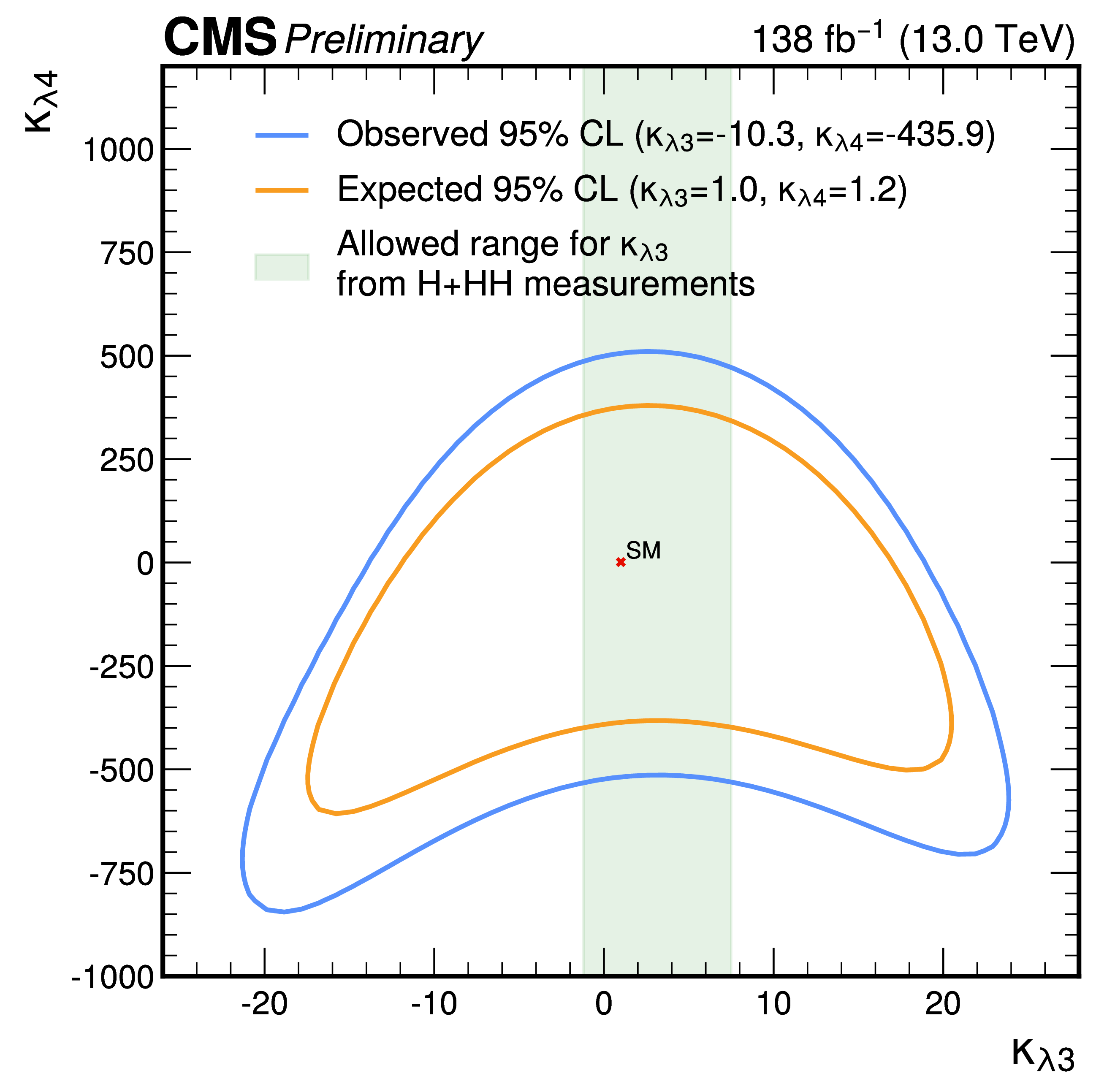
Likelihood contours at 95% CL in the ($ \kappa_{\lambda 3} $, $ \kappa_{\lambda 4} $) plane evaluated with an Asimov data set assuming SM hypothesis (in orange line) and the observed data (in blue line). The green shaded region shows the allowed bounds on $ \kappa_{\lambda 3} $ from the H+HH combination measurements [9]. |
| Summary |
| The first search for triple Higgs boson production (HHH) by the CMS collaboration has been presented, targeting the final state where two of the Higgs bosons decay to a pair of bottom quarks and one to a pair of photons. The search uses proton-proton collision data at $ \sqrt s $ = 13 TeV, corresponding to an integrated luminosity of 138 fb$ ^{-1} $. Upper limits on the product of the HHH production cross section and the $ \mathrm{HHH} \rightarrow4\mathrm{b}2\gamma $ branching fraction are extracted. The observed (expected) upper limit is 0.56 (0.35) fb at 95% confidence level (CL), corresponding to 3400 (2086) times the standard model cross section value. The results are interpreted in the $ \kappa $-framework, setting upper limits on the trilinear and quartic Higgs boson self-coupling modifiers $ \kappa_{\lambda 3} $ = $ \frac{\lambda_3}{\lambda_3^{SM}} $ and $ \kappa_{\lambda 4} $ = $ \frac{\lambda_4}{\lambda_4^{SM}} $ respectively, assuming that the top quark Yukawa coupling is standard model like. The trilinear self-coupling modifier $ \kappa_{\lambda 3} $ is observed (expected) to be constrained within a range of [$-$16.1,20.2] ([$-$13.8,18.0]) at 95% CL. The quartic self-coupling modifier $ \kappa_{\lambda 4} $ is observed (expected) to be constrained within a range of [$-$533,541] ( [$-$397,406] ) at 95% CL. The simultaneous constraints on the $ \kappa_{\lambda 3} $ and $ \kappa_{\lambda 4} $ has also been presented from the two-dimensional likelihood scan. |
| References | ||||
| 1 | CMS Collaboration | A portrait of the Higgs boson by the CMS experiment ten years after the discovery. | Nature 607 (2022) 60 | CMS-HIG-22-001 2207.00043 |
| 2 | ATLAS Collaboration | A detailed map of Higgs boson interactions by the ATLAS experiment ten years after the discovery | Nature 607 (2022) 52 | 2207.00092 |
| 3 | T. Robens, T. Stefaniak, and J. Wittbrodt | Two-real-scalar-singlet extension of the SM: LHC phenomenology and benchmark scenarios | EPJC 80 (2020) 151 | 1908.08554 |
| 4 | T.-K. Chen, C.-W. Chiang, and I. Low | Simple model of dark matter and cp violation | Physical Review D 105 (2022) | |
| 5 | H. Abouabid et al. | HHH whitepaper | EPJC 84 (2024) 1183 | 2407.03015 |
| 6 | ATLAS Collaboration | Searches for Higgs boson pair production in the $ hh\to bb\tau\tau, \gamma\gamma WW^*, \gamma\gamma bb, bbbb $ channels with the ATLAS detector | PRD 92 (2015) 092004 | 1509.04670 |
| 7 | CMS Collaboration | Search for Higgs boson pair production in the $ bb\tau\tau $ final state in proton-proton collisions at $ \sqrt{(}s)=8\text{ }\text{ }\mathrm{TeV} $ | PRD 96 (2017) 072004 | CMS-HIG-15-013 1707.00350 |
| 8 | CMS Collaboration | Search for two Higgs bosons in final states containing two photons and two bottom quarks in proton-proton collisions at 8 TeV | PRD 94 (2016) 052012 | CMS-HIG-13-032 1603.06896 |
| 9 | CMS Collaboration | Constraints on the higgs boson self-coupling from the combination of single and double higgs boson production in proton-proton collisions at $ \sqrt{s} $ = 13 tev | link | |
| 10 | ATLAS Collaboration Collaboration | Combination of searches for higgs boson pair production in $ pp $ collisions at $ \sqrt{s}=13\text{ }\text{ }\mathrm{TeV} $ with the atlas detector | PRL 133 (2024) 101801 | |
| 11 | D. de Florian, I. Fabre, and J. Mazzitelli | Triple Higgs production at hadron colliders at NNLO in QCD | JHEP 03 (2020) 155 | 1912.02760 |
| 12 | ATLAS Collaboration | HL-LHC prospects for the measurement of triple-Higgs production in the 6b final state at the ATLAS experiment | technical report, CERN, ATL-PHYS-PUB-2025-003, 2025 | |
| 13 | CMS Collaboration | Precision luminosity measurement in proton-proton collisions at $ \sqrt{s} = $ 13 TeV in 2015 and 2016 at CMS | EPJC 81 (2021) 800 | CMS-LUM-17-003 2104.01927 |
| 14 | CMS Collaboration | The CMS Experiment at the CERN LHC | JINST 3 (2008) S08004 | |
| 15 | CMS Collaboration | Description and performance of track and primary-vertex reconstruction with the CMS tracker | JINST 9 (2014) P10009 | CMS-TRK-11-001 1405.6569 |
| 16 | CMS Collaboration | Performance of the CMS Level-1 trigger in proton-proton collisions at $ \sqrt{s} = $ 13 TeV | JINST 15 (2020) P10017 | CMS-TRG-17-001 2006.10165 |
| 17 | CMS Collaboration | The CMS trigger system | JINST 12 (2017) P01020 | CMS-TRG-12-001 1609.02366 |
| 18 | CMS Collaboration | Measurements of Higgs boson properties in the diphoton decay channel in proton-proton collisions at $ \sqrt{s} = $ 13 TeV | JHEP 11 (2018) 185 | CMS-HIG-16-040 1804.02716 |
| 19 | J. Alwall et al. | The automated computation of tree-level and next-to-leading order differential cross sections, and their matching to parton shower simulations | JHEP 07 (2014) 079 | 1405.0301 |
| 20 | P. Nason and C. Oleari | NLO Higgs boson production via vector-boson fusion matched with shower in POWHEG | JHEP 02 (2010) 037 | 0911.5299 |
| 21 | T. Sjöstrand et al. | An introduction to PYTHIA8.2 | Comput. Phys. Commun. 191 (2015) 159 | 1410.3012 |
| 22 | T. Gleisberg et al. | Event generation with SHERPA 1.1 | JHEP 02 (2009) 007 | 0811.4622 |
| 23 | CMS Collaboration | Event generator tunes obtained from underlying event and multiparton scattering measurements | EPJC 76 (2016) 155 | CMS-GEN-14-001 1512.00815 |
| 24 | CMS Collaboration | Extraction and validation of a new set of CMS PYTHIA8 tunes from underlying-event measurements | EPJC 80 (2020) 4 | CMS-GEN-17-001 1903.12179 |
| 25 | R. D. Ball et al. | Parton distributions from high-precision collider data: Nnpdf collaboration | The European Physical Journal C 77 (2017) | |
| 26 | GEANT4 Collaboration | GEANT4---a simulation toolkit | NIM A 506 (2003) 250 | |
| 27 | M. Cacciari, G. P. Salam, and G. Soyez | The anti-$ k_{\mathrm{T}} $ jet clustering algorithm | JHEP 04 (2008) 063 | 0802.1189 |
| 28 | M. Cacciari, G. P. Salam, and G. Soyez | FastJet user manual | EPJC 72 (2012) 1896 | 1111.6097 |
| 29 | CMS Collaboration | Electron and photon reconstruction and identification with the CMS experiment at the CERN LHC | JINST 16 (2021) P05014 | CMS-EGM-17-001 2012.06888 |
| 30 | CMS Collaboration | Search for Higgs Boson Pair Production in the Four b Quark Final State in Proton-Proton Collisions at s=13\,\,TeV | PRL 129 (2022) 081802 | CMS-HIG-20-005 2202.09617 |
| 31 | E. Bols et al. | Jet Flavour Classification Using DeepJet | JINST 15 (2020) P12012 | 2008.10519 |
| 32 | CMS Collaboration | Performance of the DeepJet b tagging algorithm using 41.9 fb$ ^{-1} $ of data from proton-proton collisions at 13 TeV with Phase 1 CMS detector | CMS Detector Performance Note CMS-DP-2018-058, 2018 CDS |
|
| 33 | CMS Collaboration | Measurements of $ \mathrm{t\bar{t}}H $ Production and the CP Structure of the Yukawa Interaction between the Higgs Boson and Top Quark in the Diphoton Decay Channel | PRL 125 (2020) 061801 | CMS-HIG-19-013 2003.10866 |
| 34 | T. Chen and C. Guestrin | Xgboost: A scalable tree boosting system | in Proceedings of the 22nd ACM SIGKDD International Conference on Knowledge Discovery and Data Mining, KDD '16. ACM, 2016 link |
|
| 35 | C. Adam-Bourdarios et al. | The higgs machine learning challenge | Journal of Physics, 2015 Conference Series 664 (2015) 072015 |
|
| 36 | G. Cowan, K. Cranmer, E. Gross, and O. Vitells | Asymptotic formulae for likelihood-based tests of new physics | The European Physical Journal C 71 (2011) | |
| 37 | CMS Collaboration | Search for the associated production of the higgs boson with a top-quark pair | Journal of High Energy Physics 2014 (2014) 87 | |
| 38 | CMS Collaboration | CMS luminosity measurement for the 2017 data-taking period at $ \sqrt{s} = $ 13 TeV | technical report, CERN, Geneva, 2018 CDS |
|
| 39 | CMS Collaboration | CMS luminosity measurement for the 2018 data-taking period at $ \sqrt{s} = $ 13 TeV | technical report, CERN, Geneva, 2019 CDS |
|
| 40 | CMS Collaboration | The CMS Statistical Analysis and Combination Tool: Combine | Comput. Softw. Big Sci. 8 (2024) 19 | CMS-CAT-23-001 2404.06614 |
|
|
Compact Muon Solenoid LHC, CERN |

|
|
|
|
|
|