
Compact Muon Solenoid
LHC, CERN
 Visit us: CMS Public Website, CMS Physics ;
Contact us: CMS Publications Committee
Visit us: CMS Public Website, CMS Physics ;
Contact us: CMS Publications Committee
| CMS-PAS-EXO-24-019 | ||
| Search for pair production of leptoquarks decaying to electrons and quarks in proton-proton collisions at $ \sqrt{s}= $ 13 TeV | ||
| CMS Collaboration | ||
| 2026-03-16 | ||
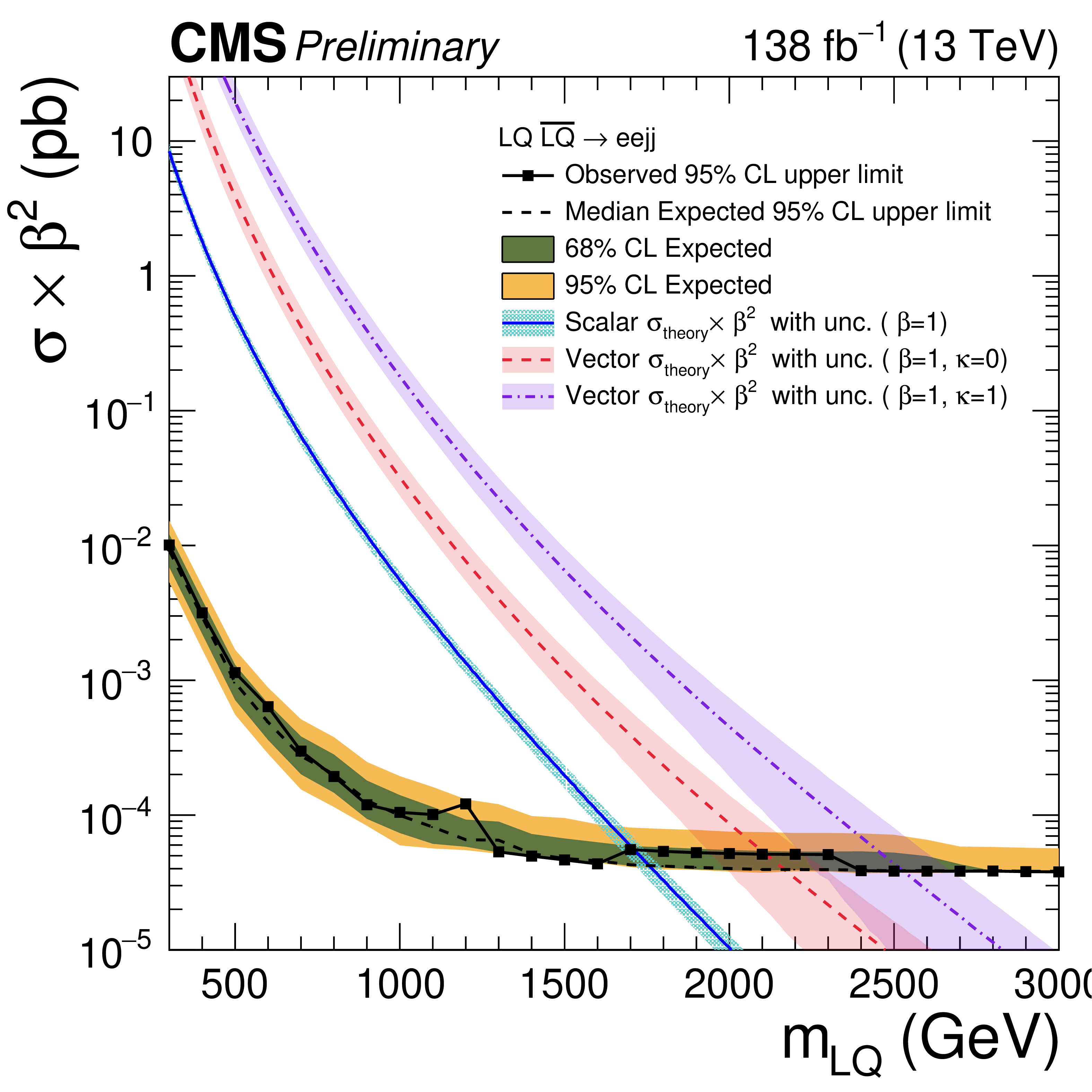
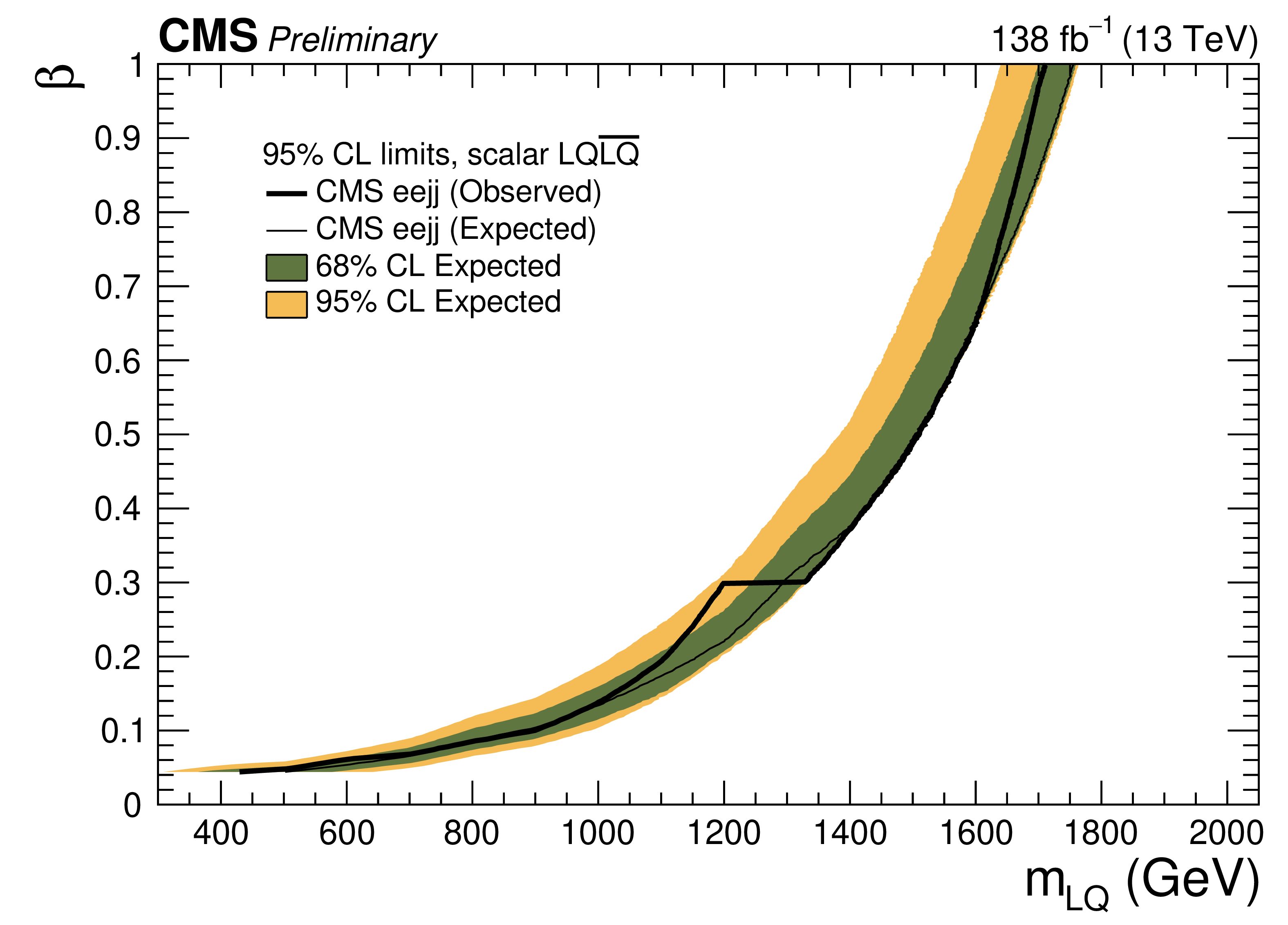
| Abstract: A search for the pair production of first-generation leptoquarks is performed using proton-proton collision data recorded at 13 TeV center-of-mass energy with the CMS detector at the LHC. The data correspond to an integrated luminosity of 138 fb$ ^{-1} $ and were collected during the full LHC Run 2. The leptoquarks are assumed to decay promptly to a quark and an electron with branching fraction $ \beta $. The search targets the prompt decay of each leptoquark into an electron and a quark, producing a final state consisting of two electrons and two quarks that are detected as hadronic jets. Scalar leptoquarks decaying to down quarks with $ \beta = $ 1.0 are excluded at the 95% confidence level for masses below 1710 GeV (1755 GeV expected). The data are also interpreted to set exclusion limits on scalar leptoquark decays to bottom quarks, as well as on vector leptoquarks considering the minimal and Yang-Mills coupling scenarios. Vector leptoquarks are excluded at the 95% confidence level for $ \beta = $ 1 below masses of 2110 GeV (2165 GeV expected) for the minimal coupling scenario, and below 2525 GeV (2525 GeV expected) for the Yang-Mills coupling scenario. | ||
| Links: CDS record (PDF) ; CADI line (restricted) ; | ||
| Figures | |
png pdf |
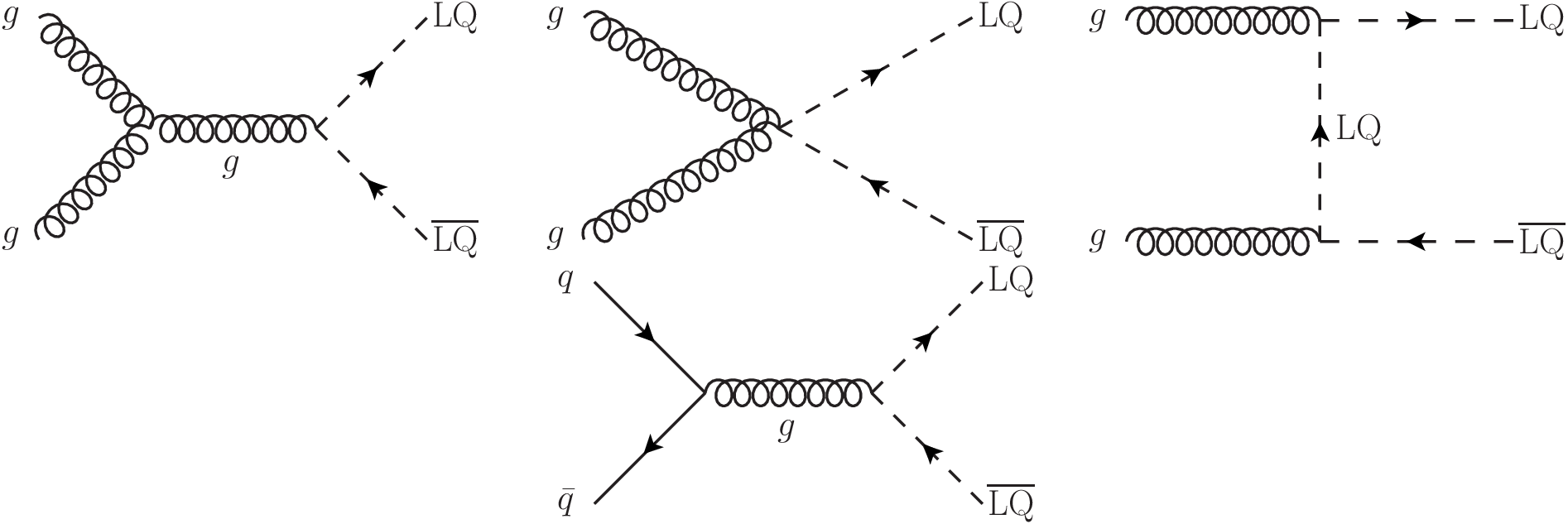
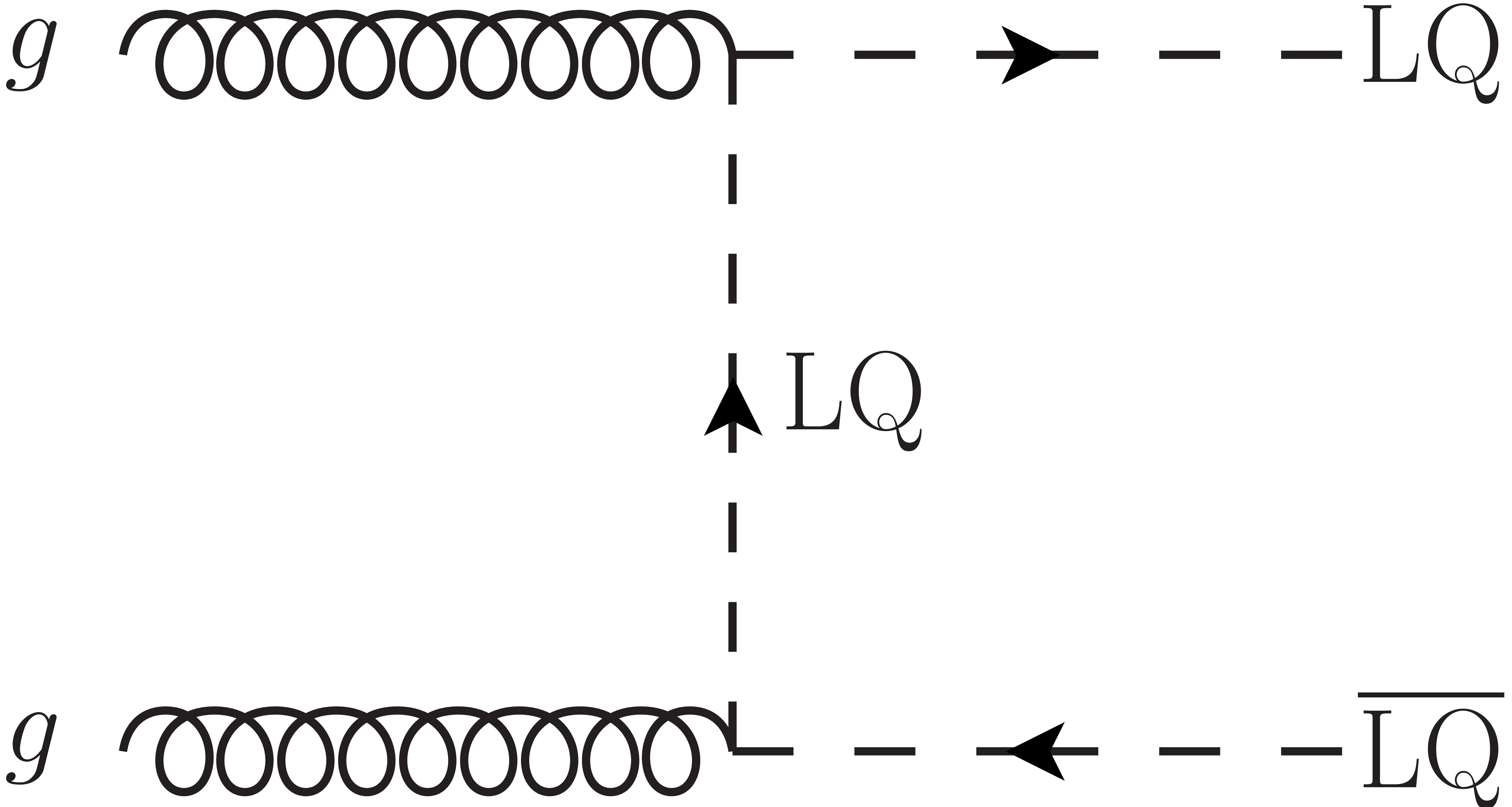
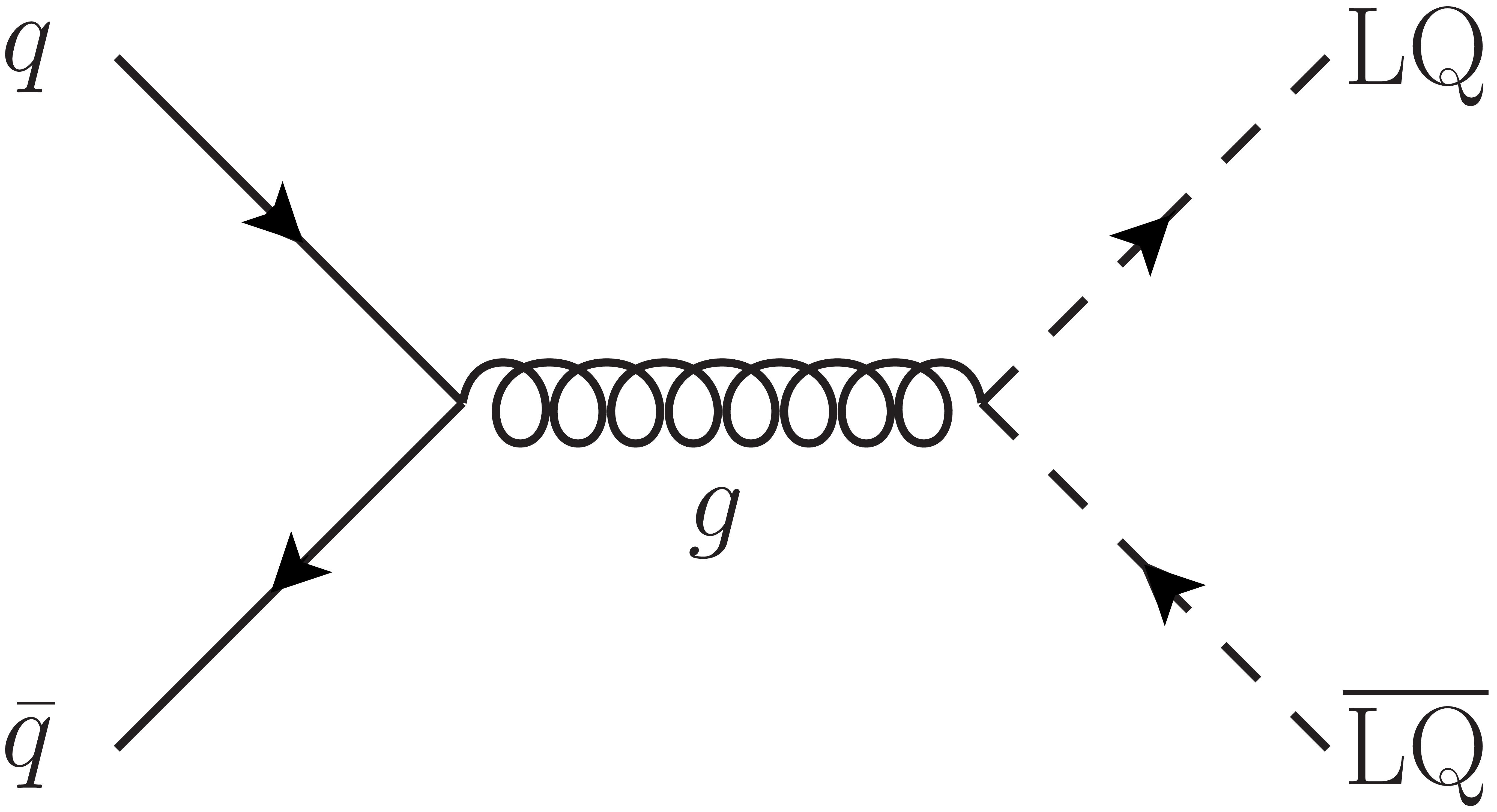
Figure 1:
Leading order Feynman diagrams for the scalar LQ pair production channels at the LHC. |
png pdf |
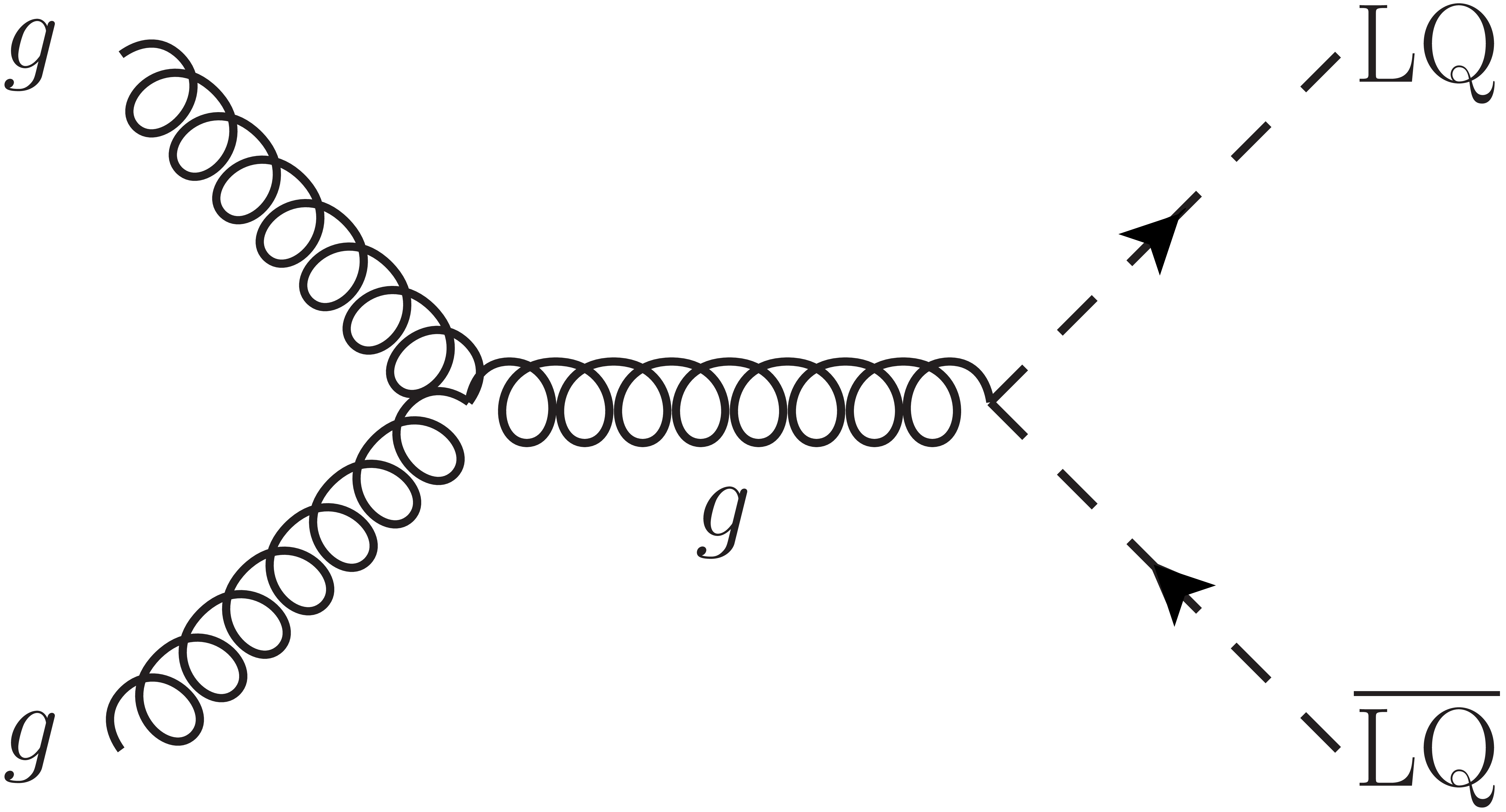
Figure 1-a:
Leading order Feynman diagrams for the scalar LQ pair production channels at the LHC. |
png pdf |
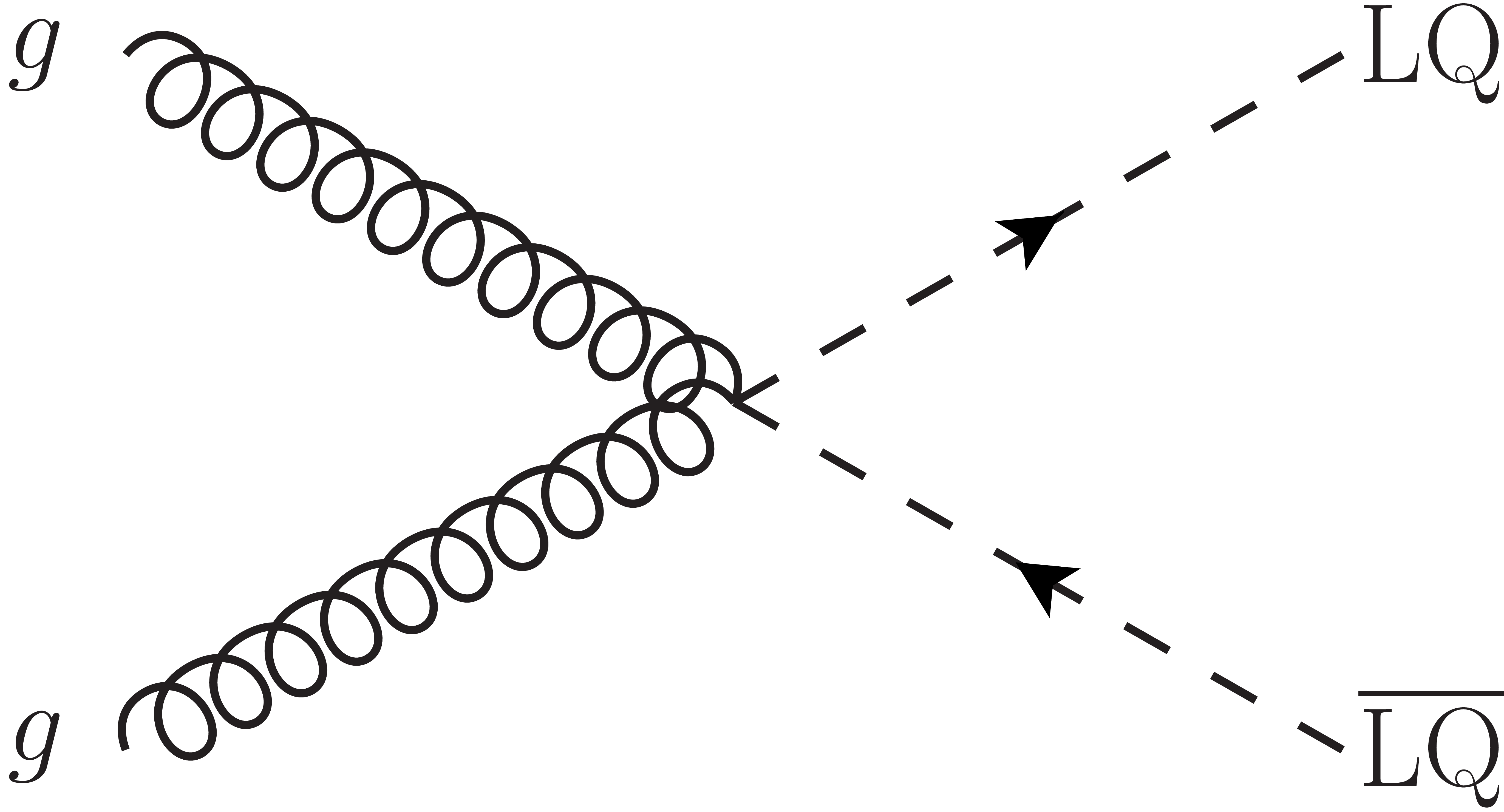
Figure 1-b:
Leading order Feynman diagrams for the scalar LQ pair production channels at the LHC. |
png pdf |
Figure 1-c:
Leading order Feynman diagrams for the scalar LQ pair production channels at the LHC. |
png pdf |
Figure 1-d:
Leading order Feynman diagrams for the scalar LQ pair production channels at the LHC. |
png pdf |
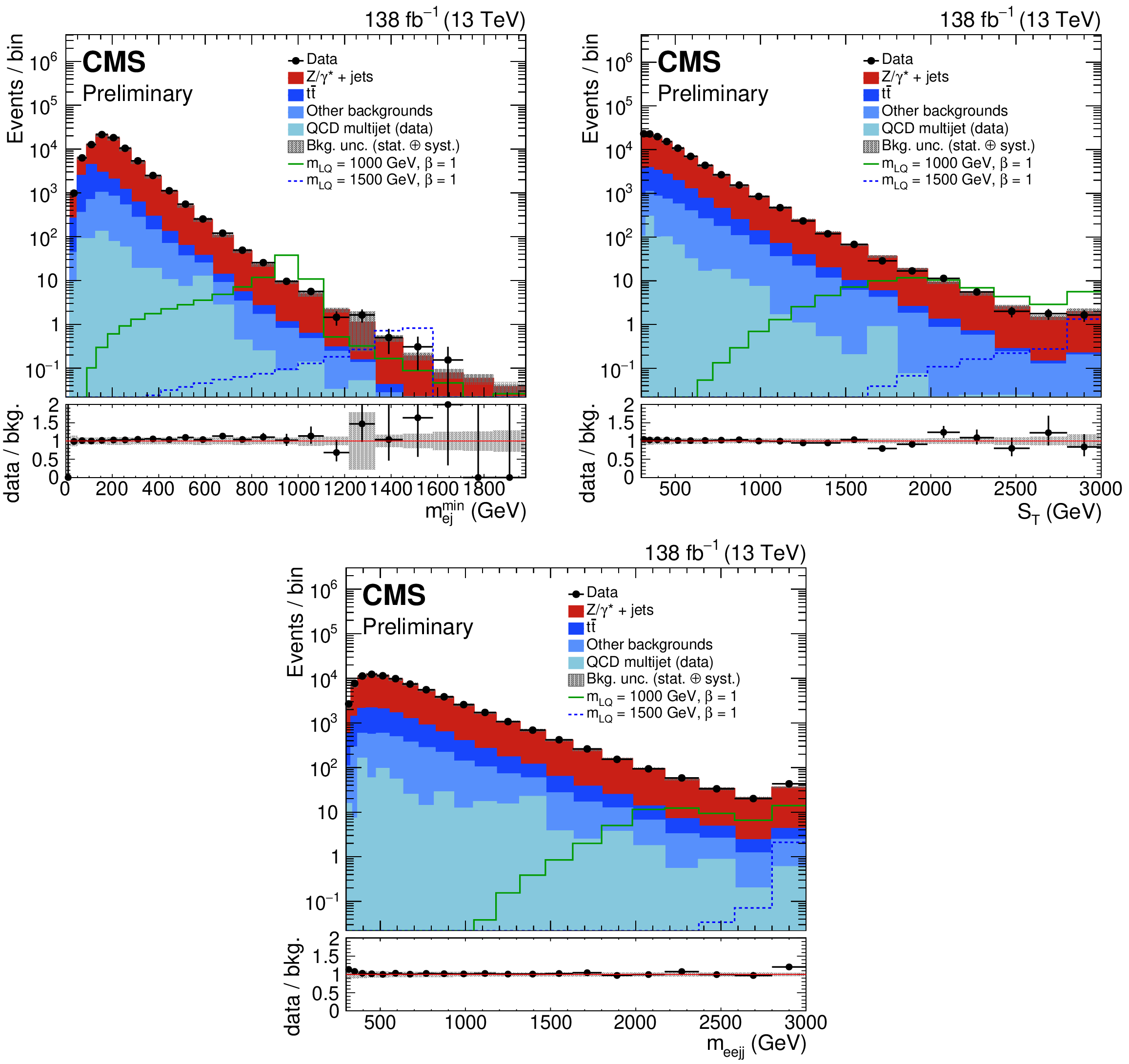
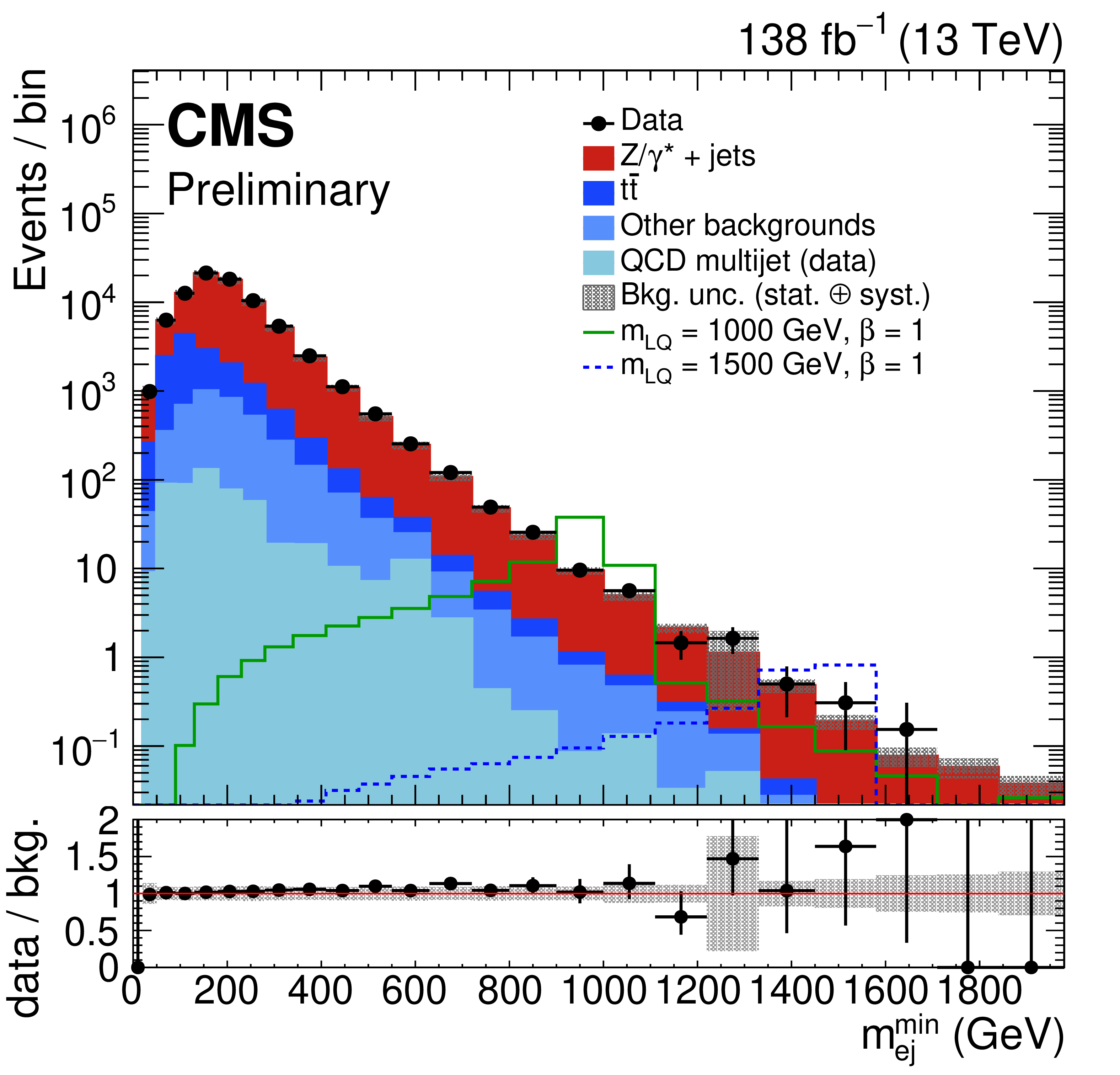
Figure 2:
Data and background comparison for events passing the initial selection requirements, shown for a subset of variables used in the boosted decision tree training: $ m_{\mathrm{e}\text{j}}^\text{min} $ (left), $ S_{\mathrm{T}} $ (center), and $ m_{\mathrm{e}\mathrm{e}\text{j}\text{j}} $ (right). ``Other background" includes diboson and single top quark processes. Signal predictions for the $ m_{\text{LQ}}= $ 1000 and 1500 GeV hypotheses are overlaid on the plots. The last bin includes all events beyond the upper $ x $-axis boundary. The gray shaded region represents the total (statistical and systematic) background uncertainty. |
png pdf |
Figure 2-a:
Data and background comparison for events passing the initial selection requirements, shown for a subset of variables used in the boosted decision tree training: $ m_{\mathrm{e}\text{j}}^\text{min} $ (left), $ S_{\mathrm{T}} $ (center), and $ m_{\mathrm{e}\mathrm{e}\text{j}\text{j}} $ (right). ``Other background" includes diboson and single top quark processes. Signal predictions for the $ m_{\text{LQ}}= $ 1000 and 1500 GeV hypotheses are overlaid on the plots. The last bin includes all events beyond the upper $ x $-axis boundary. The gray shaded region represents the total (statistical and systematic) background uncertainty. |
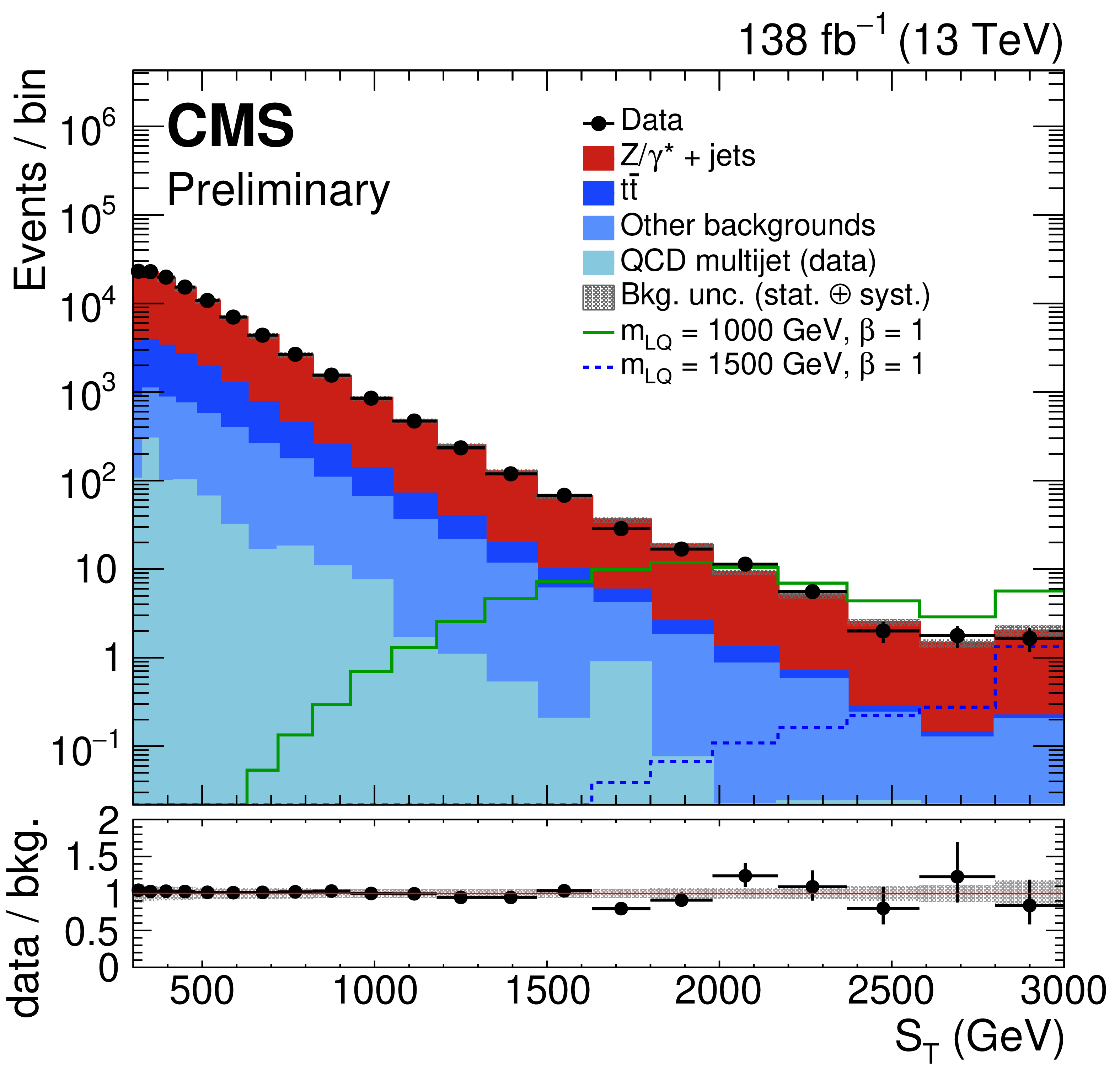
png pdf |
Figure 2-b:
Data and background comparison for events passing the initial selection requirements, shown for a subset of variables used in the boosted decision tree training: $ m_{\mathrm{e}\text{j}}^\text{min} $ (left), $ S_{\mathrm{T}} $ (center), and $ m_{\mathrm{e}\mathrm{e}\text{j}\text{j}} $ (right). ``Other background" includes diboson and single top quark processes. Signal predictions for the $ m_{\text{LQ}}= $ 1000 and 1500 GeV hypotheses are overlaid on the plots. The last bin includes all events beyond the upper $ x $-axis boundary. The gray shaded region represents the total (statistical and systematic) background uncertainty. |
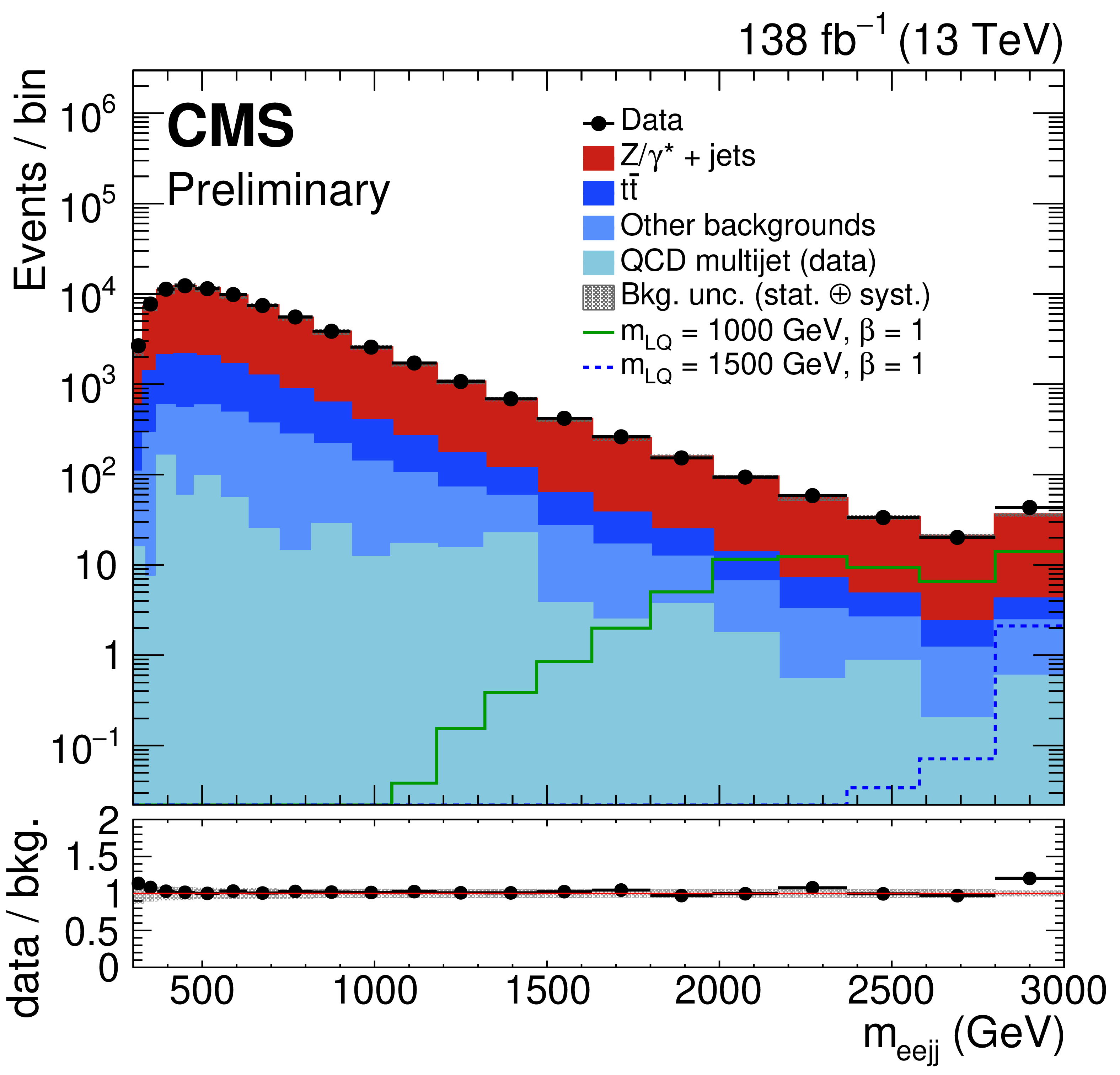
png pdf |
Figure 2-c:
Data and background comparison for events passing the initial selection requirements, shown for a subset of variables used in the boosted decision tree training: $ m_{\mathrm{e}\text{j}}^\text{min} $ (left), $ S_{\mathrm{T}} $ (center), and $ m_{\mathrm{e}\mathrm{e}\text{j}\text{j}} $ (right). ``Other background" includes diboson and single top quark processes. Signal predictions for the $ m_{\text{LQ}}= $ 1000 and 1500 GeV hypotheses are overlaid on the plots. The last bin includes all events beyond the upper $ x $-axis boundary. The gray shaded region represents the total (statistical and systematic) background uncertainty. |
png pdf |
Figure 3:
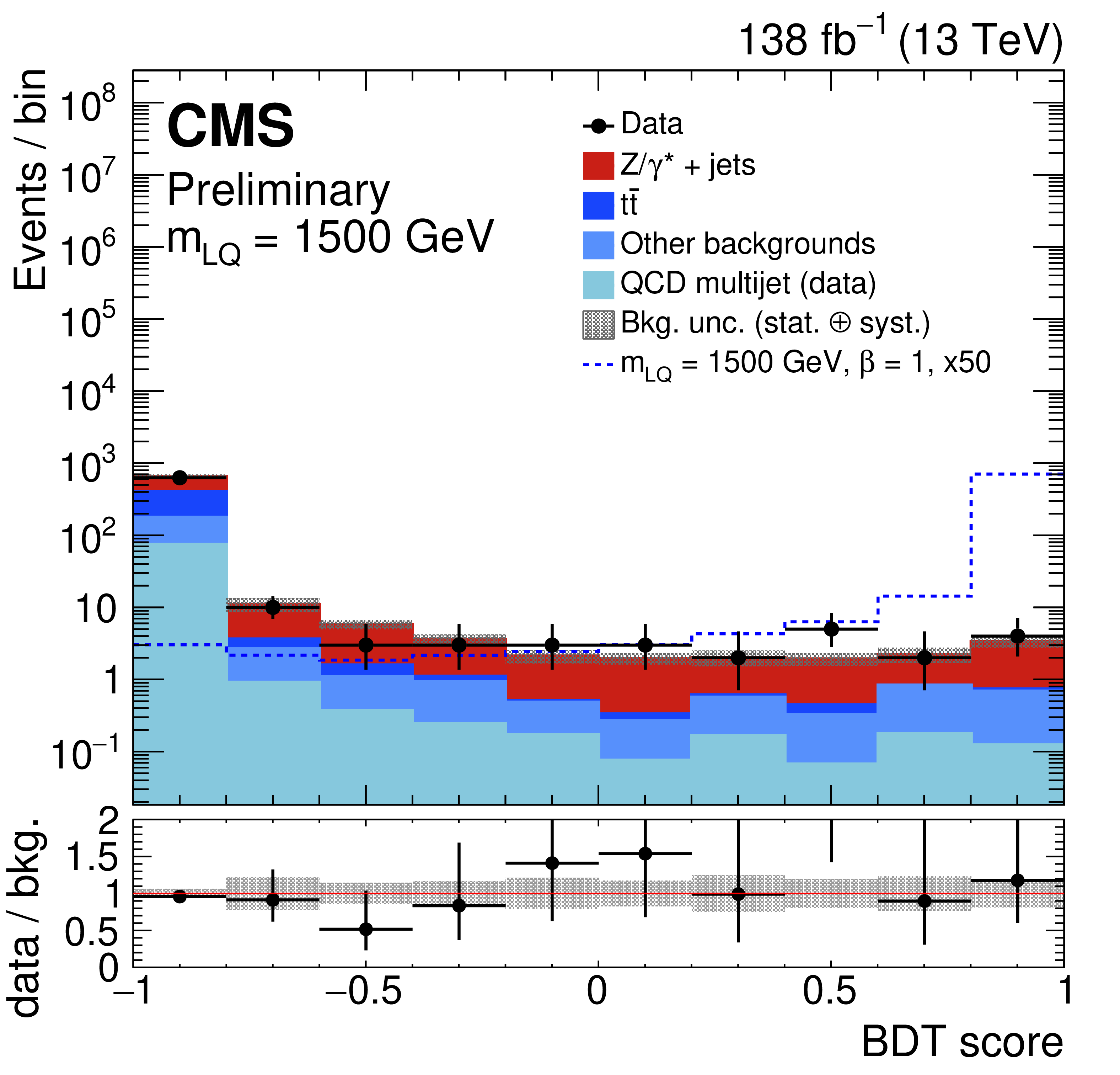
Data and background comparison in the training region for the output of the BDT model trained with signal mass $ m_{\text{LQ}} = $ 1500 GeV. ``Other background" includes diboson and single top quark processes. The signal prediction for the $ m_{\text{LQ}}= $ 1500 GeV hypothesis is overlaid on the plot. The last bin includes all events beyond the upper $ x $-axis boundary. |
png pdf |
Figure 4:
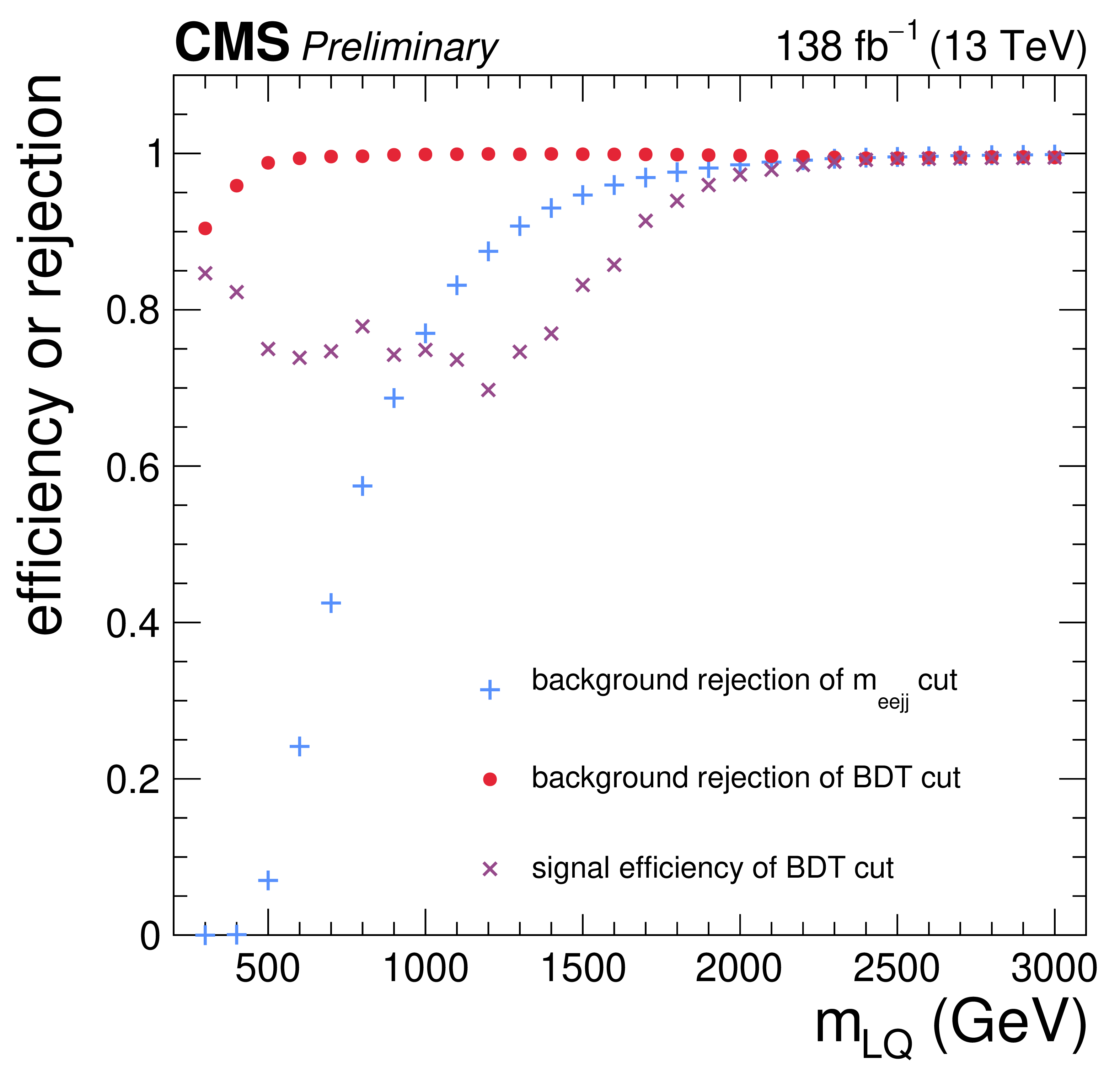
Background rejection (1 - efficiency) of the $ m_{\mathrm{e}\mathrm{e}\text{j}\text{j}} $ $ > $ $ m_{\text{LQ}} $ selection and signal efficiency and background rejection of the optimal BDT score selection for each $ m_{\text{LQ}} $ considered in the analysis. The signal efficiency of the $ m_{\mathrm{e}\mathrm{e}\text{j}\text{j}} $ $ > $ $ m_{\text{LQ}} $ selection is omitted from the plot because the difference from 1 is negligible for all masses. Note that the BDT cut is applied to events remaining after the $ m_{\mathrm{e}\mathrm{e}\text{j}\text{j}} $ cut. |
png pdf |
Figure 5:
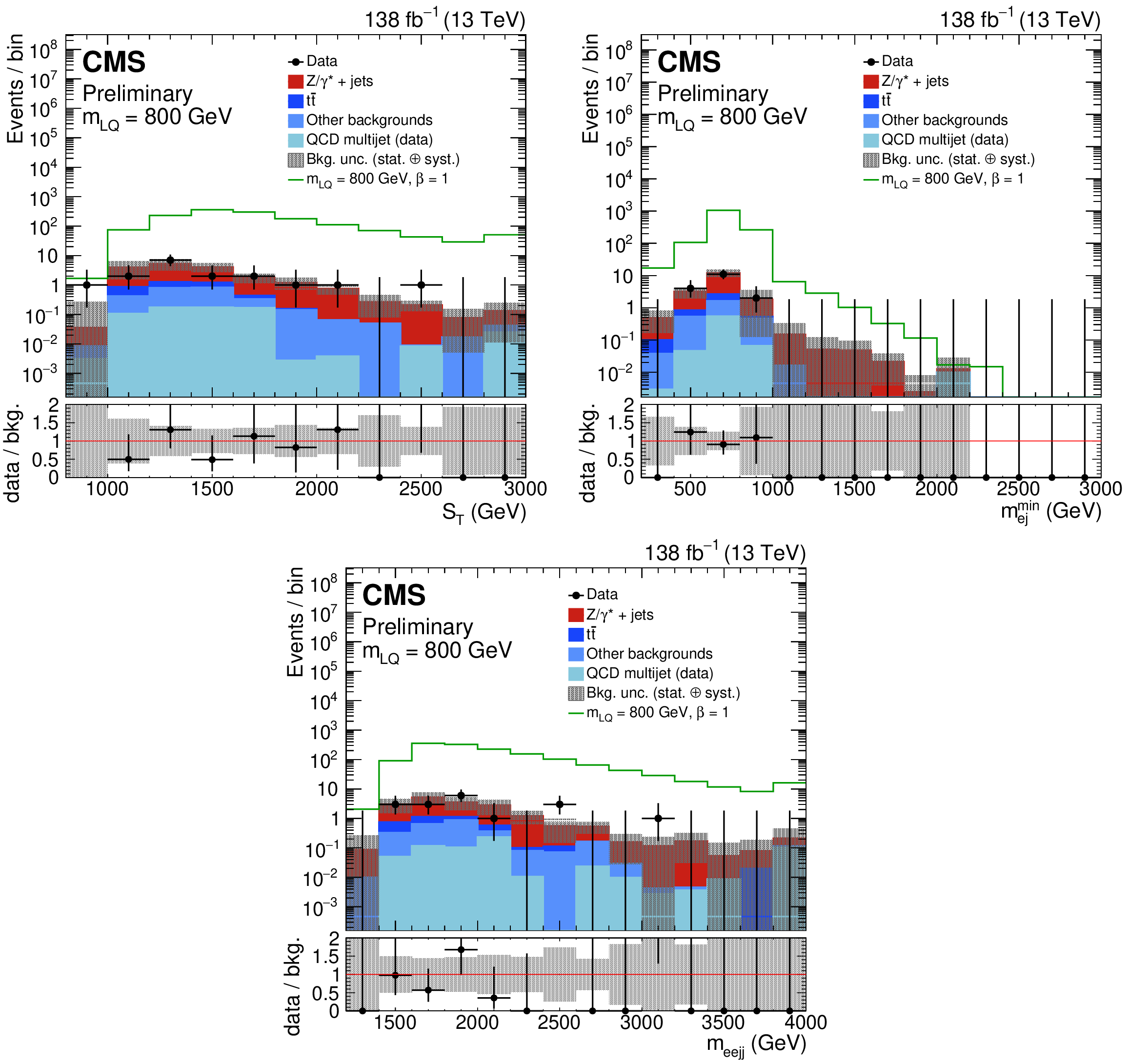
Data and background comparison for events passing the final selection requirements for the $ m_{\text{LQ}} $ of 800 GeV for $ S_{\mathrm{T}} $, $ m_{\mathrm{e}\text{j}}^\text{min} $, and $ m_{\mathrm{e}\mathrm{e}\text{j}\text{j}} $. ``Other background" includes diboson and single top quark. The signal prediction for the $ m_{\text{LQ}}= $ 800 GeV hypothesis is overlaid on the plots. The last bin includes all events beyond the upper $ x $-axis boundary. |
png pdf |
Figure 5-a:
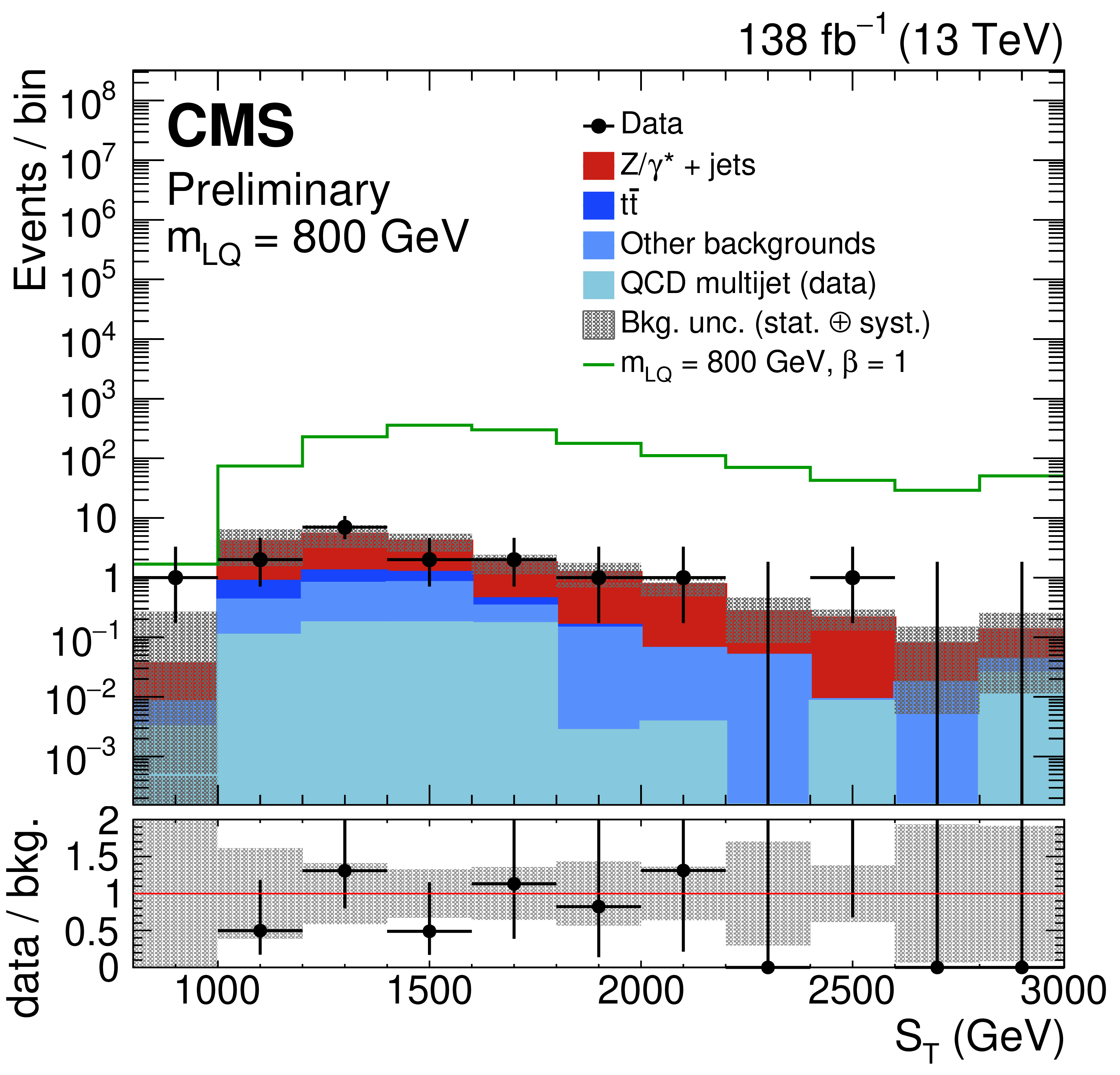
Data and background comparison for events passing the final selection requirements for the $ m_{\text{LQ}} $ of 800 GeV for $ S_{\mathrm{T}} $, $ m_{\mathrm{e}\text{j}}^\text{min} $, and $ m_{\mathrm{e}\mathrm{e}\text{j}\text{j}} $. ``Other background" includes diboson and single top quark. The signal prediction for the $ m_{\text{LQ}}= $ 800 GeV hypothesis is overlaid on the plots. The last bin includes all events beyond the upper $ x $-axis boundary. |
png pdf |
Figure 5-b:
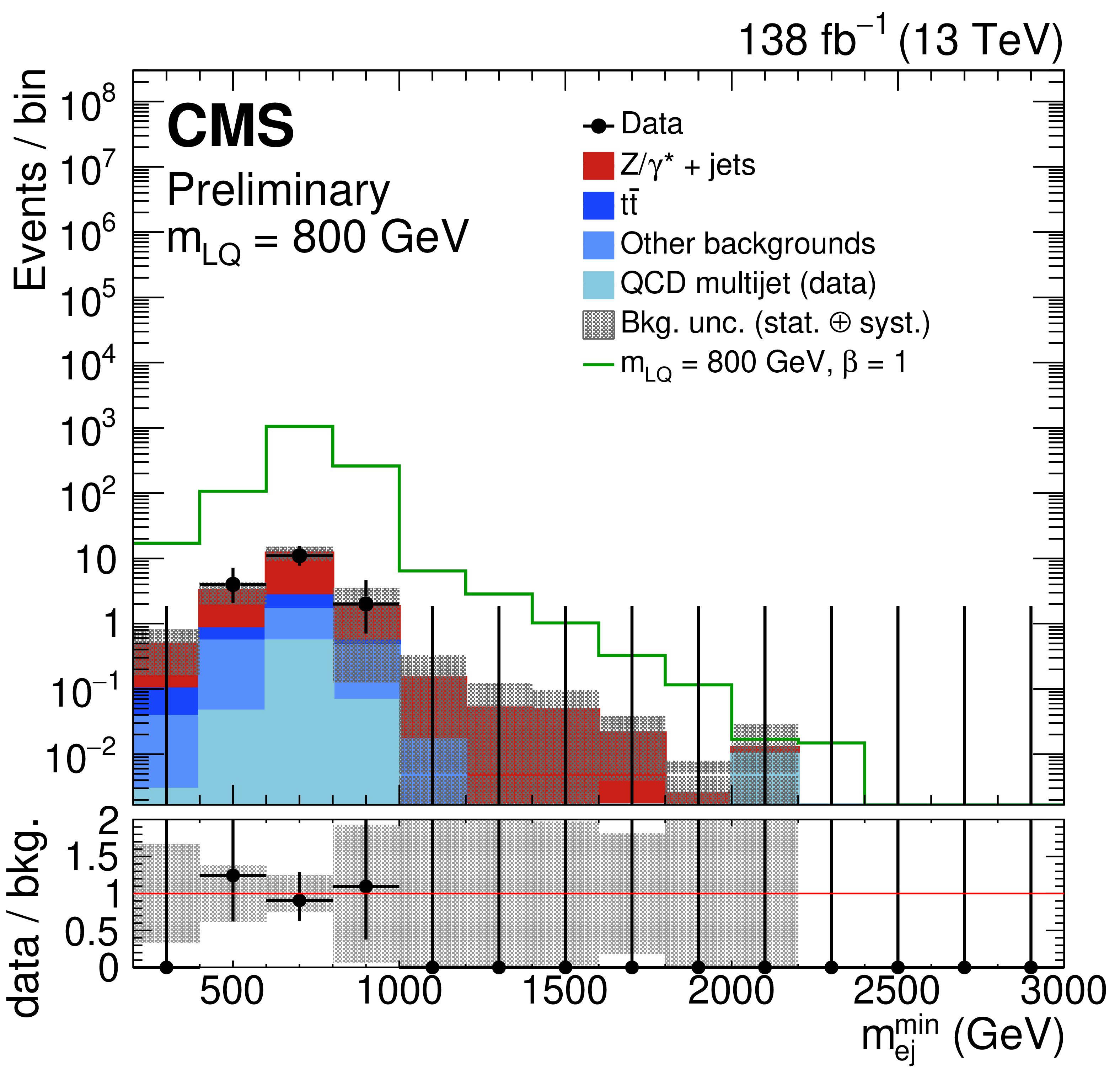
Data and background comparison for events passing the final selection requirements for the $ m_{\text{LQ}} $ of 800 GeV for $ S_{\mathrm{T}} $, $ m_{\mathrm{e}\text{j}}^\text{min} $, and $ m_{\mathrm{e}\mathrm{e}\text{j}\text{j}} $. ``Other background" includes diboson and single top quark. The signal prediction for the $ m_{\text{LQ}}= $ 800 GeV hypothesis is overlaid on the plots. The last bin includes all events beyond the upper $ x $-axis boundary. |
png pdf |
Figure 5-c:
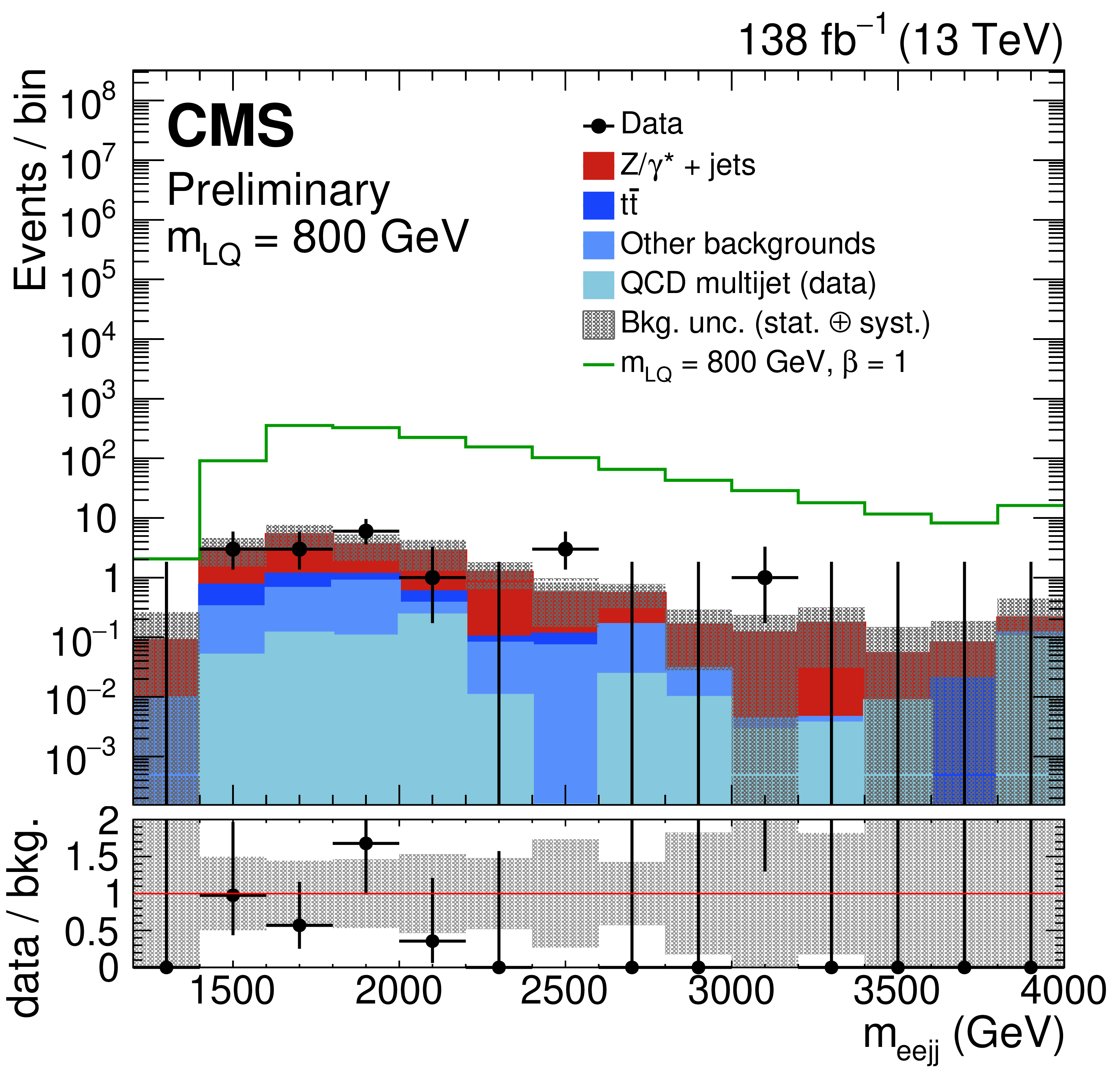
Data and background comparison for events passing the final selection requirements for the $ m_{\text{LQ}} $ of 800 GeV for $ S_{\mathrm{T}} $, $ m_{\mathrm{e}\text{j}}^\text{min} $, and $ m_{\mathrm{e}\mathrm{e}\text{j}\text{j}} $. ``Other background" includes diboson and single top quark. The signal prediction for the $ m_{\text{LQ}}= $ 800 GeV hypothesis is overlaid on the plots. The last bin includes all events beyond the upper $ x $-axis boundary. |
png pdf |
Figure 6:
Upper limits on the scalar leptoquark pair-production cross section times $ \beta^{2} $ at the 95% confidence level for the light quark decay channel. The green and yellow bands represent the 68% and 95% confidence intervals on the expected limits. |
png pdf |
Figure 7:
Lower mass limits on the scalar leptoquark at the 95% confidence level for a range of $ \beta $ values for the light quark decay channel. The green and yellow bands represent the 68% and 95% confidence intervals on the expected limits. |
| Tables | |
png pdf |
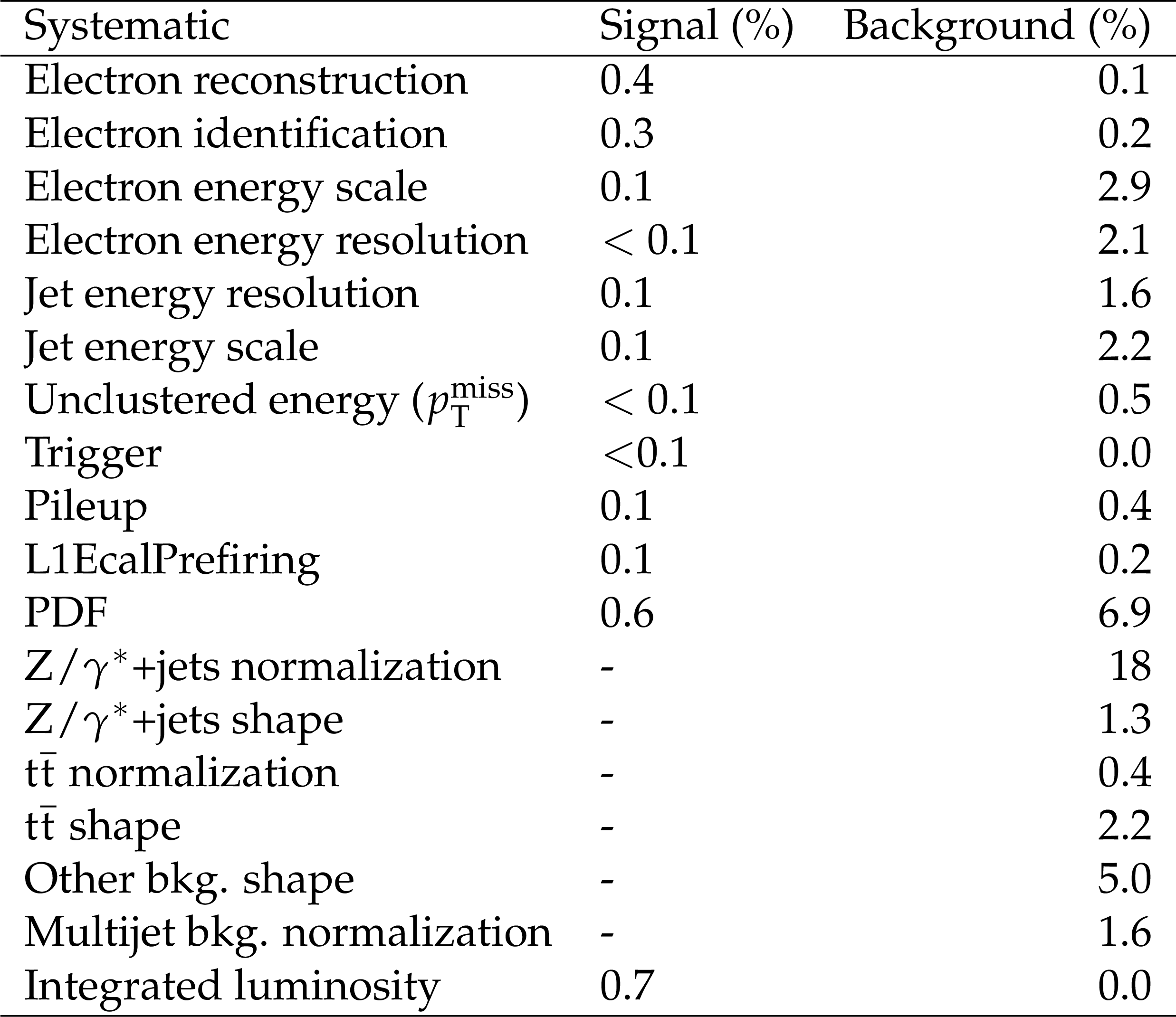
Table 1:
Effect of systematic uncertainties in the signal and background yields for the $ m_{\text{LQ}} = $ 1500 GeV hypothesis. |
png pdf |
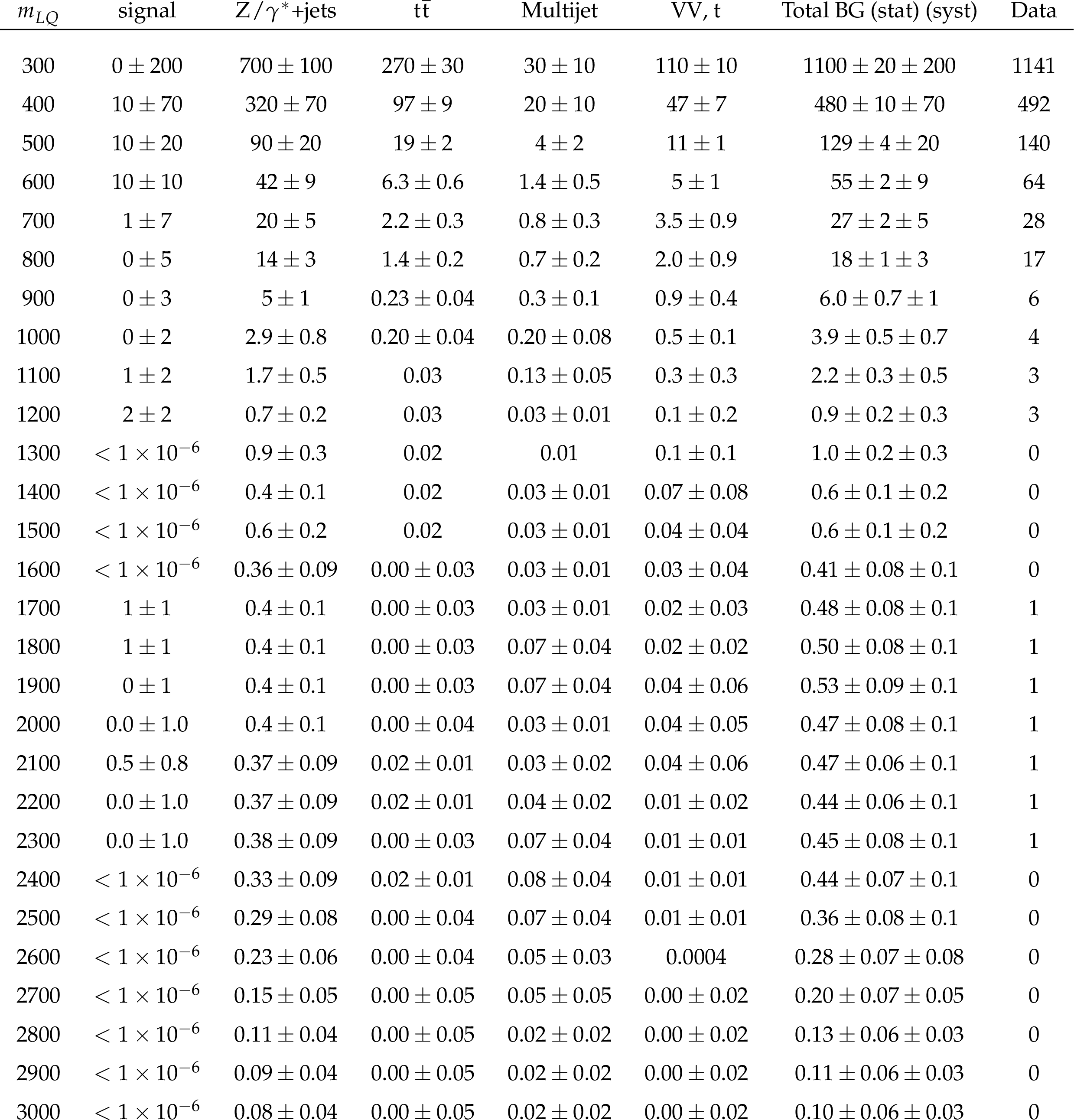
Table A1:
Event yields after applying the optimized BDT selection criteria and performing a signal plus background fit. Uncertainties are total statistical plus systematic, except for the total background, for which statistical and systematic uncertainties are given separately. |
| Summary |
| A search has been performed for pair production of scalar leptoquarks that couple to an electron and a quark using Run 2 (2016--2018) proton-proton collision data collected at 13 TeV center-of-mass energy with the CMS detector at the LHC, and corresponding to an integrated luminosity of 138 fb$ ^{-1} $. The data are found to be in agreement with standard model background expectations and a lower limit at 95% confidence level is set on the scalar leptoquark mass at 1710 or 1700 GeV (expected 1755 or 1745 GeV) for $ \beta= $ 1.0, where $ \beta $ is the branching fraction of the leptoquark decay to an electron and a light or a b quark, respectively. The results are reinterpreted to set limits on the vector leptoquark pair production in the minimal and Yang-Mills coupling scenarios, setting lower mass limits of 2110 or 2525 GeV (expected 2165 or 2525 GeV), respectively, for $ \beta= $ 1.0. |
| References | ||||
| 1 | J. C. Pati and A. Salam | Unified lepton-hadron symmetry and a gauge theory of the basic interactions | PRD 8 (1973) 1240 | |
| 2 | J. C. Pati and A. Salam | Lepton number as the fourth `color' | PRD 10 (1974) 275 | |
| 3 | H. Georgi and S. Glashow | Unity of all elementary-particle forces | PRL 32 (1974) 438 | |
| 4 | H. Murayama and T. Yanagida | A viable SU(5) GUT with light leptoquark bosons | Mod. Phys. Lett. A 07 (1992) 147 | |
| 5 | H. Fritzsch and P. Minkowski | Unified interactions of leptons and hadrons | Annals Phys. 93 (1975) 193 | |
| 6 | G. Senjanovic and A. Sokorac | Light lepto-quarks in SO(10) | Z. Phys. C 20 (1983) 255 | |
| 7 | P. H. Frampton and B.-H. Lee | SU(15) grand unification | PRL 64 (1990) 619 | |
| 8 | P. H. Frampton and T. W. Kephart | Higgs sector and proton decay in SU(15) grand unification | PRD 42 (1990) 3892 | |
| 9 | S. Dimopoulos and L. Susskind | Mass without scalars | NPB 155 (1979) 237 | |
| 10 | S. Dimopoulos | Technicoloured signatures | NPB 168 (1980) 69 | |
| 11 | E. Eichten and K. Lane | Dynamical breaking of weak interaction symmetries | PLB 90 (1980) 125 | |
| 12 | J. L. Hewett and T. G. Rizzo | Low-energy phenomenology of superstring-inspired E$ _{6} $ models | Phys. Rept. 183 193, 1989 | |
| 13 | B. Schrempp and F. Schrempp | Light leptoquarks | PLB 153 (1985) 101 | |
| 14 | W. Buchmuller, R. Ruckl, and D. Wyler | Leptoquarks in lepton-quark collisions | PLB 191 (1987) 442 | |
| 15 | M. Kuze and Y. Sirois | Search for particles and forces beyond the standard model in high energy lepton-hadron and hadron-hadron collisions | Progress in Particle and Nuclear Physics 50 (2003) no. 1, 1 | hep-ex/0211048 |
| 16 | I. Dorvsner et al. | Physics of leptoquarks in precision experiments and at particle colliders | Phys. Rep. 641 (2016) 1 | 1603.04993 |
| 17 | B. Diaz, M. Schmaltz, and Y.-M. Zhong | The leptoquark Hunter's guide: Pair production | JHEP 10 (2017) 097 | 1706.05033 |
| 18 | D. Buttazzo, A. Greljo, G. Isidori, and D. Marzocca | B-physics anomalies: a guide to combined explanations | JHEP 11 (2017) 44 | 1706.07808 |
| 19 | L. Calibbi, A. Crivellin, and T. Li | Model of vector leptoquarks in view of the $ B $-physics anomalies | PRD 98 (2018) 115002 | 1709.00692 |
| 20 | G. Hiller, D. Loose, and I. Nivs and Vzic | Flavorful leptoquarks at hadron colliders | PRD 97 (2018) 075004 | 1801.09399 |
| 21 | LHCb Collaboration | Measurement of form-factor-independent observables in the decay $ {\mathrm{B}^0}\to\mathrm{K}^{*0}\mu^{+}\mu^{-} $ | PRL 111 (2013) 191801 | 1308.1707 |
| 22 | LHCb Collaboration | Test of lepton universality using $ {\mathrm{B}^{+}}\to \mathrm{K^+}\ell^{+}\ell^{-} $ decays | PRL 113 (2014) 151601 | 1406.6482 |
| 23 | LHCb Collaboration | Angular analysis of the $ {\mathrm{B}^0}\to\mathrm{K}^{*0}\mu^{+} \mu^{-} $ decay using 3 fb$ ^{-1} $ of integrated luminosity | JHEP 02 (2016) 104 | 1512.04442 |
| 24 | LHCb Collaboration | Test of lepton universality with $ {\mathrm{B}^0}\to \mathrm{K}^{*0}\ell^{+}\ell^{-} $ decays | JHEP 08 (2017) 055 | 1705.05802 |
| 25 | Belle Collaboration | Lepton-flavor-dependent angular analysis of $ {\mathrm{B}}\to\mathrm{K}^{*} \ell^+ \ell^- $ | PRL 118 (2017) 111801 | 1612.05014 |
| 26 | BaBar Collaboration | Evidence for an excess of $ \bar{B} \to D^{(*)} \tau^-\bar{\nu}_ \tau $ decays | PRL 109 (2012) 101802 | 1205.5442 |
| 27 | BaBar Collaboration | Measurement of an excess of $ \bar{B} \to D^{(*)}\tau^- \bar{\nu}_ \tau $ decays and implications for charged Higgs bosons | PRD 88 (2013) 072012 | 1303.0571 |
| 28 | Belle Collaboration | Measurement of the branching ratio of $ \bar{B} \to D^{(\ast)} \tau ^- \bar{\nu}_\tau $ relative to $ \bar{B} \to D^{(\ast)} \ell^- \bar{ \nu}_\ell $ decays with hadronic tagging at Belle | PRD 92 (2015) 072014 | 1507.03233 |
| 29 | Belle Collaboration | Measurement of the $ \tau $ lepton polarization and $ R(D^*) $ in the decay $ \bar{B} \to D^* \tau^- \bar{\nu}_\tau $ | PRL 118 (2017) 211801 | 1612.00529 |
| 30 | Belle Collaboration | Measurement of the $ \tau $ lepton polarization and $ R(D^*) $ in the decay $ \bar{B} \rightarrow D^* \tau^- \bar{\nu}_\tau $ with one-prong hadronic $ \tau $ decays at Belle | PRD 97 (2018) 012004 | 1709.00129 |
| 31 | Belle Collaboration | Measurement of $ \mathcal{R}(D) $ and $ \mathcal{R}(D^*) $ with a semileptonic tagging method | PRL 124 (2020) 161803 | 1910.05864 |
| 32 | LHCb Collaboration | Measurement of the ratio of branching fractions $ \mathcal{B}(\bar{ B}^0 \to D^{*+}\tau^{-}\bar{\nu}_{\tau})/\mathcal{B}(\bar{B}^0 \to D^{*+}\mu^{-}\bar{\nu}_{\mu}) $ | PRL 115 (2015) 111803 | 1506.08614 |
| 33 | LHCb Collaboration | Measurement of the ratio of the $ B^0 \to D^{*-} \tau^+ \nu_{\tau} $ and $ B^0 \to D^{*-} \mu^+ \nu_{\mu} $ branching fractions using three-prong $ \tau $-lepton decays | PRL 120 (2018) 171802 | 1708.08856 |
| 34 | LHCb Collaboration | Test of lepton flavor universality by the measurement of the $ B^0 \to D^{*-} \tau^+ \nu_{\tau} $ branching fraction using three-prong $ \tau $ decays | PRD 97 (2018) 072013 | 1711.02505 |
| 35 | LHCb Collaboration | Measurement of the ratio of branching fractions $ \mathcal{B}(B_c^+ \to J/\psi\tau^+\nu_\tau) $/$ \mathcal{B}(B_c^+ \to J/\psi\mu^+ \nu_\mu) $ | PRL 120 (2018) 121801 | 1711.05623 |
| 36 | LHCb Collaboration | Test of lepton flavor universality using $ B^0 \to D^{*-}\tau^+\nu_ {\tau} $ decays with hadronic $ \tau $ channels | PRD 108 (2023) 012018 | 2305.01463 |
| 37 | LHCb Collaboration | Measurement of the ratios of branching fractions $ \mathcal{R}(D^{* }) $ and $ \mathcal{R}(D^{0}) $ | PRL 131 (2023) 111802 | 2302.02886 |
| 38 | R. Barbier et al. | $ R $-parity-violating supersymmetry | Phys. Rept. 420 (2005) 1 | hep-ph/0406039 |
| 39 | OPAL Collaboration | Search for pair produced leptoquarks in $ e^{+} e^{-} $ interactions at $ \sqrt{s} $ approximately = 189-GeV to 209-GeV | EPJC 31 (2003) 281 | hep-ex/0305053 |
| 40 | ZEUS Collaboration | Search for resonance decays to lepton+jet at DESY HERA and limits on leptoquarks | PRD 68 (2003) 052004 | hep-ex/0304008 |
| 41 | H1 Collaboration | Search for first generation leptoquarks in $ \mathrm{e}\mathrm{p} $ collisions at HERA | PLB 704 (2011) 388 | 1107.3716 |
| 42 | CDF Collaboration | Search for first-generation scalar leptoquarks in $ \mathrm{p}\overline{\mathrm{p}} $ collisions at $ \sqrt{s} = $ 1.96 TeV | PRD 72 (2005) 051107 | hep-ex/0506074 |
| 43 | D0 Collaboration | Search for pair production of first-generation leptoquarks in $ \mathrm{p} \overline{\mathrm{p}} $ collisions at $ \sqrt{s} = $ 1.96 TeV | PLB 681 (2009) 224 | 0907.1048 |
| 44 | CMS Collaboration | Search for Pair Production of First-Generation Scalar Leptoquarks in $ pp $ Collisions at $ \sqrt{s}= $ 7 TeV | PRL 106 (2011) 201802 | CMS-EXO-10-005 1012.4031 |
| 45 | CMS Collaboration | Search for First Generation Scalar Leptoquarks in the e$ \nu $jj channel in $ pp $ collisions at $ \sqrt{s}= $ 7 TeV | PLB 703 (2011) 246 | CMS-EXO-10-006 1105.5237 |
| 46 | CMS Collaboration | Search for Pair Production of First- and Second-Generation Scalar Leptoquarks in $ pp $ Collisions at $ \sqrt{s}= $ 7 TeV | PRD 86 (2012) 052013 | CMS-EXO-11-028 1207.5406 |
| 47 | CMS Collaboration | Search for pair production of first and second generation leptoquarks in proton-proton collisions at $ \sqrt{s} = $ 8 TeV | PRD 93 (2016) no. 3, 03 | CMS-EXO-12-041 1509.03744 |
| 48 | CMS Collaboration | Search for pair production of first-generation scalar leptoquarks at $ \sqrt{s} = $ 13 TeV | PRD 99 (2019) no. 5, 05 | CMS-EXO-17-009 1811.01197 |
| 49 | ATLAS Collaboration | Search for pair production of first or second generation leptoquarks in proton-proton collisions at $ \sqrt{s}= $ 7 TeV using the ATLAS detector at the LHC | PRD 83 (2011) 112006 | 1104.4481 |
| 50 | ATLAS Collaboration | Search for first generation scalar leptoquarks in $ pp $ collisions at $ \sqrt{s}= $ 7 TeV with the ATLAS detector | PLB 709 (2012) 158 | 1112.4828 |
| 51 | ATLAS Collaboration | Searches for scalar leptoquarks in pp collisions at $ \sqrt{s} = $ 8 TeV with the ATLAS detector | EPJC 76 (2016) no. 1, 5 | 1508.04735 |
| 52 | ATLAS Collaboration | Search for scalar leptoquarks in pp collisions at $ \sqrt{s} = $ 13 TeV with the ATLAS experiment | New J. Phys. 18 (2016) no. 9, 093016 | 1605.06035 |
| 53 | ATLAS Collaboration | Searches for scalar leptoquarks and differential cross-section measurements in dilepton-dijet events in proton-proton collisions at a centre-of-mass energy of $ \sqrt{s} = $ 13 TeV with the ATLAS experiment | EPJC 79 (2019) no. 9, 733 | 1902.00377 |
| 54 | ATLAS Collaboration | Search for pairs of scalar leptoquarks decaying into quarks and electrons or muons in $ \sqrt{s} = $ 13 TeV $ pp $ collisions with the ATLAS detector | JHEP 10 (2020) 112 | 2006.05872 |
| 55 | ATLAS Collaboration | Search for resonant leptoquark production via lepton-jet signatures in pp collisions at $ \sqrt{s}= $ 13 TeV and $ \sqrt{s}= $ 13.6 TeV with the ATLAS detector | JHEP 12 (2025) 180 | 2507.03650 |
| 56 | CMS Collaboration | The CMS experiment at the CERN LHC | JINST 3 (2008) S08004 | |
| 57 | CMS Collaboration | Precision luminosity measurement in proton-proton collisions at $ \sqrt{s}= $ 13 TeV in 2015 and 2016 at CMS | EPJC 81 (2021) 800 | CMS-LUM-17-003 2104.01927 |
| 58 | CMS Collaboration | Precision luminosity measurement in proton-proton collisions at $ \sqrt{s}= $ 13 TeV with the CMS detector | CMS Physics Analysis Summary, 2025 CMS-PAS-LUM-20-001 |
CMS-PAS-LUM-20-001 |
| 59 | CMS Collaboration | The CMS trigger system | Journal of Instrumentation 1 (2017) 2 | CMS-TRG-12-001 1609.02366 |
| 60 | S. Frixione and B. R. Webber | Matching NLO QCD computations and parton shower simulations | JHEP 06 (2002) 029 | hep-ph/0204244 |
| 61 | J. Alwall et al. | The automated computation of tree-level and next-to-leading order differential cross sections, and their matching to parton shower simulations | JHEP 07 (2014) 079 | 1405.0301 |
| 62 | NNPDF Collaboration | Parton distributions for the LHC Run II | JHEP 04 (2015) 040 | 1410.8849 |
| 63 | I. Dor \v s ner and A. Greljo | Leptoquark toolbox for precision collider studies | JHEP 05 (2018) 126 | 1801.07641 |
| 64 | M. Kr ä mer, T. Plehn, M. Spira, and P. M. Zerwas | Pair production of scalar leptoquarks at the CERN LHC | PRD 71 (2005) 057503 | hep-ph/0411038 |
| 65 | T. Mandal, S. Mitra, and S. Seth | Pair production of scalar leptoquarks at the LHC to NLO parton shower accuracy | PRD 93 (2016) 035018 | 1506.07369 |
| 66 | J. Butterworth et al. | PDF4LHC recommendations for LHC Run II | JPG 43 (2016) 023001 | 1510.03865 |
| 67 | J. Blumlein, E. Boos, and A. Kryukov | Leptoquark pair production in hadronic interactions | Z. Phys. C 76 (1997) 137 | hep-ph/9610408 |
| 68 | R. Frederix and S. Frixione | Merging meets matching in MC@NLO | JHEP 12 (2012) 061 | 1209.6215 |
| 69 | S. Kallweit et al. | NLO electroweak automation and precise predictions for W+multijet production at the LHC | JHEP 04 (2015) 012 | 1412.5157 |
| 70 | S. Kallweit et al. | NLO QCD+EW automation and precise predictions for V+multijet production | in 50th Rencontres de Moriond on QCD and High Energy Interactions, 2015 | 1505.05704 |
| 71 | S. Kallweit et al. | NLO QCD+EW predictions for V + jets including off-shell vector-boson decays and multijet merging | JHEP 04 (2016) 021 | 1511.08692 |
| 72 | J. M. Lindert et al. | Precise predictions for $ \mathrm{V}+ $ jets dark matter backgrounds | EPJC 77 (2017) 829 | 1705.04664 |
| 73 | S. Frixione, P. Nason, and C. Oleari | Matching NLO QCD computations with parton shower simulations: The POWHEG method | JHEP 11 (2007) 070 | 0709.2092 |
| 74 | S. Alioli, P. Nason, C. Oleari, and E. Re | NLO vector-boson production matched with shower in POWHEG | JHEP 07 (2008) 060 | 0805.4802 |
| 75 | S. Alioli, P. Nason, C. Oleari, and E. Re | NLO single-top production matched with shower in POWHEG: $ s $- and $ t $-channel contributions | JHEP 09 (2009) 111 | 0907.4076 |
| 76 | S. Alioli, P. Nason, C. Oleari, and E. Re | A general framework for implementing NLO calculations in shower Monte Carlo programs: The POWHEG BOX | JHEP 06 (2010) 043 | 1002.2581 |
| 77 | T. Melia, P. Nason, R. Rontsch, and G. Zanderighi | W+W-, WZ and ZZ production in the POWHEG BOX | JHEP 11 (2011) 078 | 1107.5051 |
| 78 | P. Nason and G. Zanderighi | $ W^+ W^- $, $ W Z $ and $ Z Z $ production in the POWHEG-BOX-V2 | EPJC 74 (2014) no. 1, 2702 | 1311.1365 |
| 79 | S. Frixione, P. Nason, and G. Ridolfi | A Positive-weight next-to-leading-order Monte Carlo for heavy flavour hadroproduction | JHEP 09 (2007) 126 | 0707.3088 |
| 80 | T. Sjöstrand et al. | An Introduction to PYTHIA 8.2 | Comput. Phys. Commun. 191 (2015) 159 | 1410.3012 |
| 81 | GEANT4 Collaboration | GEANT 4---A simulation toolkit | NIM A 506 (2003) 250 | |
| 82 | J. Allison et al. | GEANT 4 developments and applications | IEEE Trans. Nucl. Sci. 53 (2006) 270 | |
| 83 | CMS Collaboration | Extraction and validation of a new set of CMS PYTHIA8 tunes from underlying-event measurements | EPJC 80 (2020) 4 | CMS-GEN-17-001 1903.12179 |
| 84 | CMS Collaboration | Electron and photon reconstruction and identification with the CMS experiment at the CERN LHC | JINST 16 (2021) no. 05, P05014 | CMS-EGM-17-001 2012.06888 |
| 85 | CMS Collaboration | Jet energy scale and resolution in the CMS experiment in pp collisions at 8 TeV | JINST 12 (2017) no. 02, P0 | CMS-JME-13-004 1607.03663 |
| 86 | CMS Collaboration | Particle-flow reconstruction and global event description with the CMS detector | JINST 12 (2017) no. 10, P3 | CMS-PRF-14-001 1706.04965 |
| 87 | CMS Collaboration | Technical proposal for the Phase-II upgrade of the Compact Muon Solenoid | CMS Technical Proposal CERN-LHCC-2015-010, CMS-TDR-15-02, 2015 CDS |
|
| 88 | M. Cacciari, G. P. Salam, and G. Soyez | The anti-$ k_{\mathrm{T}} $ jet clustering algorithm | JHEP 04 (2008) 063 | 0802.1189 |
| 89 | M. Cacciari, G. P. Salam, and G. Soyez | FastJet user manual | EPJC 72 (2012) 1896 | 1111.6097 |
| 90 | CMS Collaboration | Performance of Electron Reconstruction and Selection with the CMS Detector in Proton-Proton Collisions at \ensuremath\sqrts = 8 TeV | JINST 10 (2015) no. 06, P06005 | CMS-EGM-13-001 1502.02701 |
| 91 | CMS Collaboration | Performance of the CMS muon detector and muon reconstruction with proton-proton collisions at $ \sqrt{s}= $ 13 TeV | JINST 13 (2018) P06015 | CMS-MUO-16-001 1804.04528 |
| 92 | J. Alwall et al. | Comparative study of various algorithms for the merging of parton showers and matrix elements in hadronic collisions | (December, ) 473, 2007 The European Physical Journal C 5 (2007) 3 |
0706.2569 |
| 93 | G. Cowan, K. Cranmer, E. Gross, and O. Vitells | Asymptotic formulae for likelihood-based tests of new physics | (February, ), 2011 The European Physical Journal C 7 (2011) 1 |
1007.1727 |
| 94 | E. Bols et al. | Jet flavour classification using DeepJet | (December, ) P1, 2020 Journal of Instrumentation 1 (2020) 5 |
2008.10519 |
| 95 | CMS Collaboration | Performance summary of AK4 jet b tagging with data from proton-proton collisions at 13 TeV with the CMS detector | CMS Detector Performance Summary CMS-DP-2023-005, March,, 2023 CDS |
|
| 96 | CMS Collaboration | Identification of heavy-flavour jets with the CMS detector in pp collisions at 13 TeV | JINST 13 (2018) no. 05, P05011 | CMS-BTV-16-002 1712.07158 |
| 97 | CMS Collaboration | Search for physics beyond the standard model in dilepton mass spectra in proton-proton collisions at $ \sqrt{s}= $ 8 TeV | Journal of High Energy Physics 201 (2015) 5 | CMS-EXO-12-061 1412.6302 |
| 98 | D. Bourilkov, R. C. Group, and M. R. Whalley | LHAPDF: PDF use from the tevatron to the LHC | link | |
| 99 | CMS Collaboration | Measurement of the inelastic proton-proton cross section at $ \sqrt{ s}= $ 13 TeV | JHEP 07 (2018) 161 | CMS-FSQ-15-005 1802.02613 |
| 100 | CMS Collaboration | Performance of the CMS Level-1 trigger in proton-proton collisions at $ \sqrt{s} = $ 13 TeV | JINST 15 (2020) no. 10, P7 | CMS-TRG-17-001 2006.10165 |
| 101 | CMS Collaboration | The CMS Statistical Analysis and Combination Tool: Combine | Computing and Software for Big Science 8 (November, ), 2024 link |
CMS-CAT-23-001 2404.06614 |
|
|
Compact Muon Solenoid LHC, CERN |

|
|
|
|
|
|