
Compact Muon Solenoid
LHC, CERN
 Visit us: CMS Public Website, CMS Physics ;
Contact us: CMS Publications Committee
Visit us: CMS Public Website, CMS Physics ;
Contact us: CMS Publications Committee
| CMS-PAS-B2G-24-005 | ||
| Search for heavy top quark partners with charge 5/3 in the single-lepton final state in proton-proton collisions at $ \sqrt{s}= $ 13 TeV | ||
| CMS Collaboration | ||
| 2026-05-15 | ||
| Abstract: A search for the pair production of a vector-like quark ($ X_{5/3} $), a heavy fermionic partner of the top quark with an exotic electric charge of 5/3 times the charge of the positron, is presented. The search is performed in the single-lepton final state, where the lepton is either an electron or a muon, using proton-proton collision data collected by the CMS experiment at the LHC from 2016 to 2018 at a center-of-mass energy of $ \sqrt{s}= $ 13 TeV, corresponding to an integrated luminosity of 138 fb$ ^{-1} $. Two decay modes are considered. In the standard model (SM) decay mode, the $ X_{5/3} $ is assumed to decay exclusively into a top quark and a W boson. In an alternative scenario involving decays to beyond SM (BSM) particles, the $ X_{5/3} $ is assumed to decay exclusively into a top quark and a charged Higgs boson ($ H^\pm $), with the $ H^\pm $ subsequently decaying into a top quark and a bottom quark. A multivariate discriminant is used to separate signal from background events and to extract any potential $ X_{5/3} $ signal. No excess of data events over the SM expectation is observed. Expected and observed upper limits on the pair production cross section of the $ X_{5/3} $ are set at 95% confidence level as a function of the $ X_{5/3} $ mass. The expected and observed exclusion ranges of the $ X_{5/3} $ mass extend up to 1600 and 1630 GeV, respectively, in the SM decay mode, and up to 1660 and 1710 GeV, respectively, in the BSM decay mode with a charged Higgs boson mass of 1000 GeV. | ||
| Links: CDS record (PDF) ; CADI line (restricted) ; | ||
| Figures | |
png pdf |
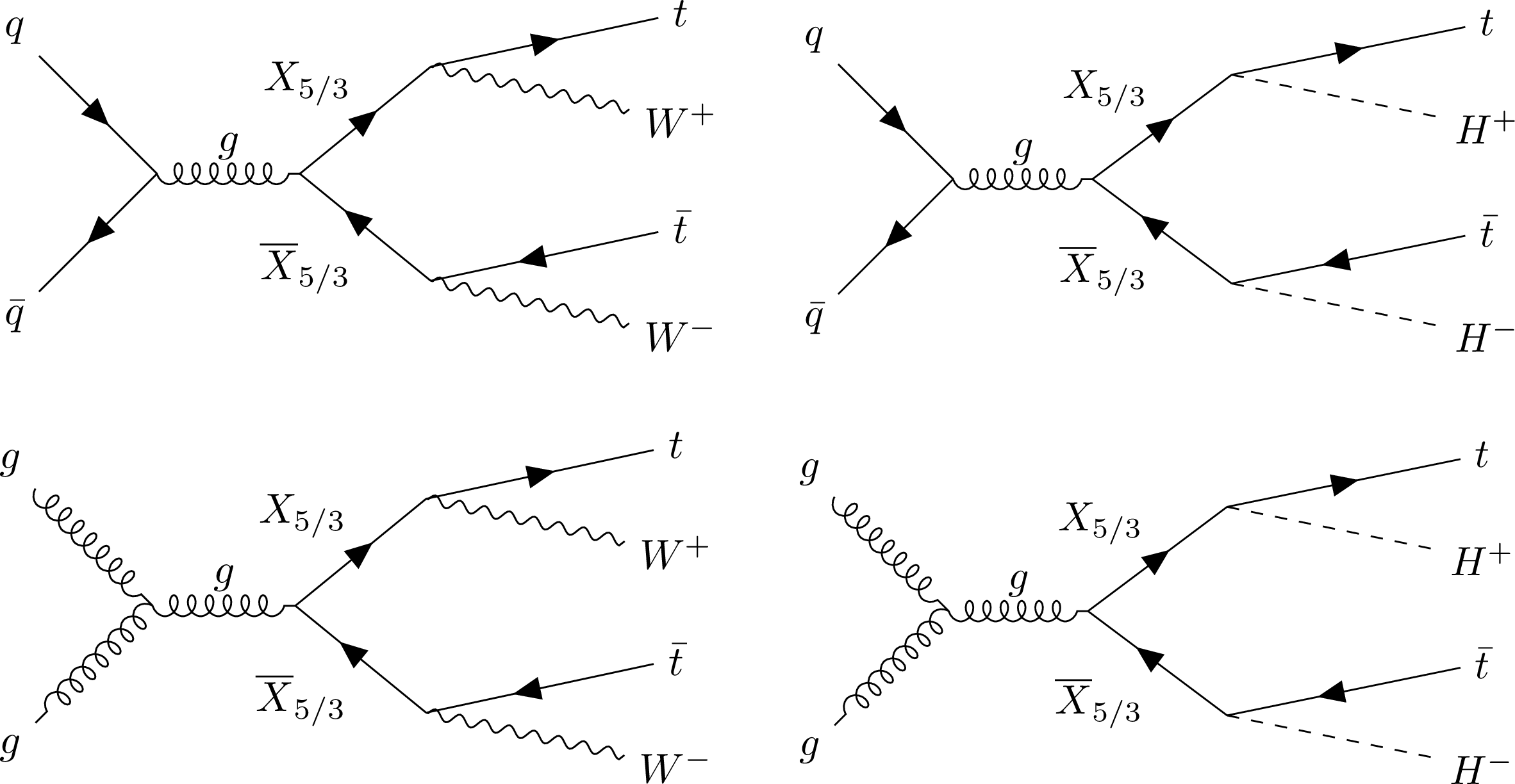
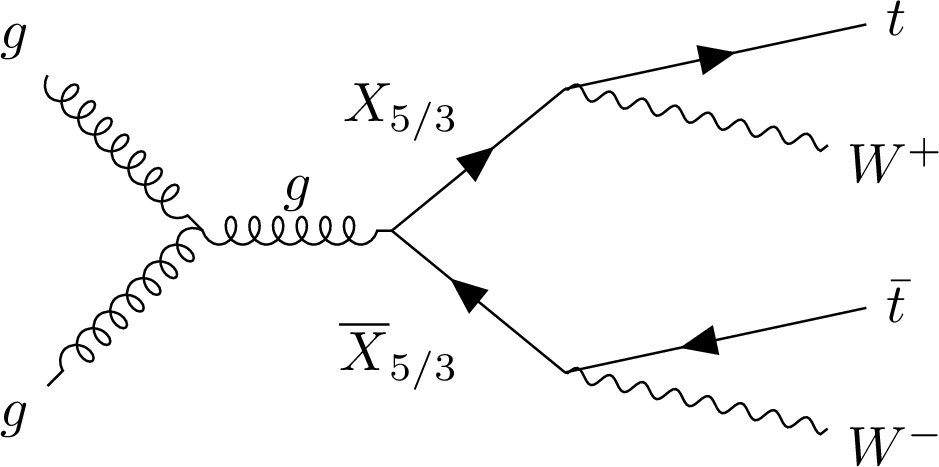
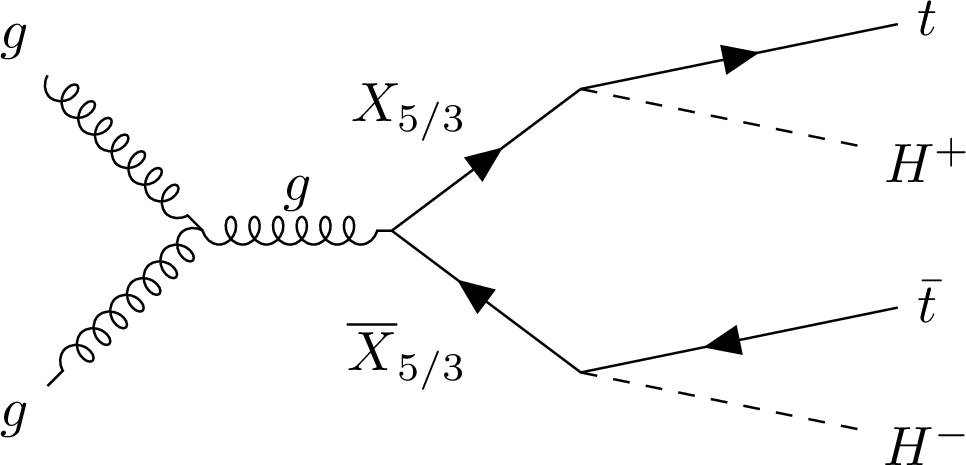
Figure 1:
Pair production of $ \mathrm{X}_{5/3} $ VLQs and their subsequent decays. |
png pdf |
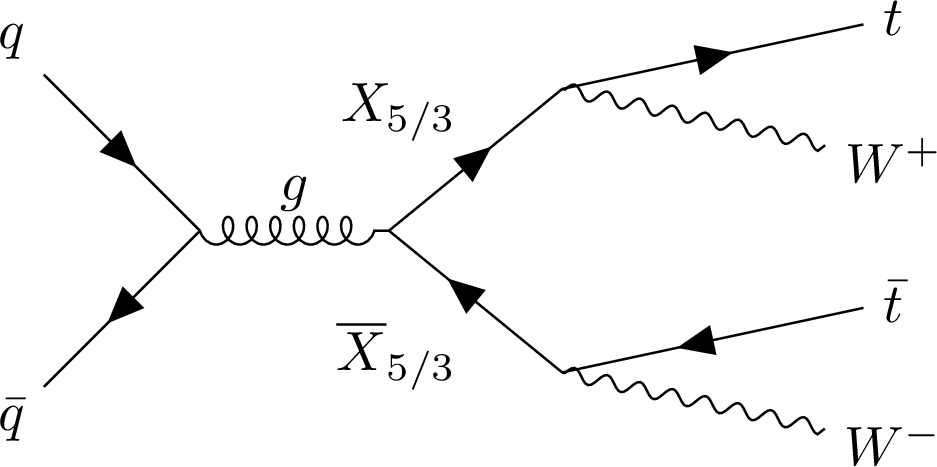
Figure 1-a:
Pair production of $ \mathrm{X}_{5/3} $ VLQs and their subsequent decays. |
png pdf |
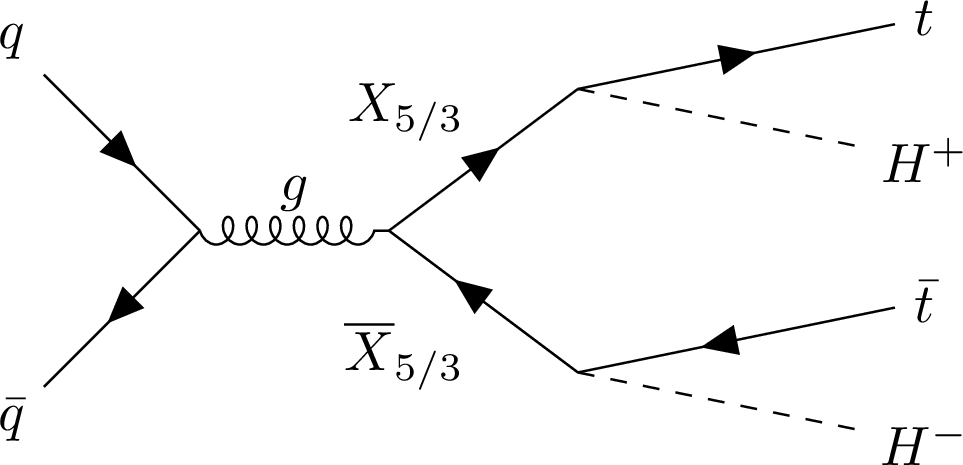
Figure 1-b:
Pair production of $ \mathrm{X}_{5/3} $ VLQs and their subsequent decays. |
png pdf |
Figure 1-c:
Pair production of $ \mathrm{X}_{5/3} $ VLQs and their subsequent decays. |
png pdf |
Figure 1-d:
Pair production of $ \mathrm{X}_{5/3} $ VLQs and their subsequent decays. |
png pdf |
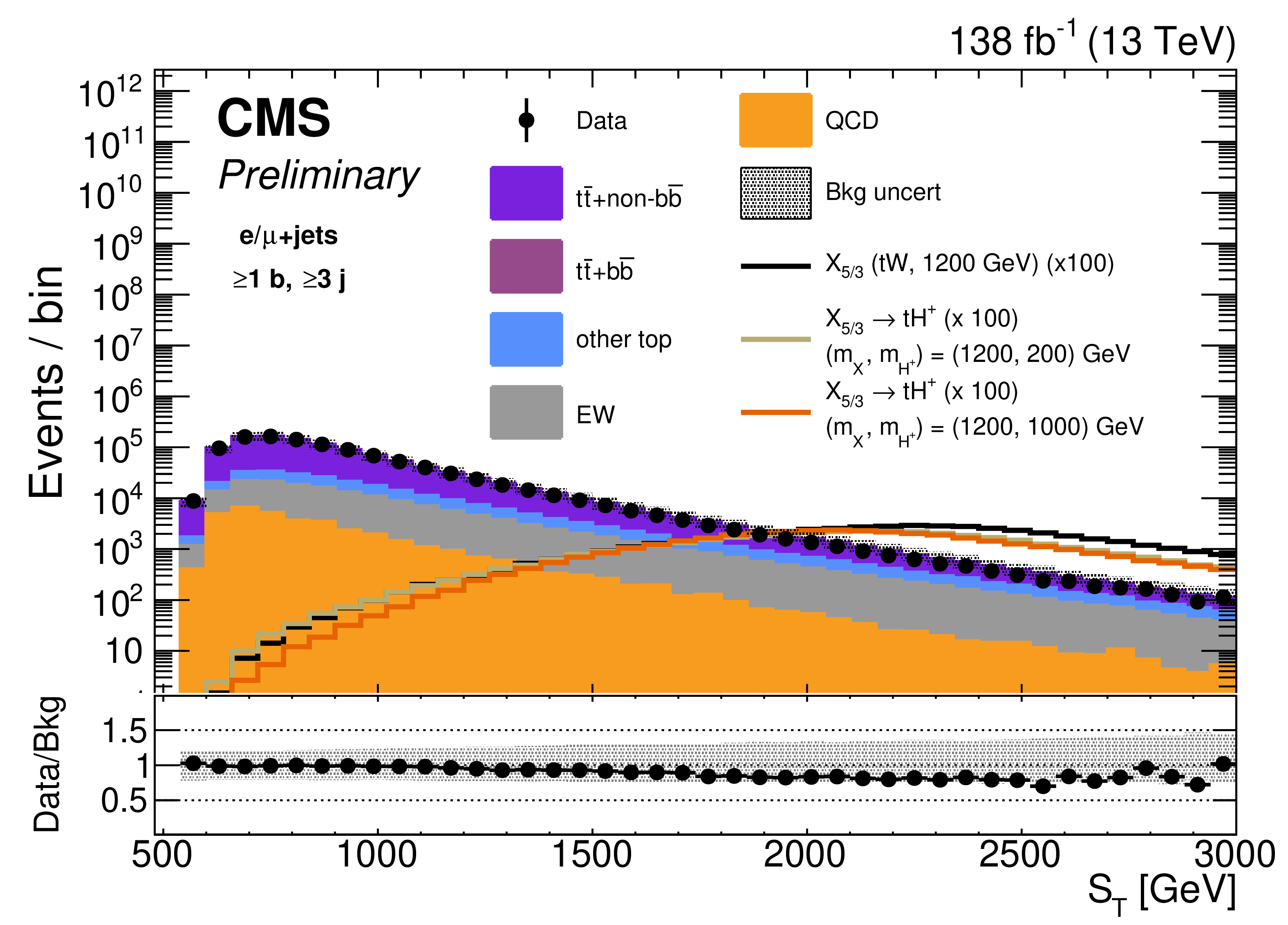
Figure 2:
Distribution of $ S_{\mathrm{T}} $ after the initial selection for data and simulated background processes. The background uncertainty includes both statistical and systematic components. |
png pdf |
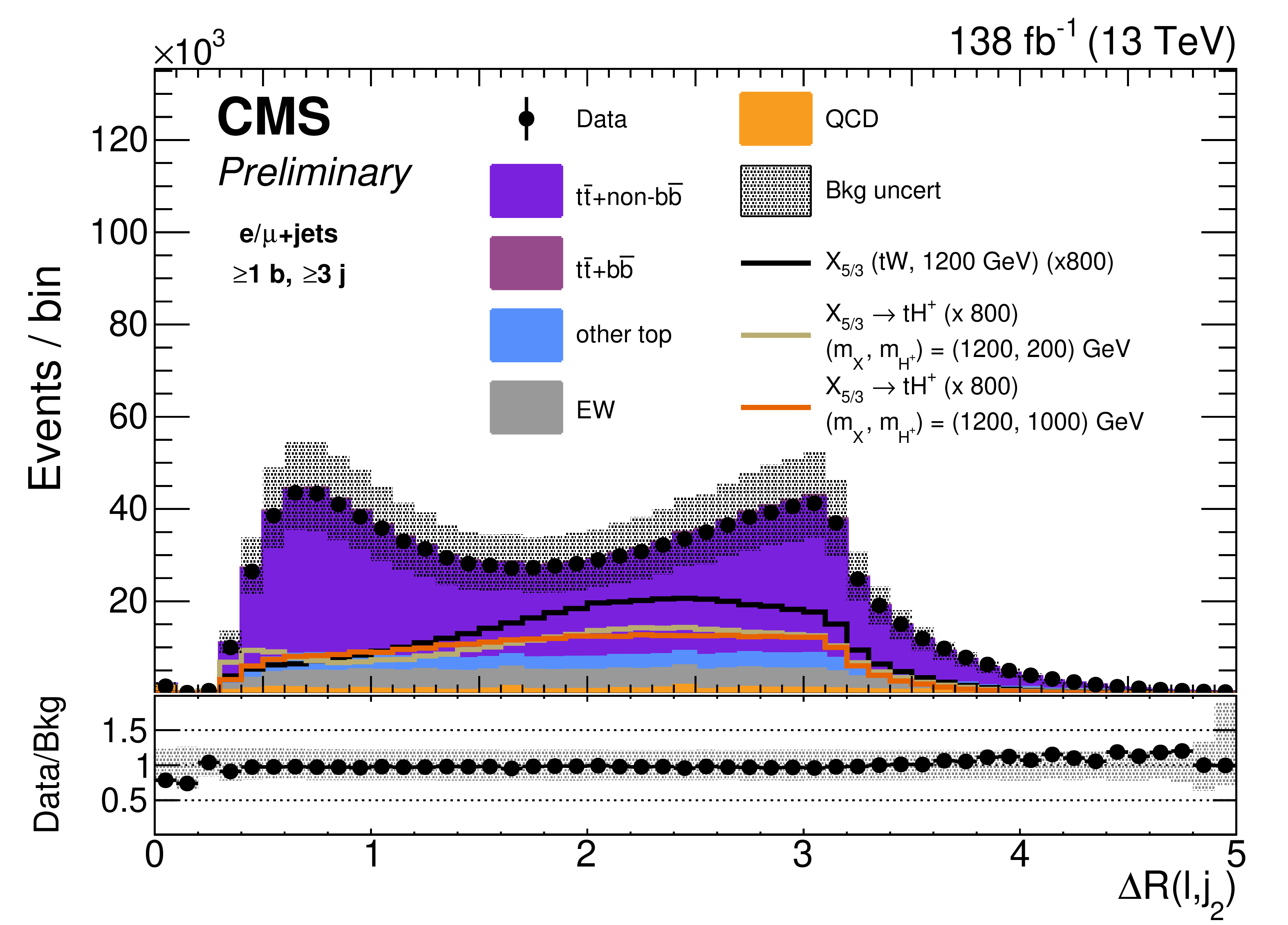
Figure 3:
Angular separation between the lepton $ \ell $ and the jet subleading in $ p_{\mathrm{T}} $ after the initial selection for data and simulated background processes. The background uncertainty includes both statistical and systematic components. |
png pdf |
Figure 4:
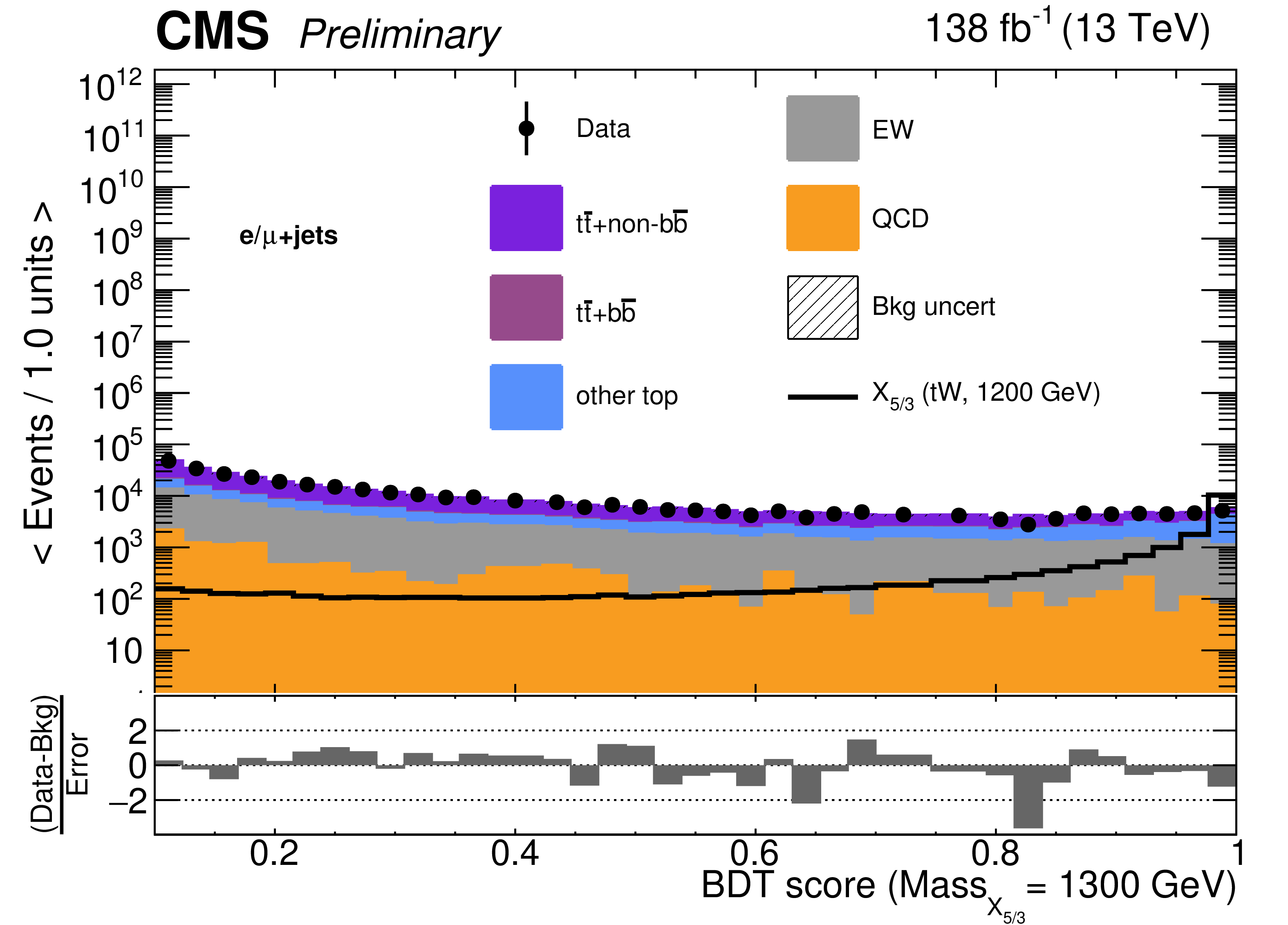
Post-fit distribution of the XGBOOST output for the $ \mathrm{X}_{5/3} \to \mathrm{t}\mathrm{W} $ model in data and simulation in the signal region after rebinning. The background contributions are shown after the fit to data, while the signal distribution is shown using the prefit prediction. The lower panel shows the difference between the data and the background prediction, divided by the total uncertainty in the background prediction. |
png pdf |
Figure 5:
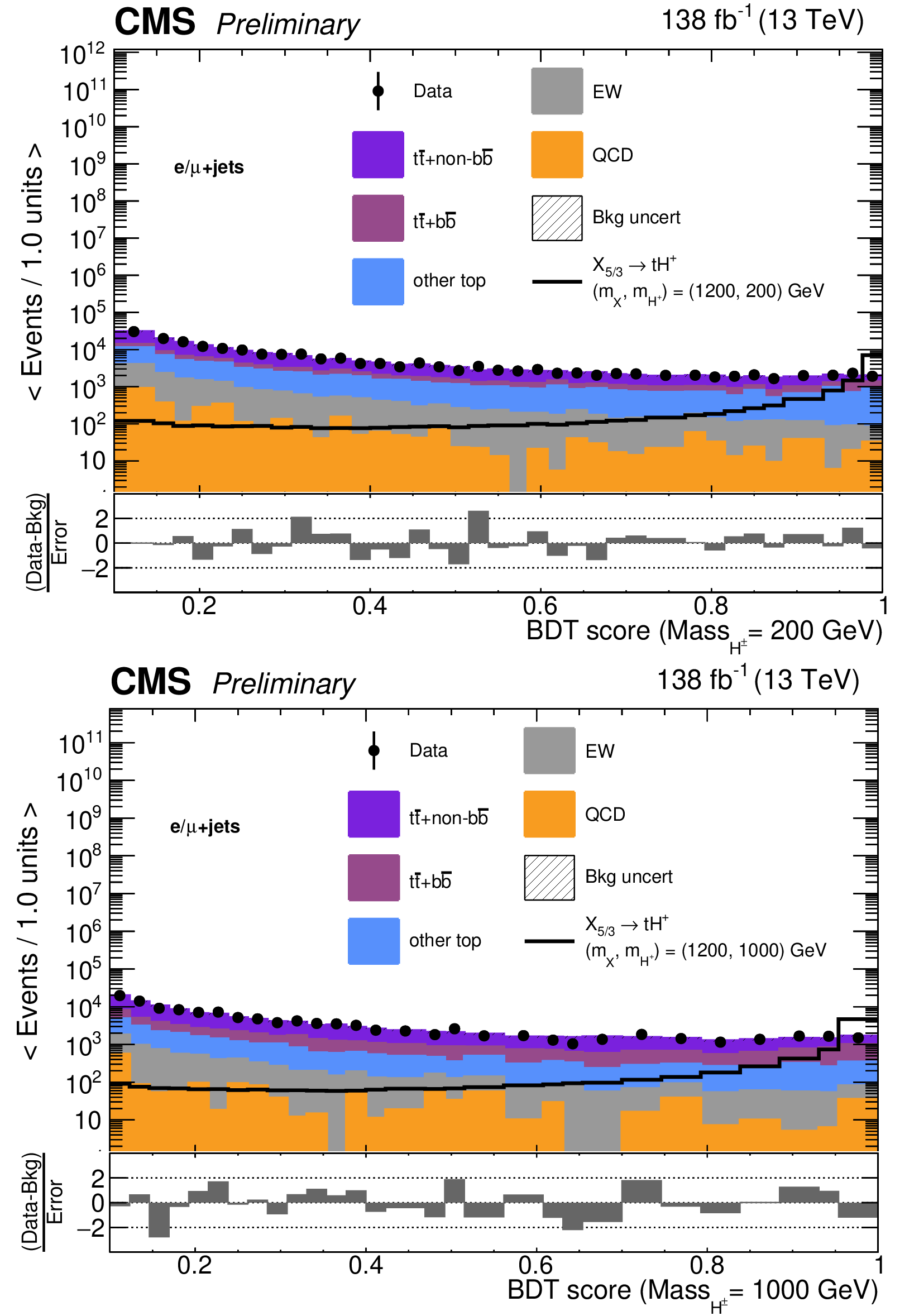
Post-fit distributions of the XGBOOST outputs for the $ \mathrm{X}_{5/3} \to \mathrm{t}\mathrm{\widetilde{H}^{\pm_j}} $ model with the lowest and highest $ \mathrm{\widetilde{H}^{\pm_j}} $ mass hypotheses, 200 and 1000 GeV, respectively, in data and simulation in the signal region after rebinning. The background contributions are shown after the fit to data, while the signal distributions are shown using the prefit predictions. The lower panels show the differences between the data and the background prediction, divided by the total uncertainty in the background prediction. |
png pdf |
Figure 5-a:
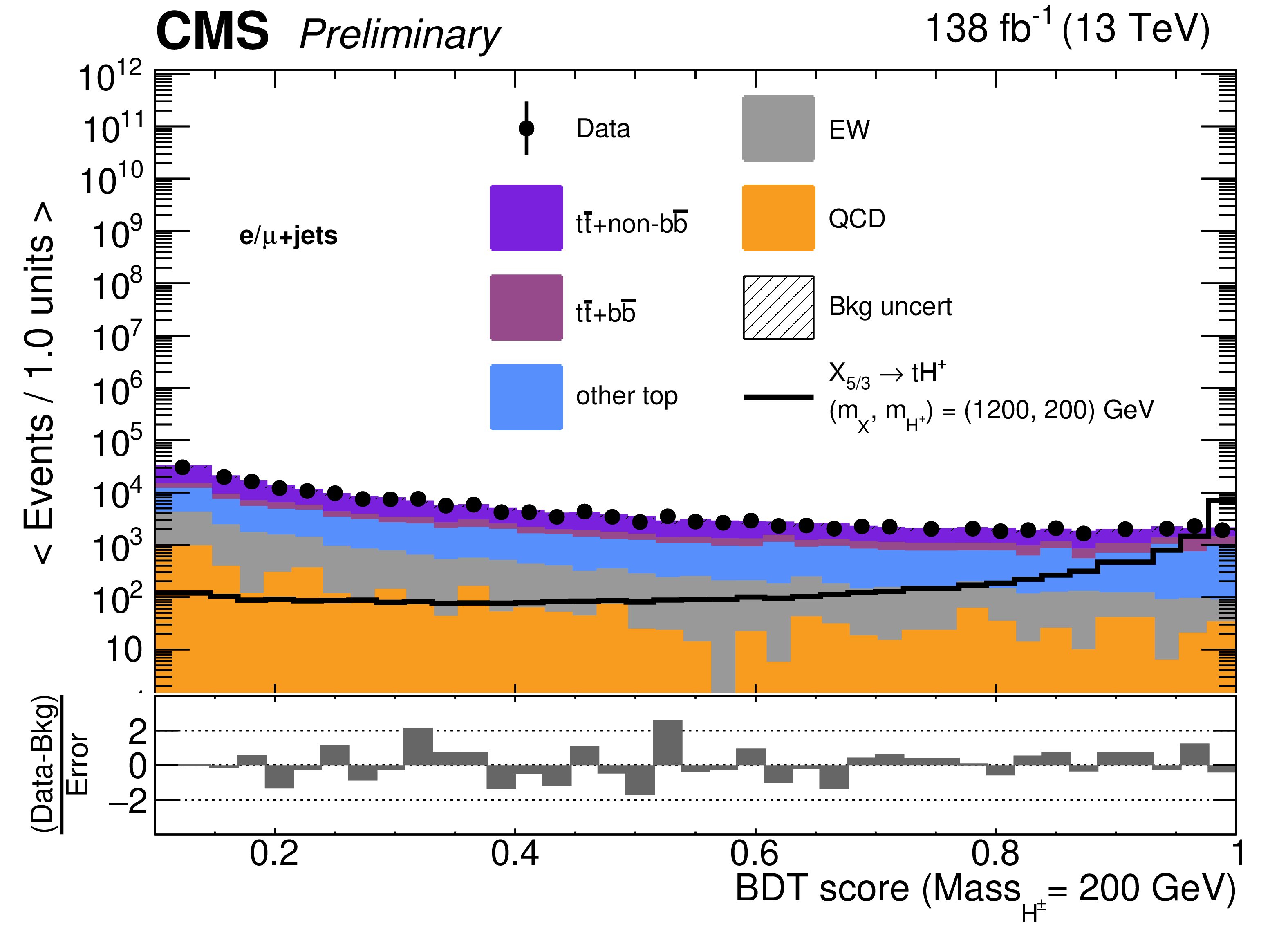
Post-fit distributions of the XGBOOST outputs for the $ \mathrm{X}_{5/3} \to \mathrm{t}\mathrm{\widetilde{H}^{\pm_j}} $ model with the lowest and highest $ \mathrm{\widetilde{H}^{\pm_j}} $ mass hypotheses, 200 and 1000 GeV, respectively, in data and simulation in the signal region after rebinning. The background contributions are shown after the fit to data, while the signal distributions are shown using the prefit predictions. The lower panels show the differences between the data and the background prediction, divided by the total uncertainty in the background prediction. |
png pdf |
Figure 5-b:
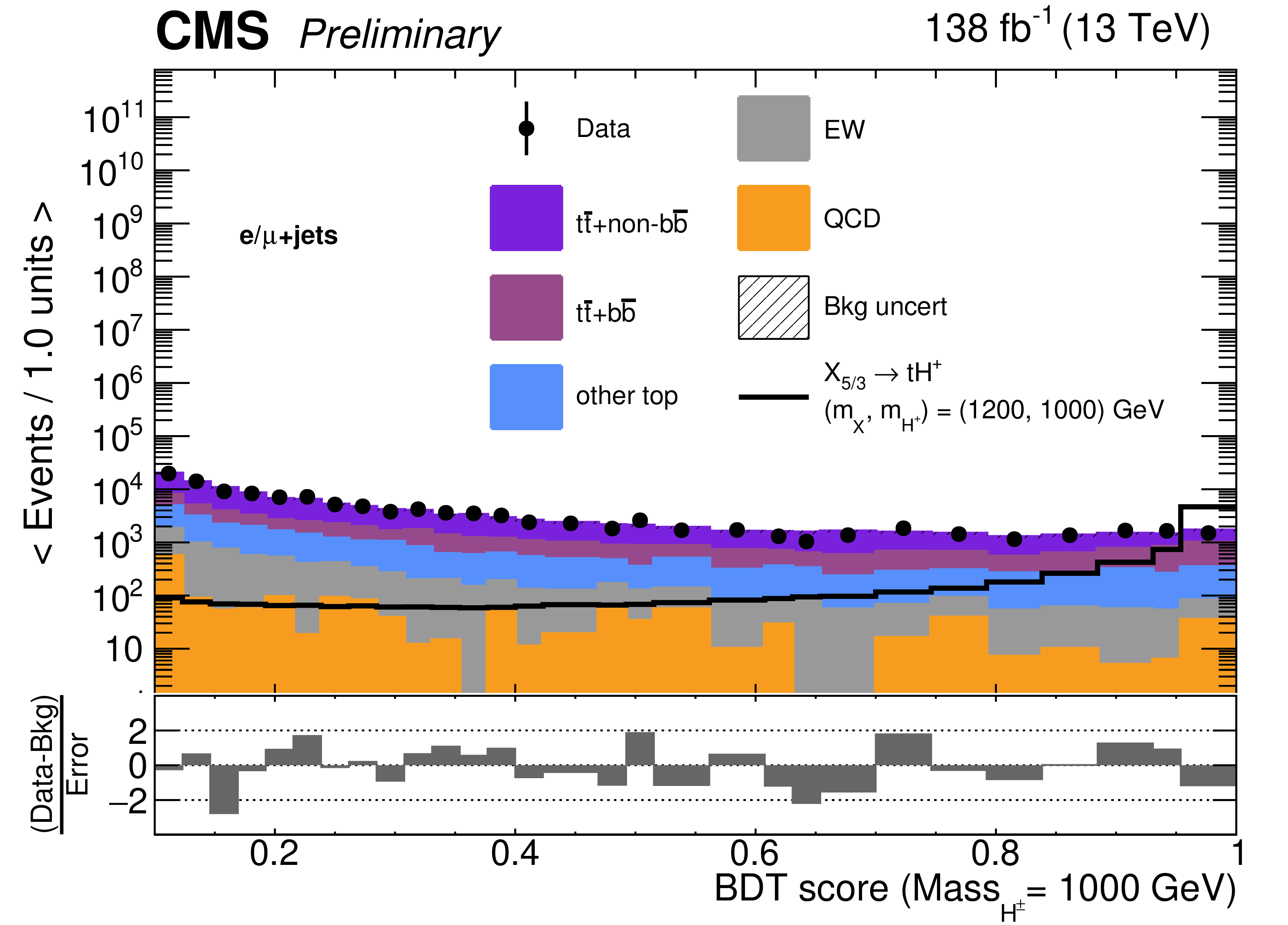
Post-fit distributions of the XGBOOST outputs for the $ \mathrm{X}_{5/3} \to \mathrm{t}\mathrm{\widetilde{H}^{\pm_j}} $ model with the lowest and highest $ \mathrm{\widetilde{H}^{\pm_j}} $ mass hypotheses, 200 and 1000 GeV, respectively, in data and simulation in the signal region after rebinning. The background contributions are shown after the fit to data, while the signal distributions are shown using the prefit predictions. The lower panels show the differences between the data and the background prediction, divided by the total uncertainty in the background prediction. |
png pdf |
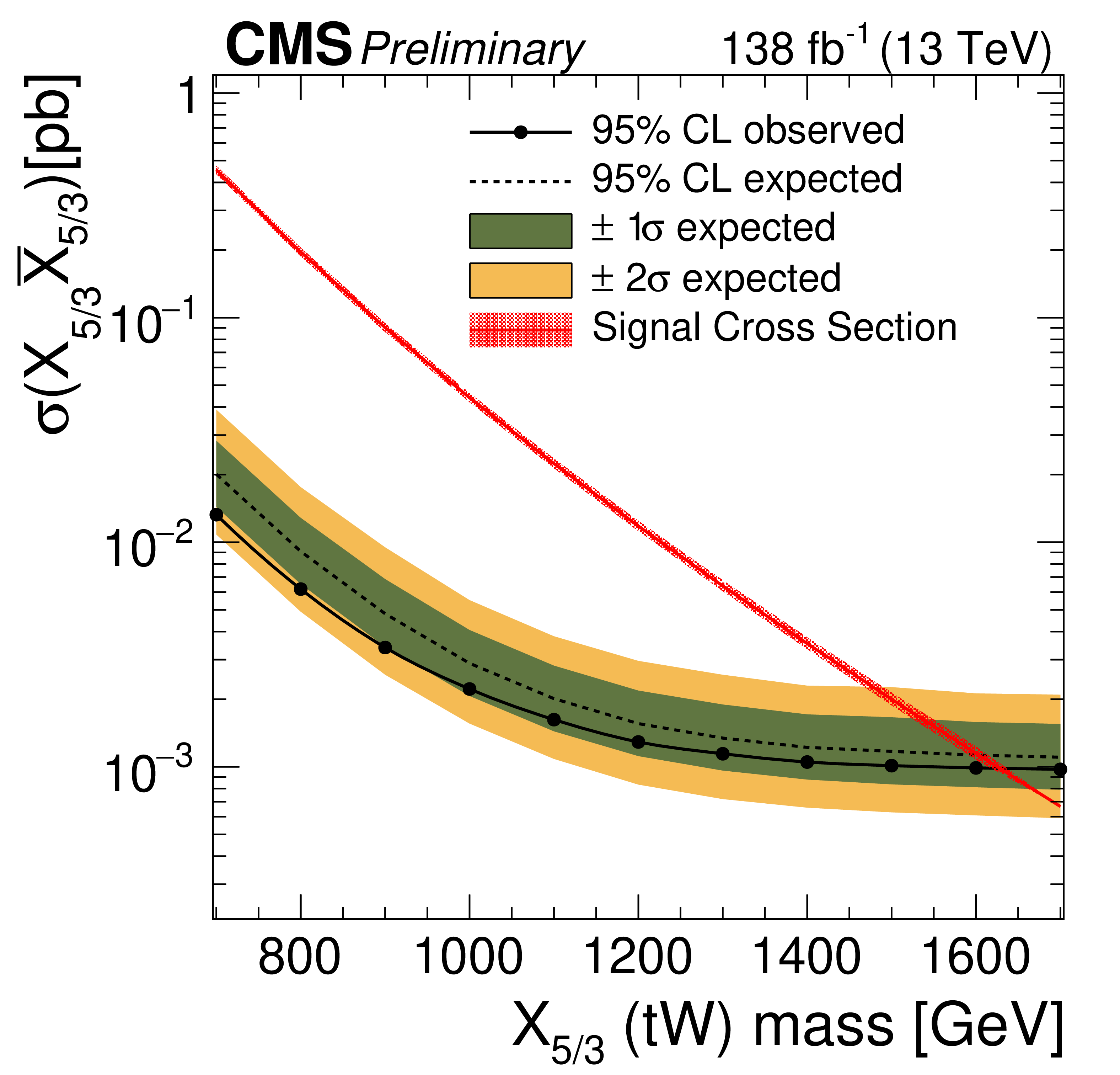
Figure 6:
Expected and observed upper limits on the $ \mathrm{X}_{5/3} $ pair production cross section for the combined 2016--2018 data set with an integrated luminosity of 138 fb$ ^{-1} $. The inner green and outer yellow bands indicate the regions containing 68 and 95%, respectively, of the distribution of limits expected under the background-only hypothesis. |
png pdf |
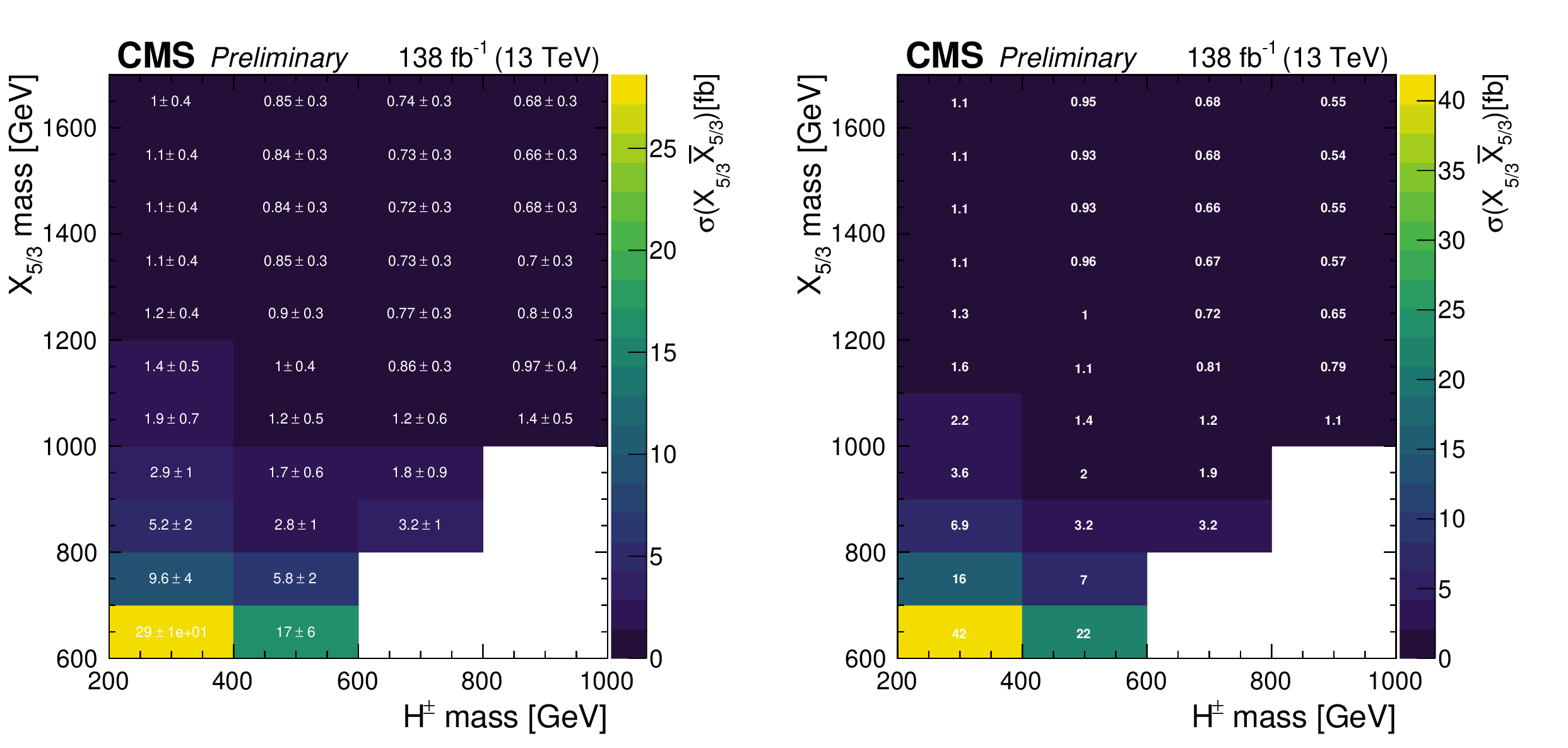
Figure 7:
Expected (left) and observed (right) 95% CL upper limits on the production cross section for pair-produced $ \mathrm{X}_{5/3} $ particles in the $ \mathrm{X}_{5/3} \to \mathrm{t}\mathrm{\widetilde{H}^{\pm_j}} $ model, shown as a function of the $ \mathrm{X}_{5/3} $ and $ \mathrm{\widetilde{H}^{\pm_j}} $ masses, for the combined 2016--2018 data set with an integrated luminosity of 138 fb$ ^{-1} $. The expected and observed lower limits on the $ \mathrm{X}_{5/3} $ mass are 1620--1690 and 1620--1740 GeV, respectively, for $ \mathrm{\widetilde{H}^{\pm_j}} $ masses between 200 and 1000 GeV. |
png pdf |
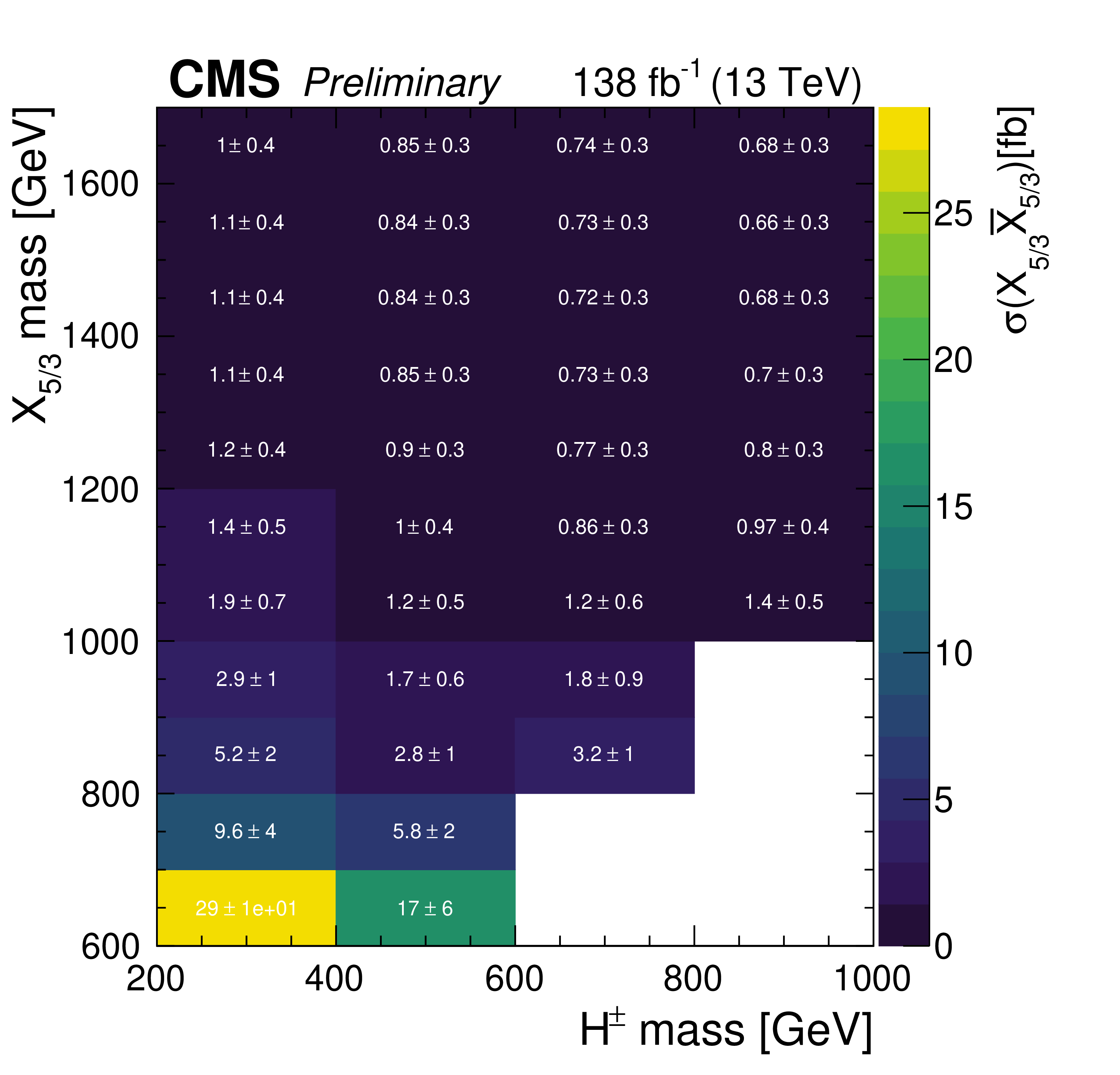
Figure 7-a:
Expected (left) and observed (right) 95% CL upper limits on the production cross section for pair-produced $ \mathrm{X}_{5/3} $ particles in the $ \mathrm{X}_{5/3} \to \mathrm{t}\mathrm{\widetilde{H}^{\pm_j}} $ model, shown as a function of the $ \mathrm{X}_{5/3} $ and $ \mathrm{\widetilde{H}^{\pm_j}} $ masses, for the combined 2016--2018 data set with an integrated luminosity of 138 fb$ ^{-1} $. The expected and observed lower limits on the $ \mathrm{X}_{5/3} $ mass are 1620--1690 and 1620--1740 GeV, respectively, for $ \mathrm{\widetilde{H}^{\pm_j}} $ masses between 200 and 1000 GeV. |
png pdf |
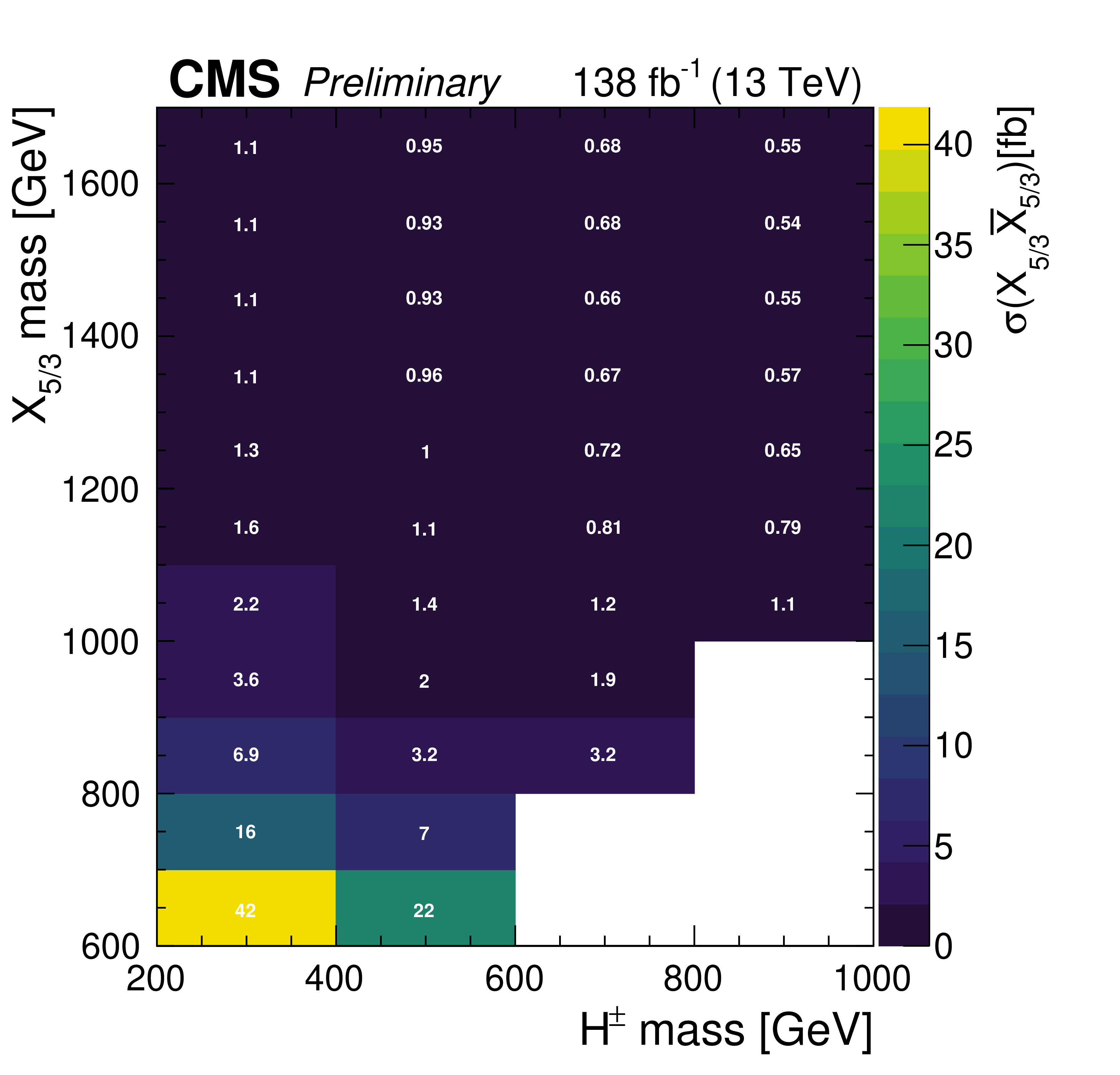
Figure 7-b:
Expected (left) and observed (right) 95% CL upper limits on the production cross section for pair-produced $ \mathrm{X}_{5/3} $ particles in the $ \mathrm{X}_{5/3} \to \mathrm{t}\mathrm{\widetilde{H}^{\pm_j}} $ model, shown as a function of the $ \mathrm{X}_{5/3} $ and $ \mathrm{\widetilde{H}^{\pm_j}} $ masses, for the combined 2016--2018 data set with an integrated luminosity of 138 fb$ ^{-1} $. The expected and observed lower limits on the $ \mathrm{X}_{5/3} $ mass are 1620--1690 and 1620--1740 GeV, respectively, for $ \mathrm{\widetilde{H}^{\pm_j}} $ masses between 200 and 1000 GeV. |
| Tables | |
png pdf |
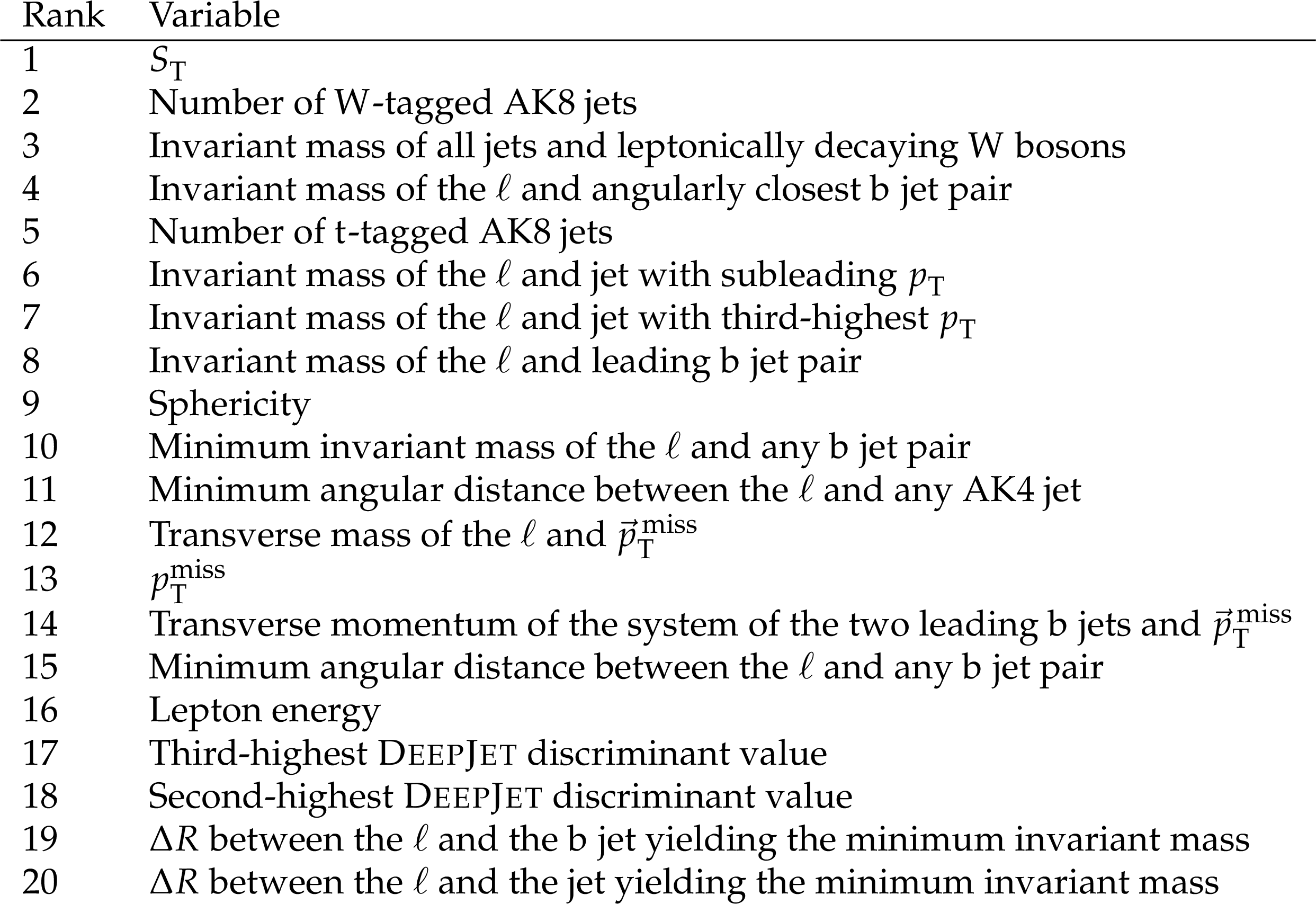
Table 1:
Ranking of input variables for the BDT trained on the 2017 data set using signal samples with an $ \mathrm{X}_{5/3} $ mass of 1300 GeV. The ranking is based on the gain metric from XGBOOST. |
png pdf |
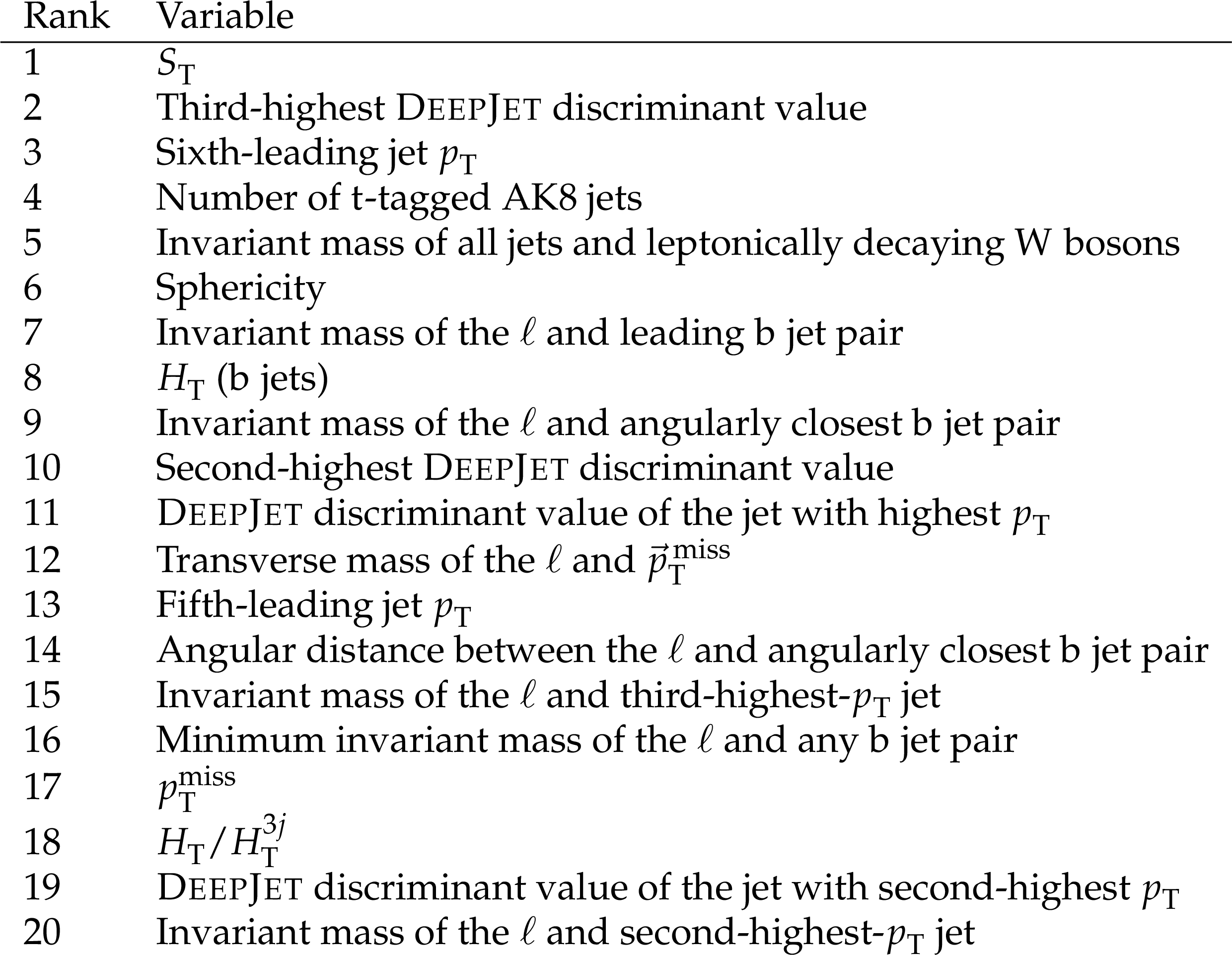
Table 2:
Ranking of input variables for the BDT trained on the 2017 data set using signal samples with an $ \mathrm{X}_{5/3} $ mass of 1200 GeV and a $ \mathrm{\widetilde{H}^{\pm_j}} $ mass of 200 GeV. The ranking is based on the gain metric from XGBOOST. |
png pdf |
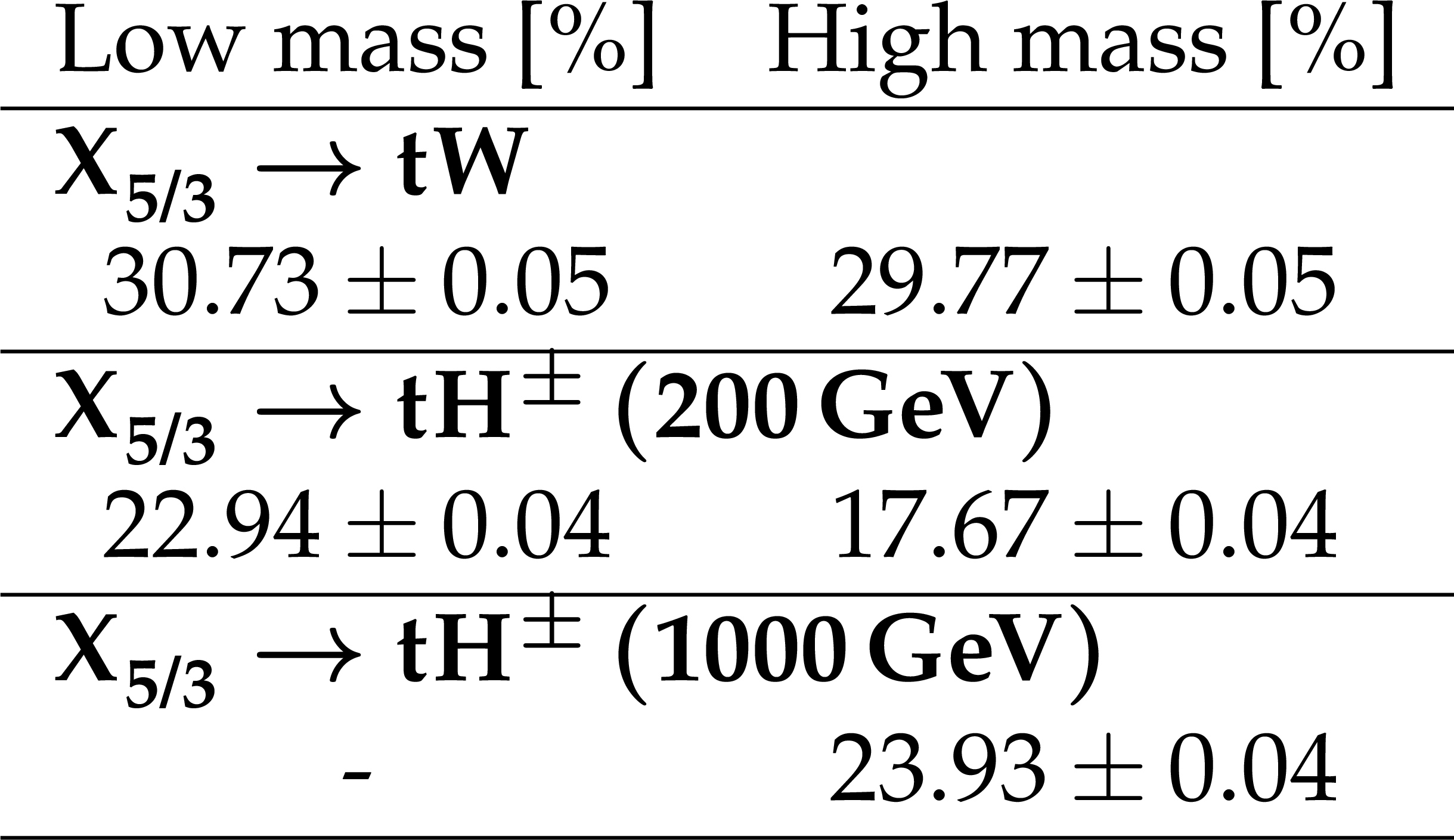
Table 3:
Signal selection efficiencies for the SM and BSM decay modes, defined as the ratio of the number of signal events passing the final event selection to the total number of generated events in the simulated signal sample. |
png pdf |
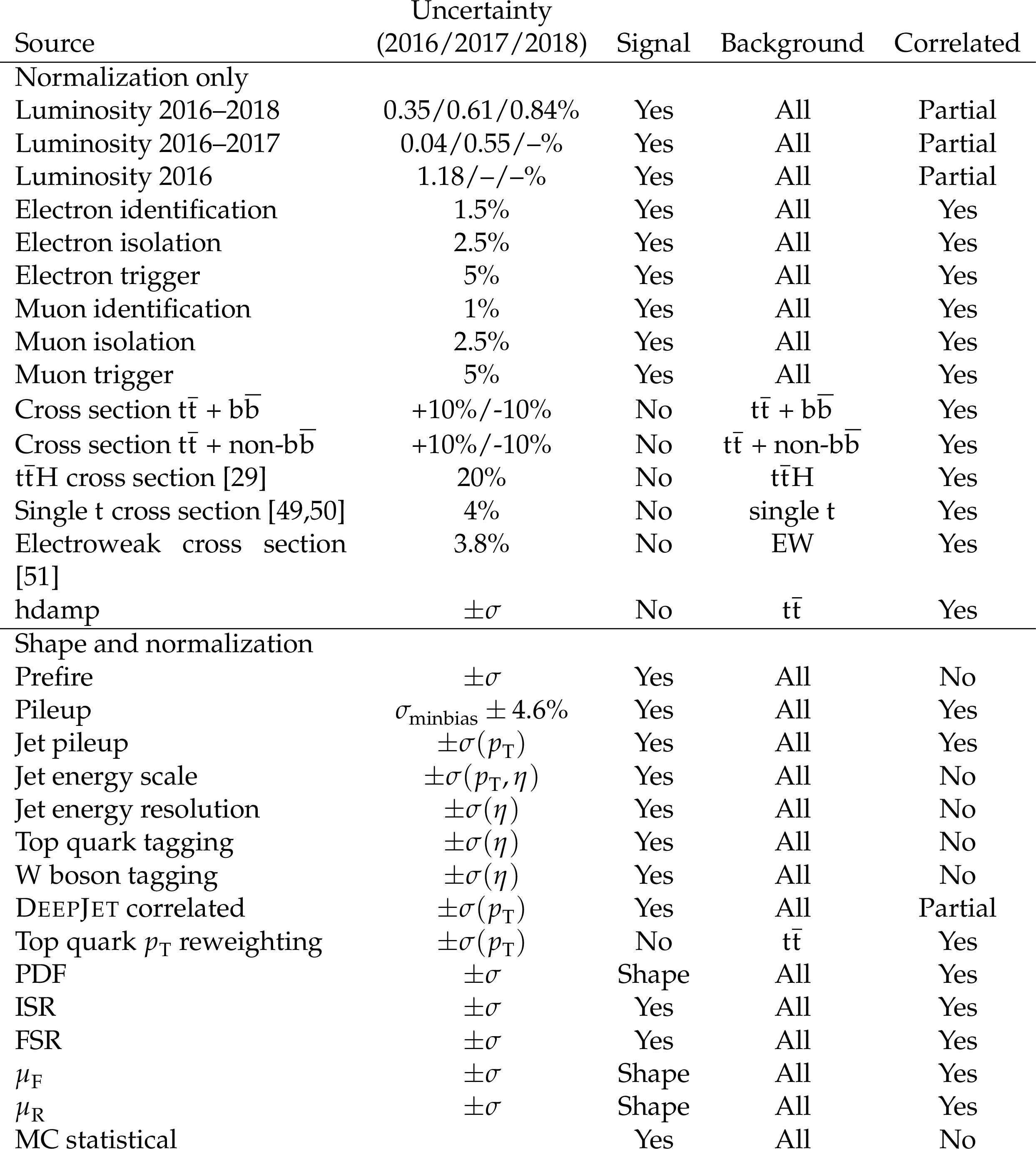
Table 4:
Summary of the systematic uncertainties considered, where one standard deviation is denoted by $ \sigma $. Uncertainties labeled as ``Shape'' correspond to variations whose templates are normalized to the total yield and therefore affect only the distribution shape. |
| Summary |
| An analysis setting the most stringent limits to date on the pair production of heavy partners of the top quark with an exotic electric charge of 5/3 times the charge of the positron ($ \mathrm{X}_{5/3} $) has been presented. The $ \mathrm{X}_{5/3} $ is assumed to decay either into a top quark and a W boson, or into a top quark and a charged Higgs boson ($ \mathrm{\widetilde{H}^{\pm_j}} $). The $ \mathrm{\widetilde{H}^{\pm_j}} $ subsequently decays into a top quark and a bottom quark. The search uses proton-proton collision data collected during 2016--2018 at a center-of-mass energy of 13 TeV, corresponding to an integrated luminosity of 138 fb$ ^{-1} $. Only the single-lepton final state is considered, where the lepton is either an electron or a muon. Upper limits on the $ \mathrm{X}_{5/3} $ pair production cross section are set at 95% confidence level using a multivariate discriminant. No significant excess of data events over the standard model expectation is observed. The expected and observed exclusion ranges of the $ \mathrm{X}_{5/3} $ mass extend up to 1600 and 1630 GeV, respectively, in the decay mode to a top quark and a W boson. In the decay mode to a top quark and a $ \mathrm{\widetilde{H}^{\pm_j}} $, $ \mathrm{X}_{5/3} $ masses in the ranges 1620--1690 and 1620--1740 GeV are excluded at 95% confidence level for the expected and observed limits, respectively, for $ \mathrm{\widetilde{H}^{\pm_j}} $ masses between 200 and 1000 GeV. The interpretation in the $ \mathrm{X}_{5/3} \to \mathrm{t}\mathrm{\widetilde{H}^{\pm_j}} $ decay chain is restricted to simulated mass points satisfying the kinematic condition $ m_{\mathrm{X}_{5/3}} > m_{\mathrm{\widetilde{H}^{\pm_j}}} + m_{\mathrm{t}} $, and no interpolation between mass hypotheses is performed. This work also presents the first set of limits for the search for the $ \mathrm{X}_{5/3} $ decaying into a top quark and a $ \mathrm{\widetilde{H}^{\pm_j}} $. \newpage |
| References | ||||
| 1 | R. Contino, L. Da Rold, and A. Pomarol | Light custodians in natural composite Higgs models | PRD 75 (2007) 055014 | hep-ph/0612048 |
| 2 | R. Contino, T. Kramer, M. Son, and R. Sundrum | Warped/composite phenomenology simplified | JHEP 05 (2007) 074 | hep-ph/0612180 |
| 3 | O. Matsedonskyi, G. Panico, and A. Wulzer | Light top partners for a light composite Higgs | JHEP 01 (2013) 164 | 1204.6333 |
| 4 | CMS Collaboration | Search for top quark partners with charge 5/3 in the same-sign dilepton and single-lepton final states in proton-proton collisions at $ \sqrt{s}= $ 13 TeV | JHEP 03 (2019) 082 | 1810.03188 |
| 5 | CMS Collaboration | Search for single production of vector-like quarks decaying to a top quark and a W boson in proton-proton collisions at $ \sqrt{s} = $ 13 TeV | EPJC 79 (2019) 90 | 1809.08597 |
| 6 | ATLAS Collaboration | Search for pair-produced vector-like top and bottom partners in events with large missing transverse momentum in pp collisions with the ATLAS detector | EPJC 83 (2023) 719 | 2212.05263 |
| 7 | A. De Simone, O. Matsedonskyi, R. Rattazzi, and A. Wulzer | A first top partner hunter's guide | JHEP 04 (2013) 004 | 1211.5663 |
| 8 | G. Cacciapaglia et al. | Heavy vector-like quark with charge 5/3 at the LHC | JHEP 03 (2013) 004 | 1211.4034 |
| 9 | J. Salko | Characterisation of models of new physics at the LHC | Master's thesis, Uppsala University, High Energy Physics, 2020 | |
| 10 | CMS Collaboration | The CMS experiment at the CERN LHC | JINST 3 (2008) S08004 | 0803.4070 |
| 11 | CMS Collaboration | Development of the CMS detector for the CERN LHC Run 3 | JINST 19 (2024) P05064 | 2312.07859 |
| 12 | CMS Collaboration | Performance of the CMS Level-1 trigger in proton-proton collisions at $ \sqrt{s} = $ 13 TeV | JINST 15 (2020) P10017 | CMS-TRG-17-001 2006.10165 |
| 13 | CMS Collaboration | The CMS trigger system | JINST 12 (2017) P01020 | CMS-TRG-12-001 1609.02366 |
| 14 | CMS Collaboration | Performance of the CMS high-level trigger during LHC Run 2 | JINST 19 (2024) P11021 | CMS-TRG-19-001 2410.17038 |
| 15 | CMS Collaboration | Performance of the CMS muon detector and muon reconstruction with proton-proton collisions at $ \sqrt{s}= $ 13 TeV | JINST 13 (2018) P06015 | CMS-MUO-16-001 1804.04528 |
| 16 | CMS Collaboration | Electron and photon reconstruction and identification with the CMS experiment at the CERN LHC | JINST 16 (2021) P05014 | CMS-EGM-17-001 2012.06888 |
| 17 | CMS Collaboration | Description and performance of track and primary-vertex reconstruction with the CMS tracker | JINST 9 (2014) P10009 | CMS-TRK-11-001 1405.6569 |
| 18 | P. Nason | A new method for combining NLO QCD with shower Monte Carlo algorithms | JHEP 11 (2004) 040 | hep-ph/0409146 |
| 19 | S. Frixione, P. Nason, and C. Oleari | Matching NLO QCD computations with parton shower simulations: the POWHEG method | JHEP 11 (2007) 070 | 0709.2092 |
| 20 | S. Alioli, P. Nason, C. Oleari, and E. Re | A general framework for implementing NLO calculations in shower Monte Carlo programs: the POWHEG BOX | JHEP 06 (2010) 043 | 1002.2581 |
| 21 | S. Alioli, S.-O. Moch, and P. Uwer | Hadronic top-quark pair-production with one jet and parton showering | JHEP 01 (2012) 137 | 1110.5251 |
| 22 | J. Alwall et al. | The automated computation of tree-level and next-to-leading order differential cross sections, and their matching to parton shower simulations | JHEP 07 (2014) 079 | 1405.0301 |
| 23 | R. Frederix and S. Frixione | Merging meets matching in MC@NLO | JHEP 12 (2012) 061 | 1209.6215 |
| 24 | M. L. Mangano, M. Moretti, F. Piccinini, and M. Treccani | Matching matrix elements and shower evolution for top-quark production in hadronic collisions | JHEP 01 (2007) 013 | hep-ph/0611129 |
| 25 | NNPDF Collaboration | Parton distributions from high-precision collider data | EPJC 77 (2017) 663 | 1706.00428 |
| 26 | CMS Collaboration | Extraction and validation of a new set of CMS PYTHIA8 tunes from underlying-event measurements | EPJC 80 (2020) 4 | CMS-GEN-17-001 1903.12179 |
| 27 | \GEANTfour Collaboration | $ GEANT $ 4 --- a simulation toolkit | NIM A 506 (2003) 250 | |
| 28 | T. Je \v z o, J. M. Lindert, N. Moretti, and S. Pozzorini | New NLOPS predictions for $ t \bar{t} +b $ -jet production at the LHC | EPJC 78 (2018) 502 | 1802.00426 |
| 29 | M. Czakon and A. Mitov | Top++: a program for the calculation of the top-pair cross-section at hadron colliders | Comput. Phys. Commun. 185 (2014) 2930 | 1112.5675 |
| 30 | M. Czakon, P. Fiedler, and A. Mitov | Total top-quark pair-production cross section at hadron colliders through $ \mathcal{O}(\alpha_s^4) $ | PRL 110 (2013) 252004 | 1303.6254 |
| 31 | CMS Collaboration | Particle-flow reconstruction and global event description with the CMS detector | JINST 12 (2017) P10003 | CMS-PRF-14-001 1706.04965 |
| 32 | CMS Collaboration | Technical proposal for the Phase-II upgrade of the Compact Muon Solenoid | CMS Technical Proposal CERN-LHCC-2015-010, CMS-TDR-15-02, 2015 link |
|
| 33 | CMS Collaboration | Performance of missing transverse momentum reconstruction in proton-proton collisions at $ \sqrt{s} = $ 13 TeV using the CMS detector | JINST 14 (2019) P07004 | CMS-JME-17-001 1903.06078 |
| 34 | CMS Collaboration | Performance of electron reconstruction and selection with the CMS detector in proton-proton collisions at $ \sqrt{s}= $ 8 TeV | JINST 10 (2015) P06005 | CMS-EGM-13-001 1502.02701 |
| 35 | CMS Collaboration | Performance of CMS muon reconstruction in $ pp $ collision events at $ \sqrt{s}= $ 7 TeV | JINST 7 (2012) P10002 | CMS-MUO-10-004 1206.4071 |
| 36 | M. Cacciari, G. P. Salam, and G. Soyez | The anti-$ k_{\mathrm{T}} $ jet clustering algorithm | JHEP 04 (2008) 063 | 0802.1189 |
| 37 | M. Cacciari, G. P. Salam, and G. Soyez | FastJet user manual | EPJC 72 (2012) 1896 | 1111.6097 |
| 38 | CMS Collaboration | Pileup mitigation at CMS in 13 TeV data | JINST 15 (2020) P09018 | CMS-JME-18-001 2003.00503 |
| 39 | D. Bertolini, P. Harris, M. Low, and N. Tran | Pileup per particle identification | JHEP 10 (2014) 059 | 1407.6013 |
| 40 | CMS Collaboration | Jet energy scale and resolution in the CMS experiment in pp collisions at 8 TeV | JINST 12 (2017) P02014 | CMS-JME-13-004 1607.03663 |
| 41 | E. Bols et al. | Jet flavour classification using DeepJet | JINST 15 (2020) P12012 | 2008.10519 |
| 42 | CMS Collaboration | Identification of heavy-flavour jets with the CMS detector in pp collisions at 13 TeV | JINST 13 (2018) P05011 | CMS-BTV-16-002 1712.07158 |
| 43 | CMS Collaboration | Performance of the DeepJet b tagging algorithm using 41.9/fb of data from proton-proton collisions at 13 TeV with Phase 1 CMS detector | CMS Detector Performance Summary CMS-DP-2018-058, 2018 CDS |
|
| 44 | H. Qu and L. Gouskos | ParticleNet: jet tagging via particle clouds | PRD 101 (2020) 056019 | 1902.08570 |
| 45 | T. Chen and C. Guestrin | XGBoost: a scalable tree boosting system | link | 1603.02754 |
| 46 | CMS Collaboration | Precision luminosity measurement in proton-proton collisions at $ \sqrt{s} = $ 13 TeV in 2015 and 2016 at CMS | EPJC 81 (2021) 800 | CMS-LUM-17-003 2104.01927 |
| 47 | CMS Collaboration | Measurements of $ \mathrm{t\overline{t}} $ differential cross sections in proton-proton collisions at $ \sqrt{s}= $ 13 TeV using events containing two leptons | JHEP 02 (2019) 149 | CMS-TOP-17-014 1811.06625 |
| 48 | W. S. Cleveland and S. J. Devlin | Locally weighted regression: an approach to regression analysis by local fitting | J. Am. Stat. Assoc. 83 (1988) 596 | |
| 49 | P. Kant et al. | HatHor for single top-quark production: updated predictions and uncertainty estimates for single top-quark production in hadronic collisions | Comput. Phys. Commun. 191 (2015) 74 | 1406.4403 |
| 50 | M. Aliev et al. | HATHOR: HAdronic Top and Heavy quarks crOss section calculatoR | Comput. Phys. Commun. 182 (2011) 1034 | 1007.1327 |
| 51 | J. M. Campbell and F. Tramontano | Next-to-leading order corrections to Wt production and decay | NPB 726 (2005) 109 | hep-ph/0506289 |
| 52 | G. Cowan, K. Cranmer, E. Gross, and O. Vitells | Asymptotic formulae for likelihood-based tests of new physics | [Erratum: Eur. Phys. J. C73, 2501 (), doi:10.1140/epjc/s2-013-2501-z], 2011 EPJC 71 (2011) 1554 |
1007.1727 |
| 53 | T. Junk | Confidence level computation for combining searches with small statistics | NIM A 434 (1999) 435 | hep-ex/9902006 |
| 54 | A. L. Read | Presentation of search results: the CL$ _{\text{s}} $ technique | JPG 28 (2002) 2693 | |
| 55 | CMS Collaboration | The CMS statistical analysis and combination tool: Combine | Comput. Softw. Big Sci. 8 (2024) 19 | CMS-CAT-23-001 2404.06614 |
| 56 | W. Verkerke and D. P. Kirkby | The RooFit toolkit for data modeling | eConf MOLT007, 2003 link |
physics/0306116 |
| 57 | L. Moneta et al. | The RooStats project | PoS 05 (2010) 7 | 1009.1003 |
|
|
Compact Muon Solenoid LHC, CERN |

|
|
|
|
|
|