Compact Muon Solenoid
LHC, CERN
 Visit us: CMS Public Website, CMS Physics ;
Contact us: CMS Publications Committee
Visit us: CMS Public Website, CMS Physics ;
Contact us: CMS Publications Committee
| CMS-PAS-HIN-25-016 | ||
| Transverse-momentum differential radial flow fluctuations across collision systems with CMS | ||
| CMS Collaboration | ||
| 2026-07-07 | ||
| Abstract: Event-by-event fluctuations of the mean transverse momentum carry direct information about collective radial expansion. The first measurement of transverse-momentum-dependent radial flow fluctuations, characterized by the observable $ v_{0}(p_{\mathrm{T}}) $, is presented for small collision systems. The measurement is performed using data from pp collisions at $ \sqrt{s}= $ 13 TeV, pPb collisions at $ \sqrt{s_{\mathrm{NN}}}= $ 8.16 TeV, and OO and NeNe collisions at $ \sqrt{s_{\mathrm{NN}}}= $ 5.36 TeV, all recorded by the CMS experiment at the CERN LHC. A two-particle correlation technique with a pseudorapidity gap is used to suppress short-range nonflow contributions. After normalization by the integrated radial flow magnitude, $ v_{0} $, the shape of $ v_{0}(p_{\mathrm{T}})/v_{0} $ as a function of $ p_{\mathrm{T}}/\langle p_{\mathrm{T}}\rangle $ is found to be approximately independent of multiplicity in all intervals with $ N_{\mathrm{trk}}^{\mathrm{offline}} \geq $ 20 in pp, pPb, OO, and NeNe collisions. The lowest multiplicity interval, 10 $ \leq N_{\mathrm{trk}}^{\mathrm{offline}} < $ 20, deviates from this common shape in all four systems. The measured $ v_{0}(p_{\mathrm{T}})/v_{0} $ is compared with hydrodynamic predictions based on TRENTO+MUSIC initial conditions for pp, pPb, OO, and NeNe collisions. Qualitative agreement is observed across all four systems up to $ p_{\mathrm{T}}/\langle p_{\mathrm{T}}\rangle \approx $ 2.5. The results are also compared with predictions from nonthermal event generators, PYTHIA and HIJING, which underpredict the magnitude of the correlation observed in data. | ||
| Links: CDS record (PDF) ; CADI line (restricted) ; | ||
| Figures | |
png pdf |
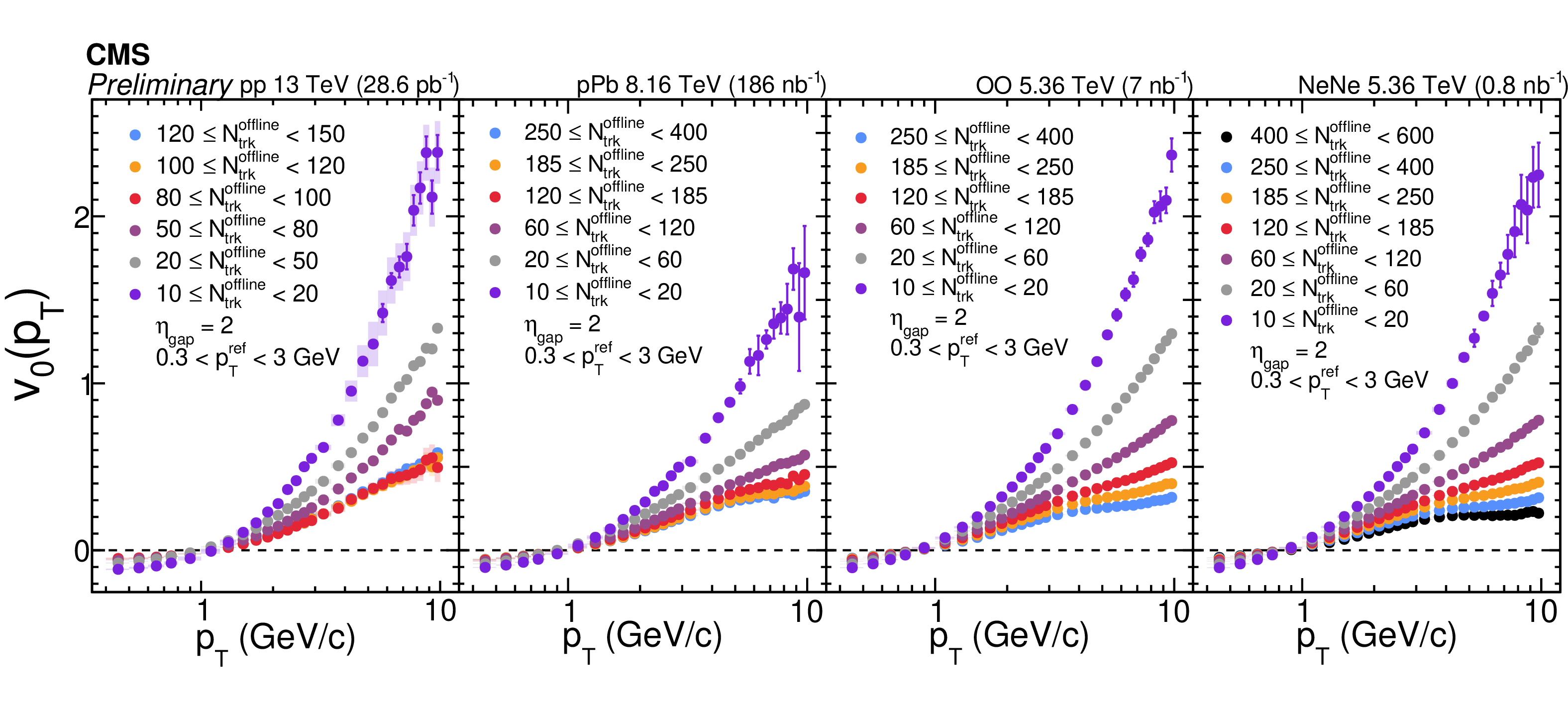
Figure 1:
The observable $ v_{0}(p_{\mathrm{T}}) $ for pp, $ \mathrm{p}\mathrm{Pb} $, OO, and NeNe collisions in different $ N_\text{trk}^\text{offline} $ intervals. The vertical bars represent the statistical uncertainties, and the boxes represent the systematic uncertainties. |
png pdf |
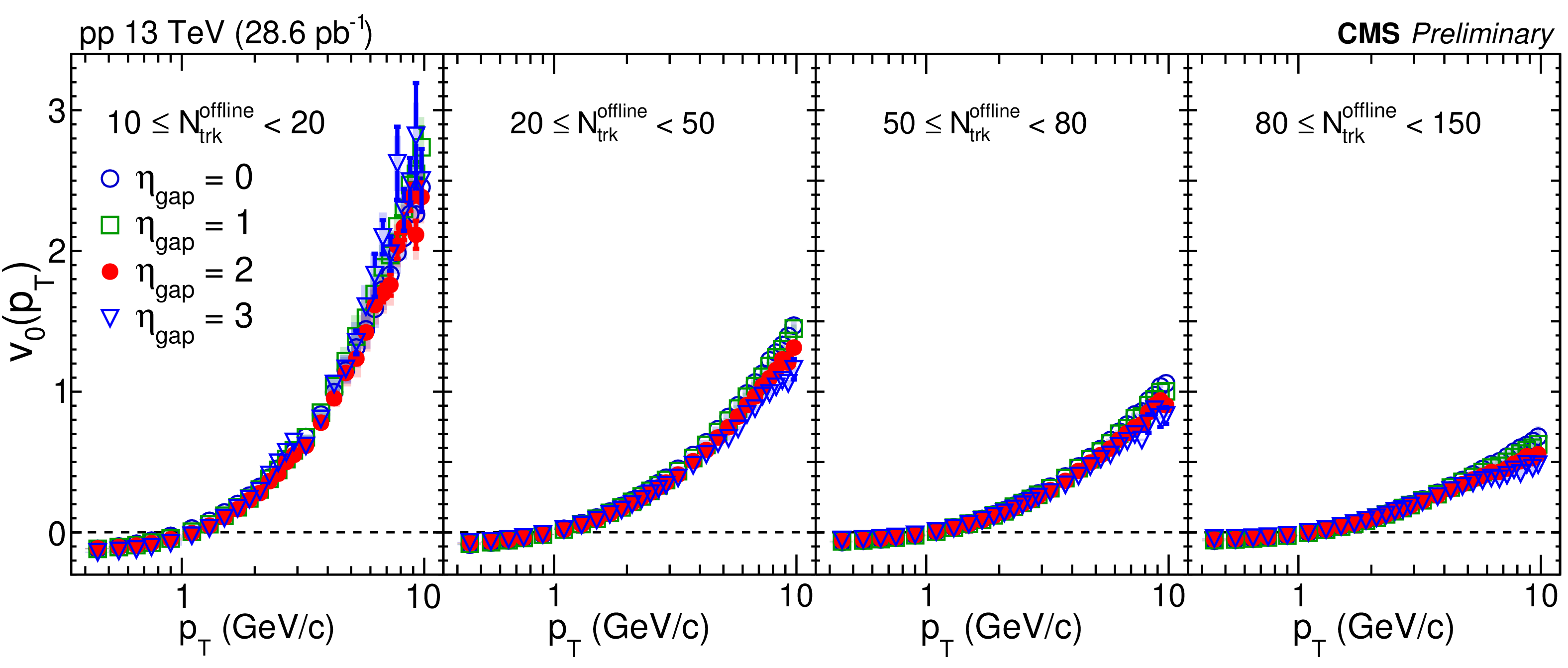
Figure 2:
The observable $ v_{0}(p_{\mathrm{T}}) $ in pp collisions for different values of $ \eta_\text{gap} $ and in different $ N_\text{trk}^\text{offline} $ intervals. |
png pdf |
Figure 3:
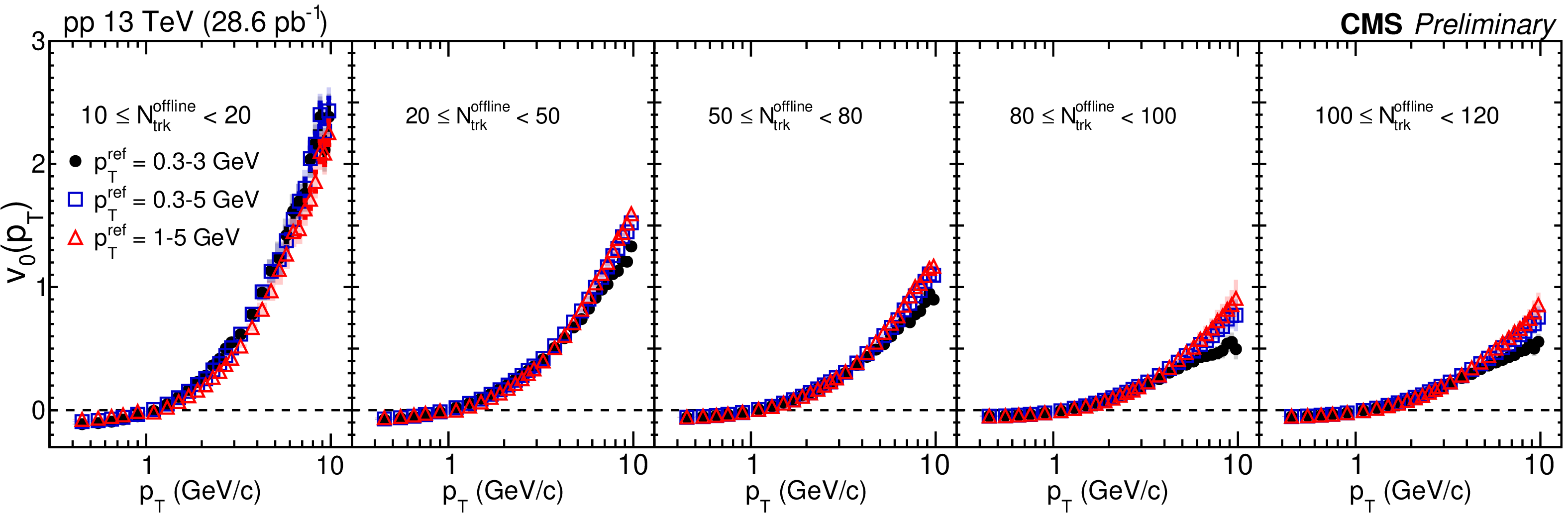
The observable $ v_{0}(p_{\mathrm{T}}) $ in pp collisions for three different reference $ p_{\mathrm{T}} $ ranges and in different $ N_\text{trk}^\text{offline} $ intervals. |
png pdf |
Figure 4:
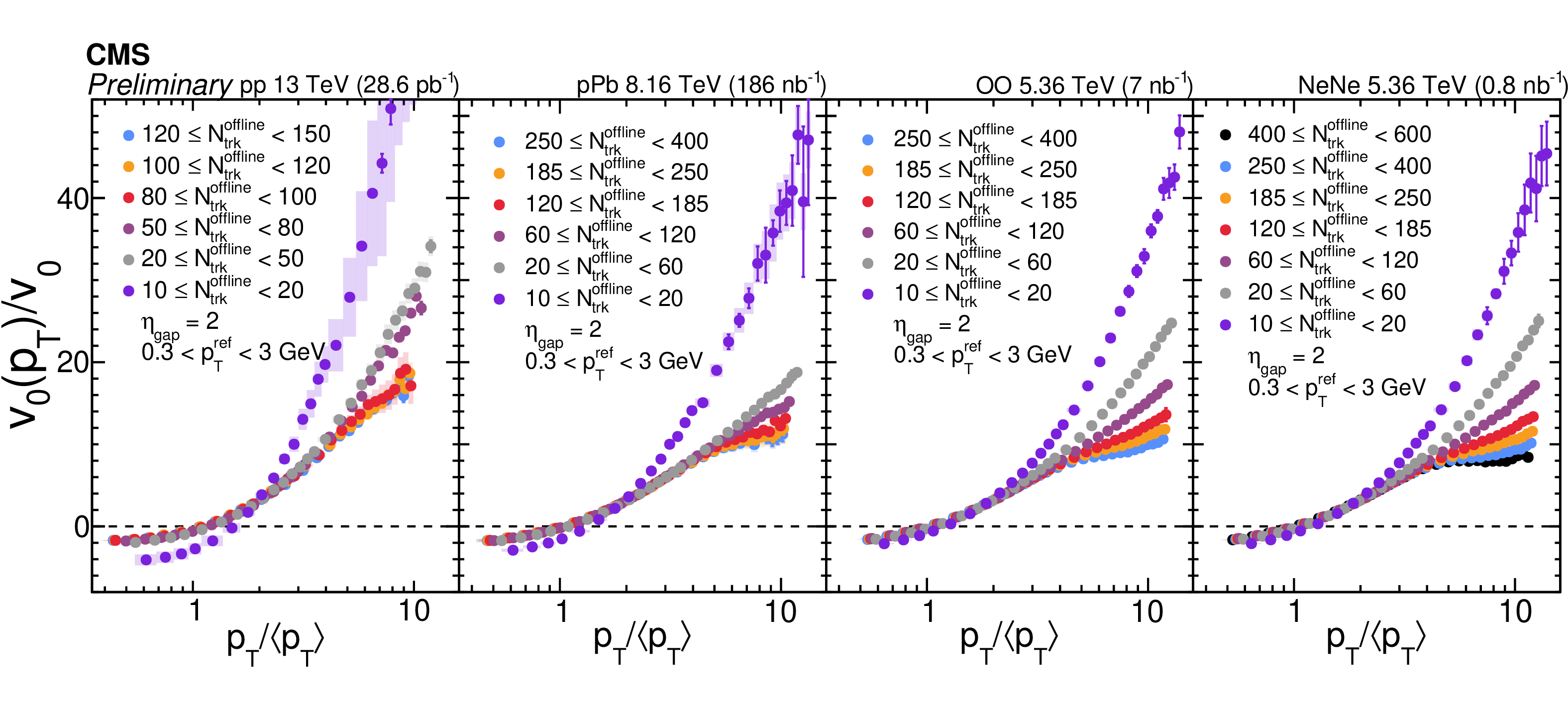
The normalized observable $ v_{0}(p_{\mathrm{T}})/v_{0} $ as a function of $ p_{\mathrm{T}}/\langle p_{\mathrm{T}}\rangle $ in different $ N_\text{trk}^\text{offline} $ intervals for pp, $ \mathrm{p}\mathrm{Pb} $, OO, and NeNe collisions. The vertical bars represent the statistical uncertainties, and the boxes represent the systematic uncertainties. The larger systematic uncertainties relative to those in Fig. 1 arise primarily from the $ v_0 $ normalization term, which has systematic uncertainties of up to 10% and 6% in pp and $ \mathrm{p}\mathrm{Pb} $ collisions, respectively. |
png pdf |
Figure 5:
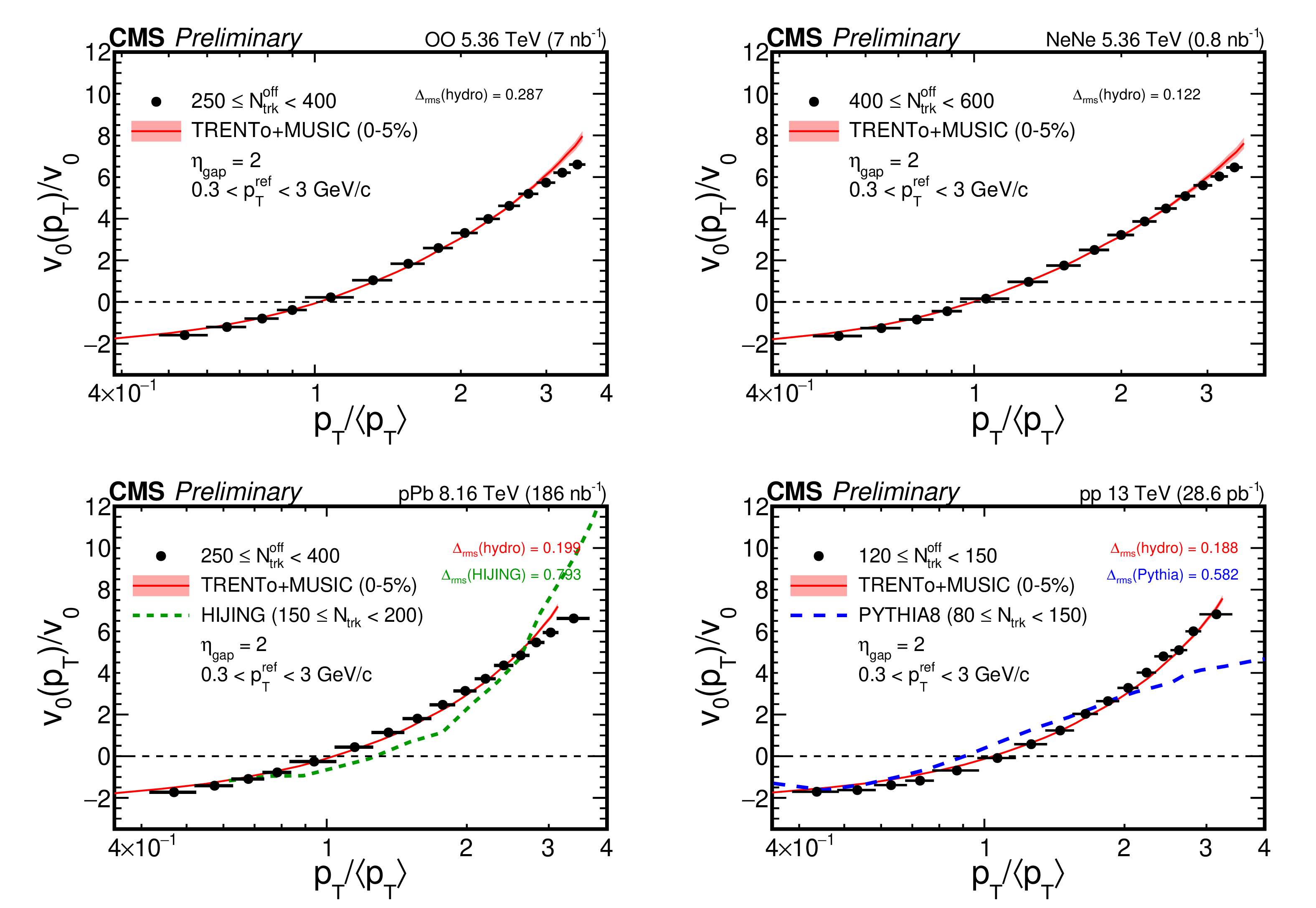
The normalized observable $ v_{0}(p_{\mathrm{T}})/v_{0} $ as a function of $ p_{\mathrm{T}}/\langle p_{\mathrm{T}}\rangle $ in the highest multiplicity interval, compared with hydrodynamic predictions based on TRENTO+MUSIC [40]. Results are shown for OO (upper left), NeNe (upper right), $ \mathrm{p}\mathrm{Pb} $ (lower left), and pp (lower right) collisions. The vertical bars and open boxes represent the statistical and systematic uncertainties, respectively. The shaded band represents the model uncertainty. Comparisons with HIJING and PYTHIA are also shown for $ \mathrm{p}\mathrm{Pb} $ and pp collisions, respectively. |
png pdf |
Figure 6:
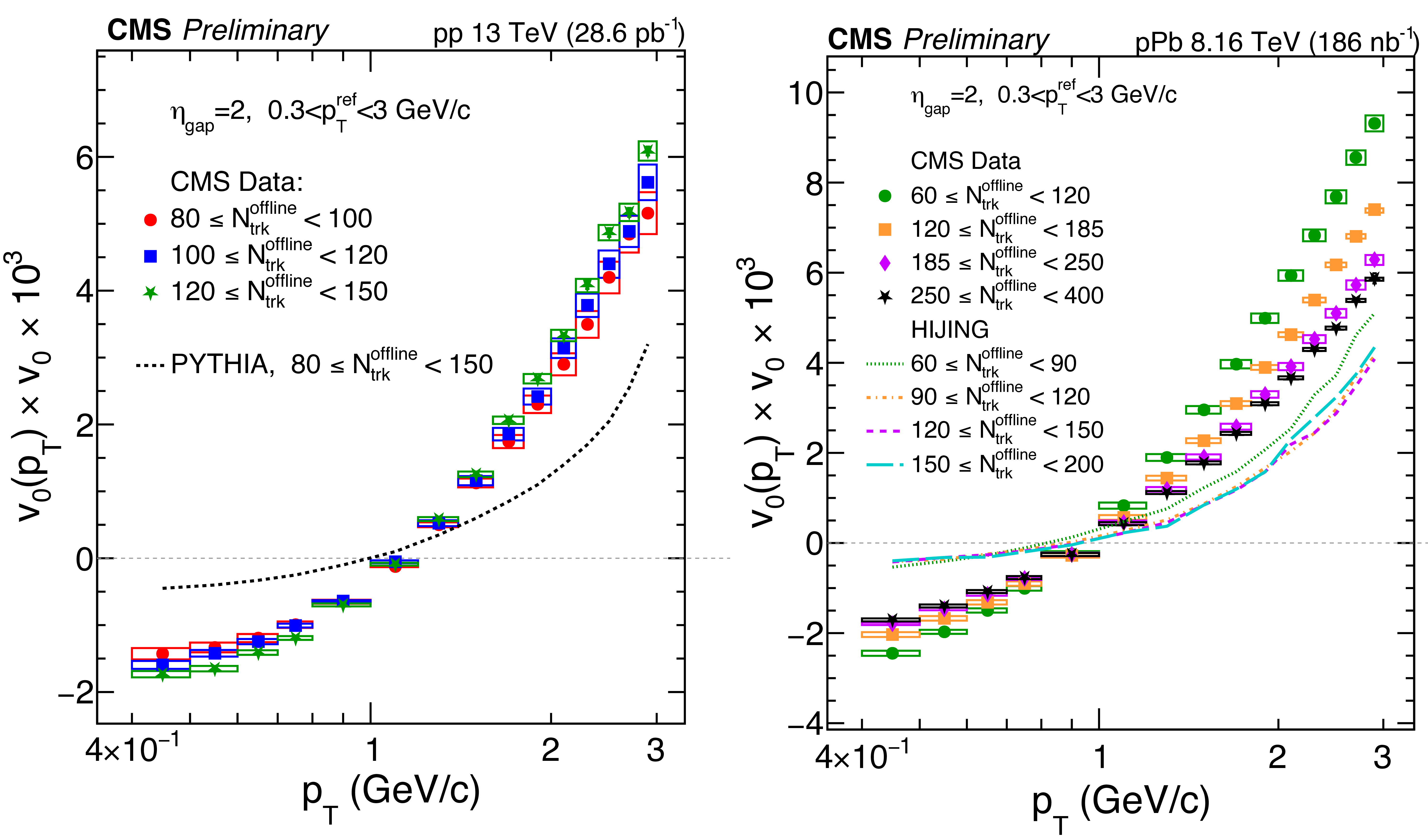
The correlation strength $ v_{0}(p_{\mathrm{T}})\cdot v_{0} $ in data, compared with predictions from PYTHIA for pp collisions (left) and from HIJING for $ \mathrm{p}\mathrm{Pb} $ collisions (right). |
| Summary |
| The first measurement of the $ p_{\mathrm{T}} $-dependent radial flow fluctuation observable $ v_{0}(p_{\mathrm{T}}) $, defined through the correlation between the single-particle spectrum and the event-by-event mean transverse momentum, is presented for pp collisions at $ \sqrt{s}= $ 13 TeV, $ \mathrm{p}\mathrm{Pb} $ collisions at $ \sqrt{\smash[b]{s_{_{\mathrm{NN}}}}}= $ 8.16 TeV, and OO and NeNe collisions at $ \sqrt{\smash[b]{s_{_{\mathrm{NN}}}}}= $ 5.36 TeV. A two-subevent method with a pseudorapidity gap is used to suppress short-range nonflow contributions. The observable $ v_{0}(p_{\mathrm{T}}) $ is found to be approximately independent of the pseudorapidity gap between the two subevents at low $ p_{\mathrm{T}} $, demonstrating the long-range nature of the correlations. The magnitude of $ v_{0}(p_{\mathrm{T}}) $ increases with decreasing multiplicity in all collision systems studied. After normalization by the integrated radial flow magnitude, $ v_{0} $, the shape of $ v_{0}(p_{\mathrm{T}})/v_{0} $ at low $ p_{\mathrm{T}} $ is approximately independent of multiplicity for $ N_\text{trk}^\text{offline} \geq $ 20 across all four collision systems. The lowest multiplicity interval, 10 $ \leq N_\text{trk}^\text{offline} < $ 20, deviates from this common shape in all four collision systems. This deviation may reflect an enhanced relative contribution from nonflow correlations, reduced collective dynamics, or initial-state effects not captured by the hydrodynamic framework in the lowest-multiplicity events. A hydrodynamic calculation based on TRENTO+MUSIC provides a qualitative framework in which the observed universal shape emerges from collective radial expansion in all four collision systems, pp, $ \mathrm{p}\mathrm{Pb} $, OO, and NeNe, up to $ p_{\mathrm{T}}/\langle p_{\mathrm{T}}\rangle \approx $ 3. Comparisons with the nonthermal event generators PYTHIA and HIJING show that they qualitatively underpredict the correlation strength and deviate from the universal shape in the higher multiplicity intervals. This result suggests that additional collective dynamics may contribute to the observed correlations. These measurements provide a new empirical baseline for the collective response of small and light-ion collision systems and complement existing measurements of anisotropic flow. |
| References | ||||
| 1 | B. Alver and G. Roland | Collision geometry fluctuations and triangular flow in heavy-ion collisions | Erratum: Phys. Rev. C 82, 039903 (), 2010 Phys. Rev. C 81 (2010) 054905 |
|
| 2 | J. Y. Ollitrault | Measures of azimuthal anisotropy in high-energy collisions | Eur. Phys. J. A 59 (2023) 236 | |
| 3 | J. D. Bjorken | Highly relativistic nucleus-nucleus collisions: The central rapidity region | PRD 27 (1983) 140 | |
| 4 | A. Dumitru, F. Gelis, L. McLerran, and R. Venugopalan | Glasma flux tubes and the near side ridge phenomenon at rhic | Nucl. Phys. A 810 (2008) 91 | |
| 5 | J. Y. Ollitrault | Anisotropy as a signature of transverse collective flow | PRD 46 (1992) 229 | |
| 6 | STAR Collaboration | Elliptic flow in Au + Au collisions at ($ \sqrt {\smash [b]{s_{_{\mathrm {NN}}}}} = $ 130 GeV | PRL 86 (2001) 402 | nucl-ex/0009011 |
| 7 | P. Bozek, W. Broniowski, E. Ruiz Arriola, and M. Rybczynski | $ \alpha $ clusters and collective flow in ultrarelativistic carbon–heavy-nucleus collisions | Phys. Rev. C 90 (2014) 064902 | |
| 8 | ALICE Collaboration | Higher harmonic anisotropic flow measurements of charged particles in Pb-Pb collisions at $ \sqrt {\smash [b]{s_{_{\mathrm {NN}}}}} = $ 2.76 TeV | PRL 107 (2011) 032301 | 1105.3865 |
| 9 | PHENIX Collaboration | Measurement of nonrandom event by event fluctuations of average transverse momentum in $ \sqrt {\smash [b]{s_{_{\mathrm {NN}}}}} = $ 200-GeV Au+Au and p+p collisions | PRL 93 (2004) 092301 | nucl-ex/0310005 |
| 10 | STAR Collaboration | Transverse-momentum p(t) correlations on (eta, phi) from mean-p(t) fluctuations in Au-Au collisions at $ \sqrt {\smash [b]{s_{_{\mathrm {NN}}}}} = $ 200-GeV | JPG 32 (2006) 37 | nucl-ex/0509030 |
| 11 | ALICE Collaboration | Event-by-event mean $ {p}_{\mathbf {T}} $ fluctuations in pp and Pb-Pb collisions at the LHC | EPJC 74 (2014) 3077 | 1407.5530 |
| 12 | ATLAS Collaboration | Correlations between flow and transverse momentum in Xe+Xe and Pb+Pb collisions at the LHC with the ATLAS detector: A probe of the heavy-ion initial state and nuclear deformation | Phys. Rev. C 107 (2023) 054910 | 2205.00039 |
| 13 | W. Broniowski, M. Chojnacki, and L. Obara | Size fluctuations of the initial source and the event-by-event transverse momentum fluctuations in relativistic heavy-ion collisions | Phys. Rev. C 80 (2009) 051902 | |
| 14 | R. Samanta et al. | Thermalization at the femtoscale seen in high-energy pb+pb collisions | Phys. Rev. C 109 (2024) L051902 | |
| 15 | ATLAS Collaboration | Evidence for the Collective Nature of Radial Flow in Pb+Pb Collisions with the ATLAS Detector | PRL 136 (2026) 032301 | 2503.24125 |
| 16 | ALICE Collaboration | Long-range transverse momentum correlations and radial flow in Pb-Pb collisions at the LHC | PRL 136 (2026) 032302 | 2504.04796 |
| 17 | CMS Collaboration | Evidence for collectivity in pp collisions at the LHC | PLB 765 (2017) 193 | CMS-HIN-16-010 1606.06198 |
| 18 | CMS Collaboration | Evidence for collective multiparticle correlations in $ \mathrm{p}\mathrm{Pb} $ collisions | PRL 115 (2015) 012301 | CMS-HIN-14-006 1502.05382 |
| 19 | CMS Collaboration | Observation of long-range collective flow in OO and NeNe collisions and implications for nuclear structure studies | CMS-HIN-25-009 2510.02580 |
|
| 20 | B. Schenke, C. Shen, and D. Teaney | Transverse momentum fluctuations and their correlation with elliptic flow in nuclear collision | Phys. Rev. C 102 (2020) 034905 | |
| 21 | P. Bo\.zek and W. Broniowski | Transverse momentum fluctuations in ultrarelativistic pb + pb and p + pb collisions with ``wounded'' quarks | Phys. Rev. C 96 (2017) 014904 | |
| 22 | F. Cooper and G. Frye | Comment on the single particle distribution in the hydrodynamic and statistical thermodynamic models of multiparticle production | PRD 10 (1974) 186 | |
| 23 | E. Schnedermann, J. Sollfrank, and U. W. Heinz | Thermal phenomenology of hadrons from 200-a/gev s+s collisions | Phys. Rev. C 48 (1993) 2462 | |
| 24 | CMS Collaboration | The CMS experiment at the CERN LHC | JINST 3 (2008) S08004 | |
| 25 | CMS Collaboration | Performance of the CMS level-1 trigger in proton-proton collisions at $ \sqrt{s} = $ 13 TeV | JINST 15 (2020) P10017 | CMS-TRG-17-001 2006.10165 |
| 26 | CMS Collaboration | Electron and photon reconstruction and identification with the CMS experiment at the CERN LHC | JINST 16 (2021) P05014 | CMS-EGM-17-001 2012.06888 |
| 27 | CMS Collaboration | Performance of the CMS Level-1 trigger in proton-proton collisions at $ \sqrt{s} = $ 13 TeV | JINST 15 (2020) P10017 | CMS-TRG-17-001 2006.10165 |
| 28 | CMS Collaboration | The CMS trigger system | JINST 12 (2017) 01020 | CMS-TRG-12-001 1609.02366 |
| 29 | CMS Collaboration | Multiplicity and transverse momentum dependence of two- and four-particle correlations in $ \mathrm{p}\mathrm{Pb} $ and PbPb collisions | PLB 724 (2013) 213 | CMS-HIN-13-002 1305.0609 |
| 30 | CMS Collaboration | Evidence for collectivity in pp collisions at the LHC | PLB 765 (2017) 193 | CMS-HIN-16-010 1606.06198 |
| 31 | CMS Collaboration | Description and performance of track and primary-vertex reconstruction with the CMS tracker | JINST 9 (2014) P10009 | CMS-TRK-11-001 1405.6569 |
| 32 | T. Sjöstrand et al. | An introduction to PYTHIA 8.2 | Comput. Phys. Commun. 191 (2015) 159 | 1410.3012 |
| 33 | M. Gyulassy and X.-N. Wang | HIJING 1.0: A Monte Carlo program for parton and particle production in high-energy hadronic and nuclear collisions | Comput. Phys. Commun. 83 (1994) 307 | nucl-th/9502021 |
| 34 | GEANT4 Collaboration | GEANT 4--a simulation toolkit | NIM A 506 (2003) 250 | |
| 35 | J. Jia, M. Zhou, and A. Trzupek | Revealing long-range multiparticle collectivity in small collision systems via subevent cumulants | Phys. Rev. C 96 (2017) 034906 | 1701.03830 |
| 36 | B. Schenke, S. Jeon, and C. Gale | (3+1)d hydrodynamic simulation of relativistic heavy-ion collisions | Phys. Rev. C 82 (2010) 014903 | |
| 37 | J. S. Moreland, J. E. Bernhard, and S. A. Bass | Alternative ansatz to wounded nucleon and binary collision scaling in high-energy nuclear collisions | Phys. Rev. C 92 (2015) 011901 | 1412.4708 |
| 38 | J. Jia | Sources of Radial-Flow Fluctuations in the Quark-Gluon Plasma | PRL 136 (2026) 112301 | 2507.14399 |
| 39 | T. Osada | Radial-flow fluctuations in the geometrical-scaling framework | 2606.02108 | |
| 40 | T. Parida, R. Samanta, and J.-Y. Ollitrault | Probing collectivity in heavy-ion collisions with fluctuations of the p spectrum | Physics Letters B 857 (2024) 138985 | |
|
|
Compact Muon Solenoid LHC, CERN |

|
|
|
|
|
|