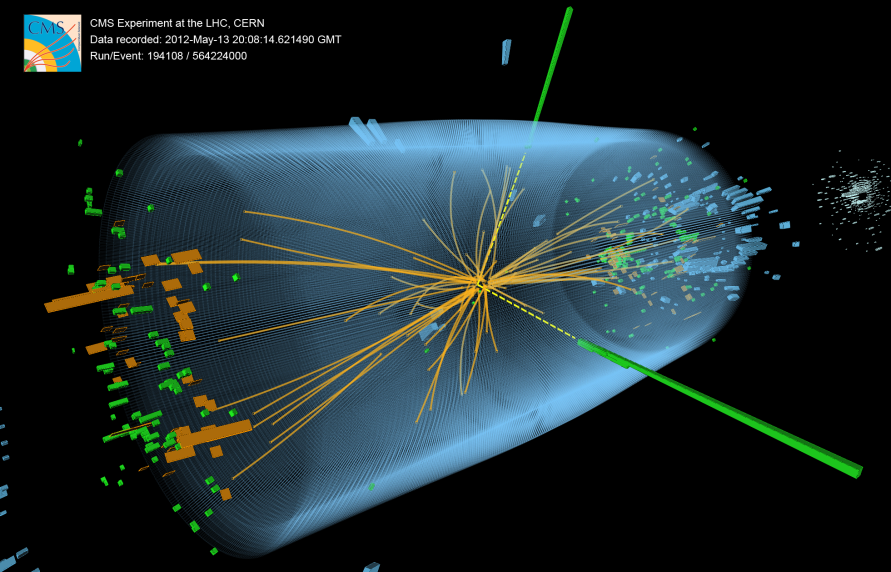
CMS logoCMS event Hgg
Compact Muon Solenoid
LHC, CERN

CMS-PAS-HIG-24-011
Measurement of the Higgs boson decay width from off-shell production using the WW $ \to $ 2$\ell$ 2$\nu $ final state in proton-proton collisions at 13 TeV
Abstract: We constrain the Higgs decay width using the off-shell production of Higgs bosons in their decay H $ \to $ WW $ \to $2$\ell $2$\nu $. The analysis uses proton-proton collision data with an integrated luminosity of 138 fb$ ^{-1} $ collected at a center-of-mass energy of $ \sqrt{s}= $ 13 TeV by the CMS experiment at the LHC. On- and off-shell signal strengths are used to derive the Higgs boson total decay width as $ \Gamma_{\mathrm{H}} = $ 3.9 $ ^{+2.7}_{-2.2} $ MeV, in agreement with the standard model value. This is an order of magnitude improvement over previous CMS results in this decay channel.
Figures & Tables Summary References CMS Publications
Figures

png pdf
Figure 1:
Example of feynman diagrams for Higgs boson production and decays to WW in ggF (left) and VBF (right).

png pdf
Figure 1-a:
Example of feynman diagrams for Higgs boson production and decays to WW in ggF (left) and VBF (right).

png pdf
Figure 1-b:
Example of feynman diagrams for Higgs boson production and decays to WW in ggF (left) and VBF (right).

png pdf
Figure 2:
Feynman diagrams for continuum WW production: $ \mathrm{g}\mathrm{g} \to \mathrm{W}\mathrm{W} $ (left) and $ \mathrm{q}\mathrm{q} \to \mathrm{q}\mathrm{q}\mathrm{W}\mathrm{W} $ (right).

png pdf
Figure 2-a:
Feynman diagrams for continuum WW production: $ \mathrm{g}\mathrm{g} \to \mathrm{W}\mathrm{W} $ (left) and $ \mathrm{q}\mathrm{q} \to \mathrm{q}\mathrm{q}\mathrm{W}\mathrm{W} $ (right).

png pdf
Figure 2-b:
Feynman diagrams for continuum WW production: $ \mathrm{g}\mathrm{g} \to \mathrm{W}\mathrm{W} $ (left) and $ \mathrm{q}\mathrm{q} \to \mathrm{q}\mathrm{q}\mathrm{W}\mathrm{W} $ (right).

png pdf
Figure 3:
Post-fit DNN output distributions in each off-shell SR. From upper left to lower right: (upper left) 2-jet DNN score for VBF SR, (upper right) 2-jet DNN score for ggF SR, (lower left) 1-jet DNN score for ggF SR, and (lower right) 0-jet DNN score for ggF SR. The ggF H off-shell S+B+I and VBF H off-shell S+B+I contributions are displayed both as part of the total stacked prediction with all other processes in the legend, and again as separate lines that are stacked with respect to each other but unstacked from the other processes, overlaid on top of the stacked background for visibility. The Data/Pred ratio includes the post-fit signal.

png pdf
Figure 3-a:
Post-fit DNN output distributions in each off-shell SR. From upper left to lower right: (upper left) 2-jet DNN score for VBF SR, (upper right) 2-jet DNN score for ggF SR, (lower left) 1-jet DNN score for ggF SR, and (lower right) 0-jet DNN score for ggF SR. The ggF H off-shell S+B+I and VBF H off-shell S+B+I contributions are displayed both as part of the total stacked prediction with all other processes in the legend, and again as separate lines that are stacked with respect to each other but unstacked from the other processes, overlaid on top of the stacked background for visibility. The Data/Pred ratio includes the post-fit signal.

png pdf
Figure 3-b:
Post-fit DNN output distributions in each off-shell SR. From upper left to lower right: (upper left) 2-jet DNN score for VBF SR, (upper right) 2-jet DNN score for ggF SR, (lower left) 1-jet DNN score for ggF SR, and (lower right) 0-jet DNN score for ggF SR. The ggF H off-shell S+B+I and VBF H off-shell S+B+I contributions are displayed both as part of the total stacked prediction with all other processes in the legend, and again as separate lines that are stacked with respect to each other but unstacked from the other processes, overlaid on top of the stacked background for visibility. The Data/Pred ratio includes the post-fit signal.

png pdf
Figure 3-c:
Post-fit DNN output distributions in each off-shell SR. From upper left to lower right: (upper left) 2-jet DNN score for VBF SR, (upper right) 2-jet DNN score for ggF SR, (lower left) 1-jet DNN score for ggF SR, and (lower right) 0-jet DNN score for ggF SR. The ggF H off-shell S+B+I and VBF H off-shell S+B+I contributions are displayed both as part of the total stacked prediction with all other processes in the legend, and again as separate lines that are stacked with respect to each other but unstacked from the other processes, overlaid on top of the stacked background for visibility. The Data/Pred ratio includes the post-fit signal.

png pdf
Figure 3-d:
Post-fit DNN output distributions in each off-shell SR. From upper left to lower right: (upper left) 2-jet DNN score for VBF SR, (upper right) 2-jet DNN score for ggF SR, (lower left) 1-jet DNN score for ggF SR, and (lower right) 0-jet DNN score for ggF SR. The ggF H off-shell S+B+I and VBF H off-shell S+B+I contributions are displayed both as part of the total stacked prediction with all other processes in the legend, and again as separate lines that are stacked with respect to each other but unstacked from the other processes, overlaid on top of the stacked background for visibility. The Data/Pred ratio includes the post-fit signal.

png pdf
Figure 4:
Post-fit DNN output distributions in each on-shell CR. From upper left to lower right: (upper left) 2-jet DNN score for VBF CR, (upper right) 2-jet DNN score for ggF CR, (lower left) 1-jet DNN score for ggF CR, and (lower right) 0-jet DNN score for ggF CR. The ggF H off-shell S+B+I and VBF H off-shell S+B+I contributions are displayed both as part of the total stacked prediction with all other processes in the legend, and again as separate lines that are stacked with respect to each other but unstacked from the other processes, overlaid on top of the stacked background for visibility. The Data/Pred ratio includes the post-fit signal. Note that in the ggF on-shell distributions, VBF off-shell events will most likely not populate these regions, which causes the lack of VBF off-shell S+B+I.

png pdf
Figure 4-a:
Post-fit DNN output distributions in each on-shell CR. From upper left to lower right: (upper left) 2-jet DNN score for VBF CR, (upper right) 2-jet DNN score for ggF CR, (lower left) 1-jet DNN score for ggF CR, and (lower right) 0-jet DNN score for ggF CR. The ggF H off-shell S+B+I and VBF H off-shell S+B+I contributions are displayed both as part of the total stacked prediction with all other processes in the legend, and again as separate lines that are stacked with respect to each other but unstacked from the other processes, overlaid on top of the stacked background for visibility. The Data/Pred ratio includes the post-fit signal. Note that in the ggF on-shell distributions, VBF off-shell events will most likely not populate these regions, which causes the lack of VBF off-shell S+B+I.

png pdf
Figure 4-b:
Post-fit DNN output distributions in each on-shell CR. From upper left to lower right: (upper left) 2-jet DNN score for VBF CR, (upper right) 2-jet DNN score for ggF CR, (lower left) 1-jet DNN score for ggF CR, and (lower right) 0-jet DNN score for ggF CR. The ggF H off-shell S+B+I and VBF H off-shell S+B+I contributions are displayed both as part of the total stacked prediction with all other processes in the legend, and again as separate lines that are stacked with respect to each other but unstacked from the other processes, overlaid on top of the stacked background for visibility. The Data/Pred ratio includes the post-fit signal. Note that in the ggF on-shell distributions, VBF off-shell events will most likely not populate these regions, which causes the lack of VBF off-shell S+B+I.

png pdf
Figure 4-c:
Post-fit DNN output distributions in each on-shell CR. From upper left to lower right: (upper left) 2-jet DNN score for VBF CR, (upper right) 2-jet DNN score for ggF CR, (lower left) 1-jet DNN score for ggF CR, and (lower right) 0-jet DNN score for ggF CR. The ggF H off-shell S+B+I and VBF H off-shell S+B+I contributions are displayed both as part of the total stacked prediction with all other processes in the legend, and again as separate lines that are stacked with respect to each other but unstacked from the other processes, overlaid on top of the stacked background for visibility. The Data/Pred ratio includes the post-fit signal. Note that in the ggF on-shell distributions, VBF off-shell events will most likely not populate these regions, which causes the lack of VBF off-shell S+B+I.

png pdf
Figure 4-d:
Post-fit DNN output distributions in each on-shell CR. From upper left to lower right: (upper left) 2-jet DNN score for VBF CR, (upper right) 2-jet DNN score for ggF CR, (lower left) 1-jet DNN score for ggF CR, and (lower right) 0-jet DNN score for ggF CR. The ggF H off-shell S+B+I and VBF H off-shell S+B+I contributions are displayed both as part of the total stacked prediction with all other processes in the legend, and again as separate lines that are stacked with respect to each other but unstacked from the other processes, overlaid on top of the stacked background for visibility. The Data/Pred ratio includes the post-fit signal. Note that in the ggF on-shell distributions, VBF off-shell events will most likely not populate these regions, which causes the lack of VBF off-shell S+B+I.

png pdf
Figure 5:
The likelihood scan corresponding for the off-shell signal strength (left) and $ \Gamma_\text{H} $ (right). The 68% and 95% confidence intervals are delineated as horizontal lines.

png pdf
Figure 5-a:
The likelihood scan corresponding for the off-shell signal strength (left) and $ \Gamma_\text{H} $ (right). The 68% and 95% confidence intervals are delineated as horizontal lines.

png pdf
Figure 5-b:
The likelihood scan corresponding for the off-shell signal strength (left) and $ \Gamma_\text{H} $ (right). The 68% and 95% confidence intervals are delineated as horizontal lines.
Tables

png pdf
Table 1:
Measurements of off-shell signal strength $ \mu_{\text{off-shell}} $, on-shell signal strength $ \mu_{\text{on-shell}} $, and $ \Gamma_\text{H} $. Listed are the measurements of the $ \mathrm{H} \to \mathrm{W}\mathrm{W} $, $ \mu_{\text{off-shell}} $ and $ \Gamma_\text{H} $ in the 2 $ \ell 2\nu $ channel. The central value (c.v.) is reported together with the 68% and 95% confidence levels.

png pdf
Table 2:
Uncertainties and their contribution to the parameter of interest $ r = \frac{\mu_\text{off-shell}}{\mu_\text{on-shell}} $. These contributions are the impact of each uncertainty group divided by the total uncertainty. ``Other" includes background normalization parameters and MC statistical uncertainties. The final column showcases the impact of each uncertainty group on $ \mu_\text{off-shell} $.
Summary
Measurements of the off-shell signal strengths for the Higgs boson have been performed with the VBF and ggF production modes in the $ \mathrm{H} \to \mathrm{W}\mathrm{W} $ channel, using proton-proton collision data from the CMS experiment with an integrated luminosity of 138 fb$ ^{-1} $. Specific event selection and background discrimination techniques were applied in order to extract the results from likelihood fits for all the analysis categories. The combined signal strengths from VBF and ggF for production of an off-shell Higgs boson is found to be $ \mu_\text{off-shell} = $ 1.2 $ ^{+0.8}_{-0.7} $, which is used to derive the decay width $ \Gamma_\text{H} = $ 3.9 $ ^{+2.7}_{-2.2} $ MeV at 68% confidence level, in agreement with SM expectation. This measurement represents the first CMS constraint on the Higgs boson width in the WW final state with the Run 2 dataset, improving the Run 1 limit by more than an order of magnitude and complementing the ZZ Run 2 measurements.
References
1 S. Weinberg A model of leptons PRL 19 (1967) 1264--1266
2 S. L. Glashow Partial-symmetries of weak interactions NP 22 (1961) 579--588
3 A. Salam Weak and Electromagnetic Interactions Conf. Proc. C 680519 (1968) 367--377
4 P. W. Higgs Broken symmetries, massless particles and gauge fields PL 12 (1964) 132--133
5 P. W. Higgs Spontaneous Symmetry Breakdown without Massless Bosons PR 145 (1966) 1156--1163
6 F. Englert and R. Brout Broken Symmetry and the Mass of Gauge Vector Mesons PRL 13 (1964) 321--323
7 P. W. Higgs Broken symmetries and the masses of gauge bosons PRL 13 (1964) 508--509
8 ATLAS Collaboration Observation of a new particle in the search for the standard model Higgs boson with the ATLAS detector at the LHC PLB 716 (2012) 1--29
9 CMS Collaboration Observation of a New Boson at a Mass of 125 GeV with the CMS Experiment at the LHC PLB 716 (2012) 30--61 CMS-HIG-12-028
1207.7235
10 ATLAS Collaboration A detailed map of Higgs boson interactions by the ATLAS experiment ten years after the discovery Nature 607 (2022) 52--59 2207.00092
11 CMS Collaboration A portrait of the Higgs boson by the CMS experiment ten years after the discovery Nature 607 (2022) 60--68 CMS-HIG-22-001
2207.00043
12 D. de Florian et al. Handbook of LHC Higgs Cross Sections: 4. Deciphering the Nature of the Higgs Sector CERN Yellow Rep. Monogr. 2 (2017) 1--869 1610.07922
13 CMS Collaboration Measurement of the Higgs boson mass and width using the four-lepton final state in proton-proton collisions at $ \sqrt{s}= $ 13 TeV no. 9, 2025
Physical Review D 111 (2025)
14 ATLAS Collaboration Measurement of off-shell Higgs boson production in the $ H^*\rightarrow ZZ\rightarrow 4\ell $ decay channel using a neural simulation-based inference technique in 13 TeV pp collisions with the ATLAS detector Rept. Prog. Phys. 88 (2025) 057803 2412.01548
15 ATLAS Collaboration Constraining off-shell Higgs boson production and the Higgs boson total width using $ WW\to \ell\nu\ell\nu $ final states with the ATLAS detector 2504.07710
16 ATLAS Collaboration Constraint on the total width of the Higgs boson from Higgs boson and four-top-quark measurements in pp collisions at $ \sqrt{s}= $ 13 TeV with the ATLAS detector PLB 861 (2025) 139277 2407.10631
17 CMS Collaboration Search for Higgs boson off-shell production in proton-proton collisions at 7 and 8 TeV and derivation of constraints on its total decay width JHEP 09 (2016) 051 CMS-HIG-14-032
1605.02329
18 N. Kauer and G. Passarino Inadequacy of zero-width approximation for a light Higgs boson signal JHEP 08 (2012) 116 1206.4803
19 D. A. Dicus and S. S. D. Willenbrock Photon Pair Production and the Intermediate Mass Higgs Boson PRD 37 (1988) 1801
20 L. J. Dixon and Y. Li Bounding the Higgs Boson Width Through Interferometry PRL 111 (2013) 111802 1305.3854
21 J. M. Campbell, R. K. Ellis, and C. Williams Gluon-Gluon Contributions to $ W^+ W^- $ Production and Higgs Interference Effects JHEP 10 (2011) 005 1107.5569
22 CMS Collaboration The CMS Experiment at the CERN LHC JINST 3 (2008) S08004
23 CMS Collaboration Development of the CMS detector for the CERN LHC Run 3 JINST 19 (2024) P05064 CMS-PRF-21-001
2309.05466
24 CMS Collaboration Performance of the CMS Level-1 trigger in proton-proton collisions at $ \sqrt{s} = $ 13 TeV JINST 15 (2020) P10017 CMS-TRG-17-001
2006.10165
25 CMS Collaboration The CMS trigger system JINST 12 (2017) P01020 CMS-TRG-12-001
1609.02366
26 CMS Collaboration Performance of the CMS high-level trigger during LHC Run 2 JINST 19 (2024) P11021
27 CMS Collaboration Electron and photon reconstruction and identification with the CMS experiment at the CERN LHC JINST 16 (2021) P05014 CMS-EGM-17-001
2012.06888
28 CMS Collaboration Performance of the CMS muon detector and muon reconstruction with proton-proton collisions at $ \sqrt{s}= $ 13 TeV JINST 13 (2018) P06015
29 CMS Collaboration Description and performance of track and primary-vertex reconstruction with the CMS tracker JINST 9 (2014) P10009 CMS-TRK-11-001
1405.6569
30 CMS Collaboration Particle-flow reconstruction and global event description with the CMS detector JINST 12 (2017) P10003 CMS-PRF-14-001
1706.04965
31 CMS Collaboration Performance of missing transverse momentum reconstruction in proton-proton collisions at $ \sqrt{s}= $ 13 TeV using the CMS detector JINST 14 (2019) P07004
32 M. Cacciari, G. P. Salam, and G. Soyez The anti-$ k_{\mathrm{T}} $ jet clustering algorithm JHEP 04 (2008) 063 0802.1189
33 M. Cacciari, G. P. Salam, and G. Soyez FastJet user manual EPJC 72 (2012) 1896 1111.6097
34 CMS Collaboration Jet energy scale and resolution in the CMS experiment in pp collisions at 8 TeV JINST 12 (2017) P02014 CMS-JME-13-004
1607.03663
35 CMS Collaboration Precision luminosity measurement in proton-proton collisions at $ \sqrt{s} = $ 13 TeV in 2015 and 2016 at CMS EPJC 81 (2021) 800 CMS-LUM-17-003
2104.01927
36 CMS Collaboration CMS luminosity measurement for the 2017 data-taking period at $ \sqrt{s} = $ 13 TeV
37 CMS Collaboration CMS luminosity measurement for the 2018 data-taking period at $ \sqrt{s} = $ 13 TeV
38 CMS Collaboration Methods for off-shell Higgs boson production simulation used in CMS analyses technical report, CERN, Geneva, 2022
CDS
39 P. Nason A New method for combining NLO QCD with shower Monte Carlo algorithms JHEP 11 (2004) 040 hep-ph/0409146
40 S. Frixione, P. Nason, and C. Oleari Matching NLO QCD computations with Parton Shower simulations: the POWHEG method JHEP 11 (2007) 070 0709.2092
41 S. Alioli, P. Nason, C. Oleari, and E. Re A general framework for implementing NLO calculations in shower Monte Carlo programs: the POWHEG BOX JHEP 06 (2010) 043 1002.2581
42 S. Bolognesi et al. On the Spin and Parity of a Single-Produced Resonance at the LHC PRD 86 (2012) 095031 1208.4018
43 S. Goria, G. Passarino, and D. Rosco The Higgs Boson Lineshape NPB 864 (2012) 530--579 1112.5517
44 A. V. Gritsan et al. New features in the JHU generator framework: constraining Higgs boson properties from on-shell and off-shell production PRD 102 (2020) 056022 2002.09888
45 I. Anderson Manual for the JHU generator and MELA package et al.,, Available at [Link: https://spin.pha.jhu.edu/Manual.pdf], 2024
46 J. M. Campbell and R. K. Ellis An Update on vector boson pair production at hadron colliders PRD 60 (1999) 113006 hep-ph/9905386
47 J. M. Campbell, R. K. Ellis, and C. Williams Vector boson pair production at the LHC JHEP 07 (2011) 018 1105.0020
48 J. M. Campbell, R. K. Ellis, and W. T. Giele A multi-threaded version of MCFM EPJC 75 (2015) 246 1503.06182
49 CMS Collaboration Measurement of the Higgs boson width and evidence of its off-shell contributions to ZZ production Nature Phys. 18 (2022) 1329--1334 CMS-HIG-21-013
2202.06923
50 C. Anastasiou et al. High precision determination of the gluon fusion Higgs boson cross-section at the LHC JHEP 05 (2016) 058 1602.00695
51 K. Hamilton, P. Nason, E. Re, and G. Zanderighi NNLOPS simulation of Higgs boson production JHEP 10 (2013) 222 1309.0017
52 K. Hamilton, P. Nason, and G. Zanderighi Finite quark-mass effects in the NNLOPS POWHEG+MiNLO Higgs generator JHEP 05 (2015) 140 1501.04637
53 CMS Collaboration Measurements of the Higgs boson production cross section and couplings in the W boson pair decay channel in proton-proton collisions at $ \sqrt{s}=13 \text {Te\hspace{-.08em}V} $ EPJC 83 (2023) 667 CMS-HIG-20-013
2206.09466
54 J. Alwall et al. The automated computation of tree-level and next-to-leading order differential cross sections, and their matching to parton shower simulations JHEP 07 (2014) 079 1405.0301
55 M. Czakon et al. Top-pair production at the LHC through NNLO QCD and NLO EW JHEP 2017 (2017)
56 T. Sjostrand et al. An introduction to PYTHIA 8.2 Comput. Phys. Commun. 191 (2015) 159 1410.3012
57 CMS Collaboration Extraction and validation of a new set of CMS PYTHIA8 tunes from underlying-event measurements EPJC 80 (2020) 4 CMS-GEN-17-001
1903.12179
58 NNPDF Collaboration Parton distributions from high-precision collider data EPJC 77 (2017) 663 1706.00428
59 GEANT4 Collaboration GEANT 4 --- a simulation toolkit NIM A 506 (2003) 250
60 CMS Collaboration Evidence for associated production of a Higgs boson with a top quark pair in final states with electrons, muons, and hadronically decaying $ \tau $ leptons at $ \sqrt{s}= $ 13 TeV JHEP 08 (2018) 066
61 CMS Collaboration Electron and photon reconstruction and identification with the CMS detector in Run 2 JINST 16 (2021) P05014
62 CMS Collaboration Identification of heavy-flavour jets with the CMS detector in pp collisions at 13 TeV JINST 13 (2018) P05011 CMS-BTV-16-002
1712.07158
63 E. Bols et al. Jet Flavour Classification Using DeepJet JINST 15 (2020) P12012 2008.10519
64 CMS Collaboration Performance summary of AK4 jet b tagging with data from proton-proton collisions at 13 TeV with the CMS detector CDS
65 CMS Collaboration Pileup mitigation at CMS in 13 TeV data JINST 15 (2020) P09018
66 F. Chollet et al. Keras Journal of Machine Learning Research 18 (2015) 1--5
67 D. P. Kingma and J. Ba Adam: A method for stochastic optimization \url https://arxiv.org/abs/1412.6980, 2017
link
68 CMS Collaboration Measurements of properties of the Higgs boson decaying to a W boson pair in pp collisions at $ \sqrt{s}= $ 13 TeV PLB 791 (2019) 96 CMS-HIG-16-042
1806.05246
69 A. Hayrapetyan, et. al. The CMS statistical analysis and combination tool: Combine Computing and Software for Big Science 8 (2024)
70 W. Verkerke and D. Kirkby The RooFit toolkit for data modeling in Proc. 13th International Conference on Computing in High Energy and Nuclear Physics (CHEP 2003): La Jolla CA, United States, March 24--28, 2003. 2003.. [eConf C0303241 (2003) MOLT007]
link
physics/0306116
71 L. Moneta et al. The RooStats project in Proc. 13th International Workshop on Advanced Computing and Analysis Techniques in Physics Research (ACAT 2010): Jaipur, India, February 22--27, 2010. 2010.. [PoS (ACAT2010) 057]
link
1009.1003
Compact Muon Solenoid
LHC, CERN