
Compact Muon Solenoid
LHC, CERN
 Visit us: CMS Public Website, CMS Physics ;
Contact us: CMS Publications Committee
Visit us: CMS Public Website, CMS Physics ;
Contact us: CMS Publications Committee
| CMS-PAS-EXO-23-008 | ||
| Search for dark photon bremsstrahlung by muons in proton-proton collisions at $ \sqrt{s} = $ 13 TeV | ||
| CMS Collaboration | ||
| 2026-03-14 | ||
| Abstract: A search for dark bremsstrahlung interactions between muons from Z boson decay and the CMS endcap calorimeters is presented. The search is performed with the CMS detector at the CERN LHC using a proton-proton collision data sample at a center-of-mass energy of 13 TeV corresponding to an integrated luminosity of 59.6 fb$ ^{-1} $. The search utilizes Z boson decays to a muon-antimuon pair. One of the muons is required to have no anomalous interactions and serves as a trigger for the event. Secondary interactions are then searched for between the second muon and the calorimeters, such that the response in tracker volume of the detector can be used to cleanly identify the muon through the invariant mass of the trigger muon and the tracker track of the second muon. The search is performed with two mutually-exclusive categories of events, one where the trajectory of the second muon is severely altered by a dark bremsstrahlung interaction and there are no nearby muon chamber hits to the projected tracker track, and one where the trajectory of the second muon is slightly altered and there is a nearby muon that is reconstructed purely by hits in the muon chambers. Limits are placed in the two dimensional plane of the square of the dark photon mixing parameter $ \epsilon^{2} $ and the dark photon mass for A' masses in the range 10 MeV to 1 GeV. This is the first search of this type at an LHC experiment. | ||
| Links: CDS record (PDF) ; CADI line (restricted) ; | ||
| Figures | |
png pdf |
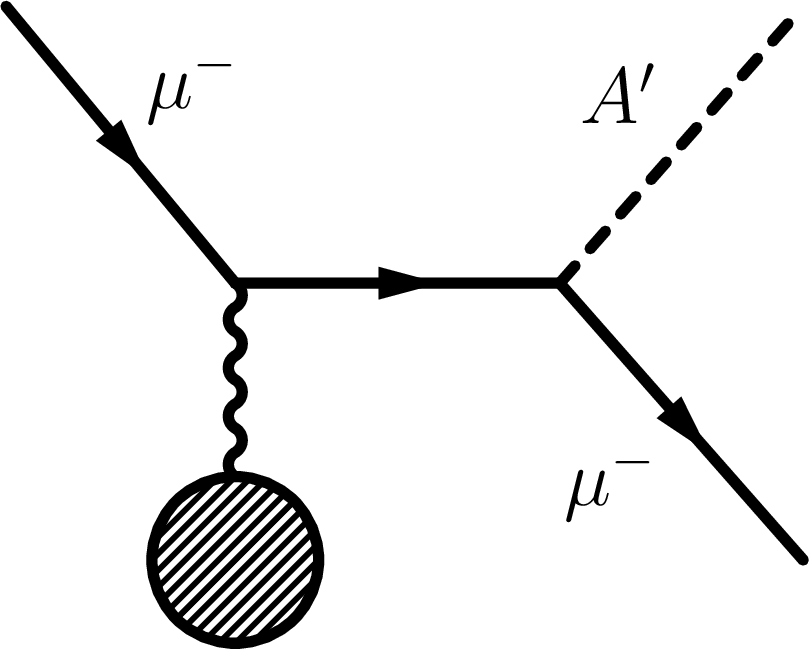
Figure 1:
Feynman diagram of the dark bremsstrahlung process |
png pdf |
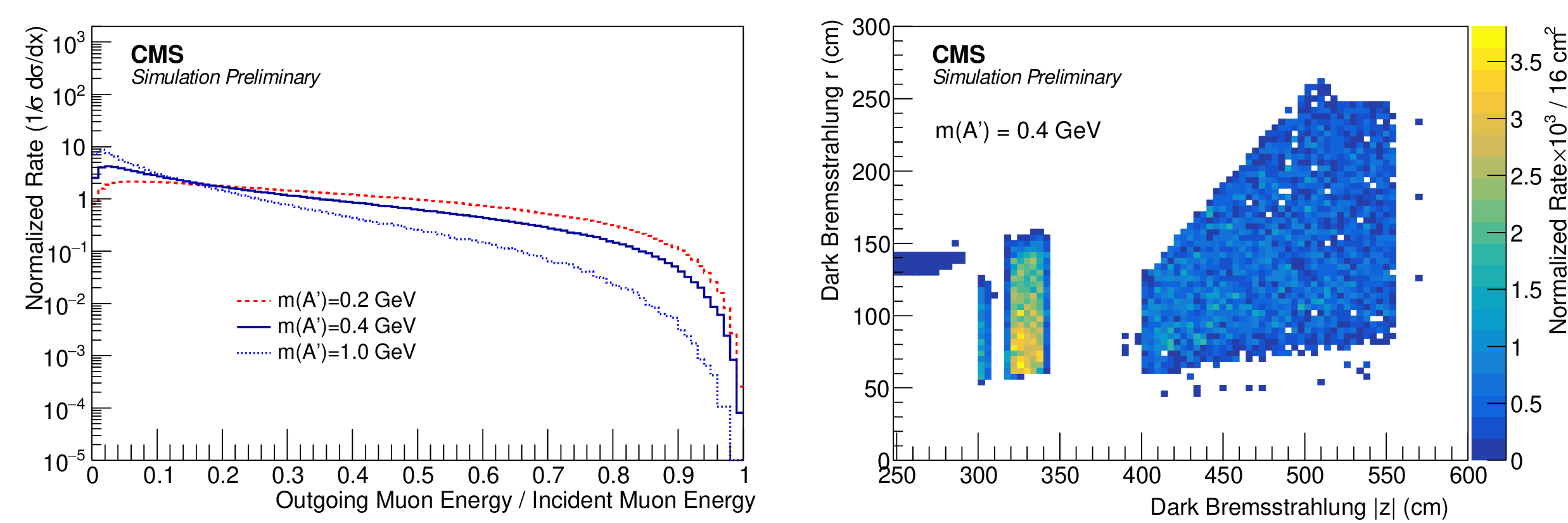
Figure 2:
The ratio of the outgoing muon energy after dark bremsstrahlung to the incident muon energy prior to dark bremsstrahlung (left). The locations of simulated dark bremsstrahlung interactions at a representative $ {A} ^{\prime} $ mass of 0.4 GeV (right). The process is enabled only within the volume of the ECAL and HCAL endcap calorimeters. The higher density of the ECAL produces more interactions per unit volume of detector, while the larger size of the HCAL results in roughly twice as many total interactions occurring within it. |
png pdf |
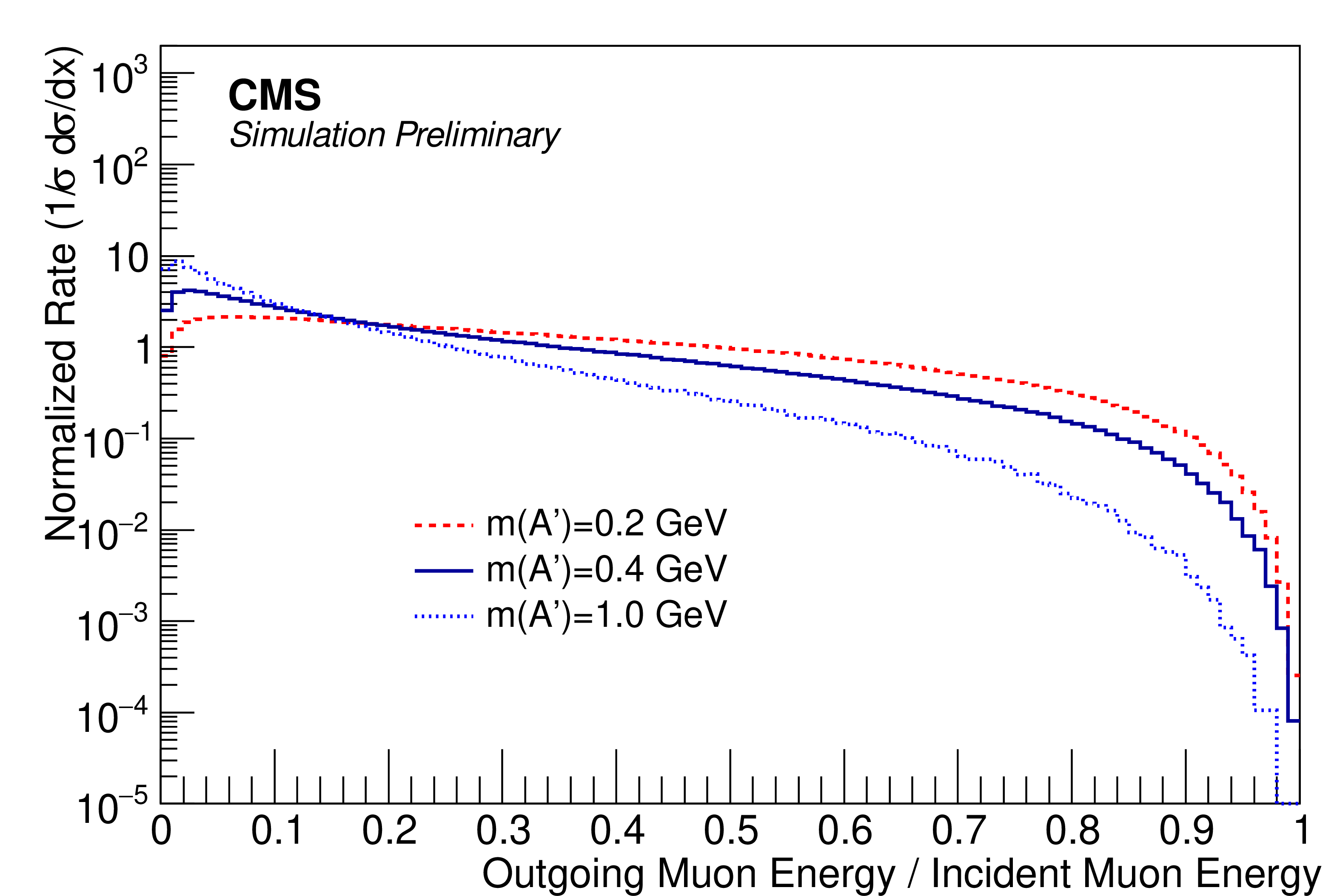
Figure 2-a:
The ratio of the outgoing muon energy after dark bremsstrahlung to the incident muon energy prior to dark bremsstrahlung (left). The locations of simulated dark bremsstrahlung interactions at a representative $ {A} ^{\prime} $ mass of 0.4 GeV (right). The process is enabled only within the volume of the ECAL and HCAL endcap calorimeters. The higher density of the ECAL produces more interactions per unit volume of detector, while the larger size of the HCAL results in roughly twice as many total interactions occurring within it. |
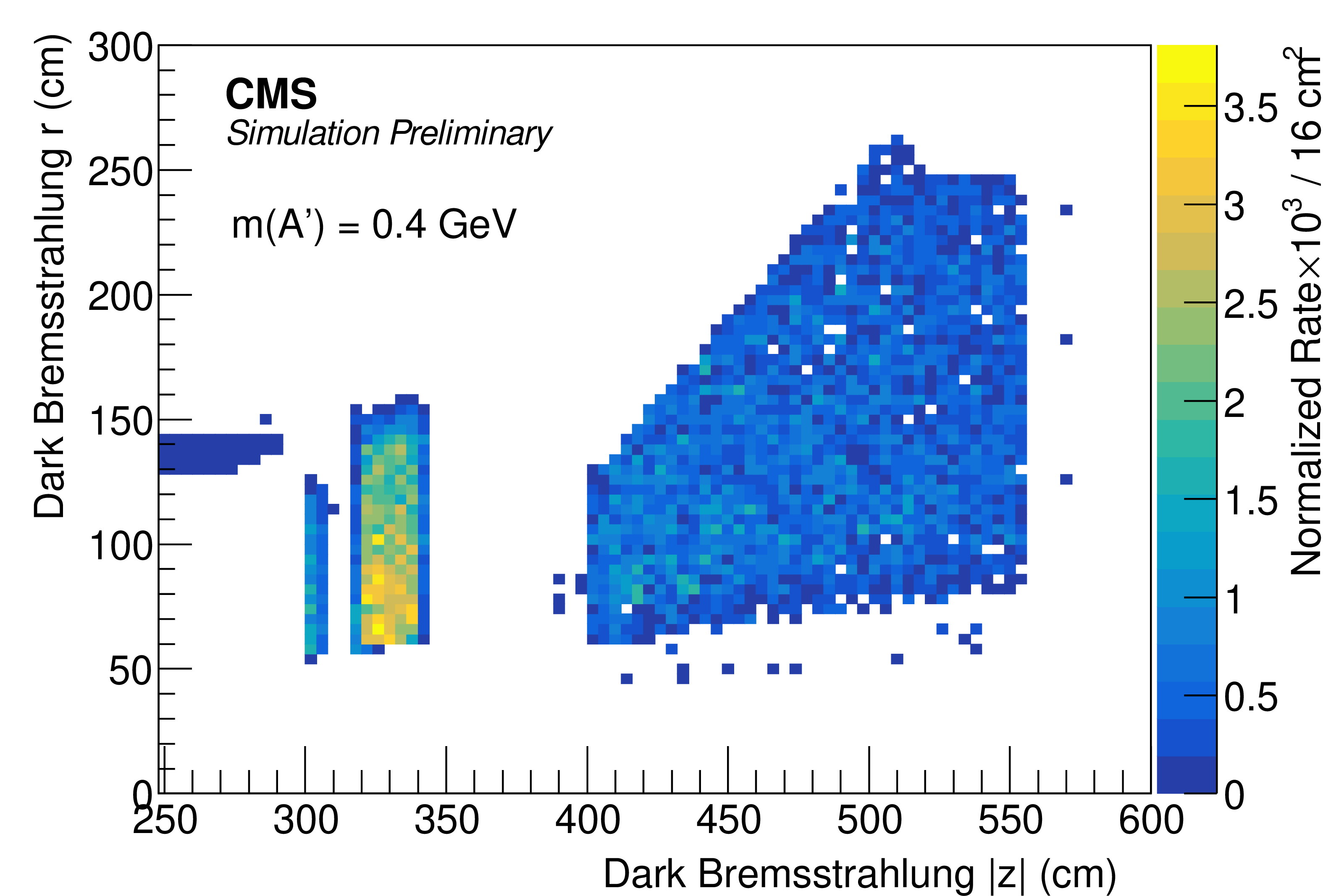
png pdf |
Figure 2-b:
The ratio of the outgoing muon energy after dark bremsstrahlung to the incident muon energy prior to dark bremsstrahlung (left). The locations of simulated dark bremsstrahlung interactions at a representative $ {A} ^{\prime} $ mass of 0.4 GeV (right). The process is enabled only within the volume of the ECAL and HCAL endcap calorimeters. The higher density of the ECAL produces more interactions per unit volume of detector, while the larger size of the HCAL results in roughly twice as many total interactions occurring within it. |
png pdf |
Figure 3:
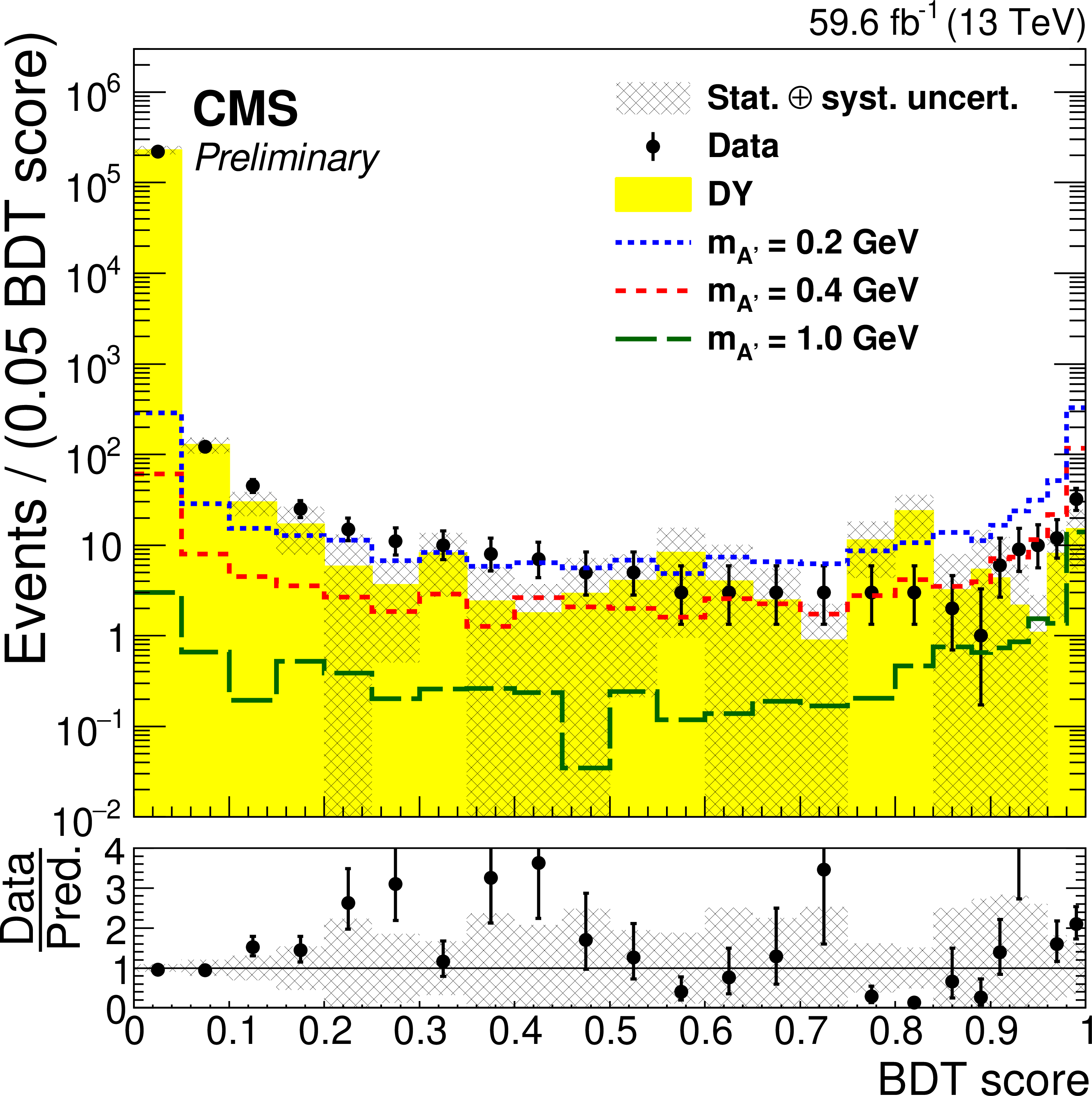
The BDT distribution in the partial disappearance region for the DY MC (yellow), signal (dashed lines) and data samples before the fit. The non-DY background is not shown. The hatched uncertainty bands on the simulated background histogram include statistical and systematic components. The systematic uncertainty of the BDT shape is primarily driven by the pileup modeling, muon identification, and muon isolation uncertainties, with an additional systematic applied based on differences observed in validation regions. |
png pdf |
Figure 4:
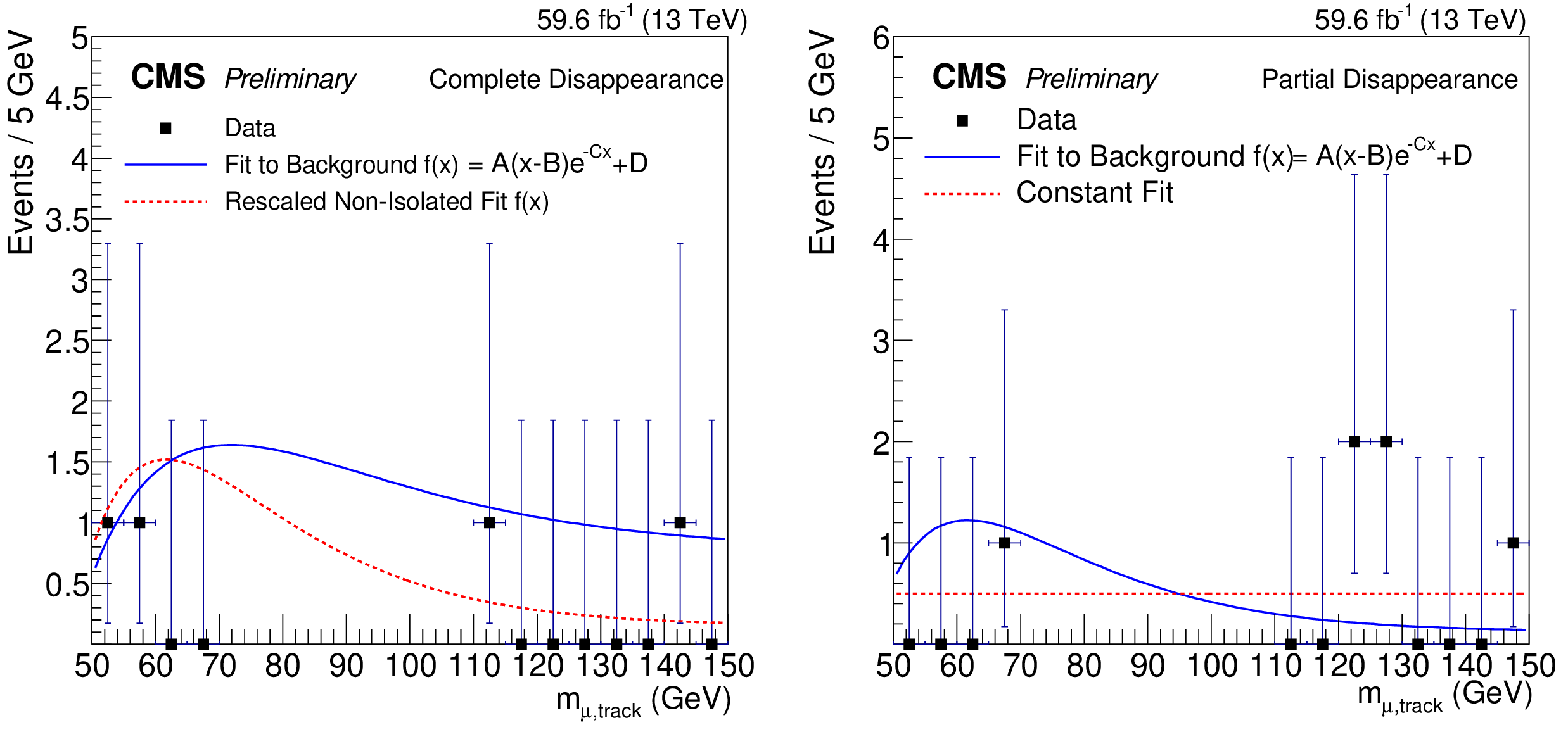
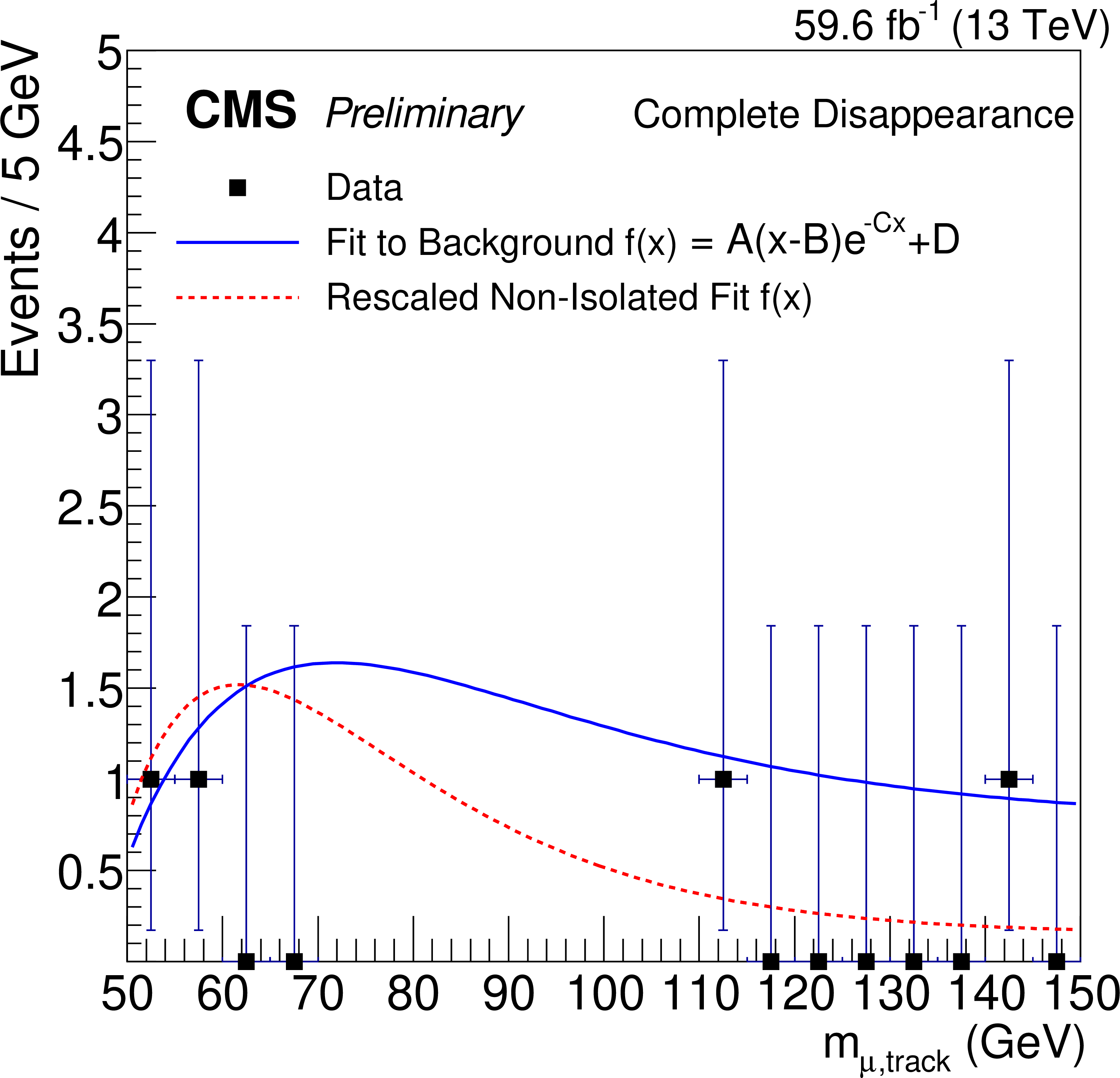
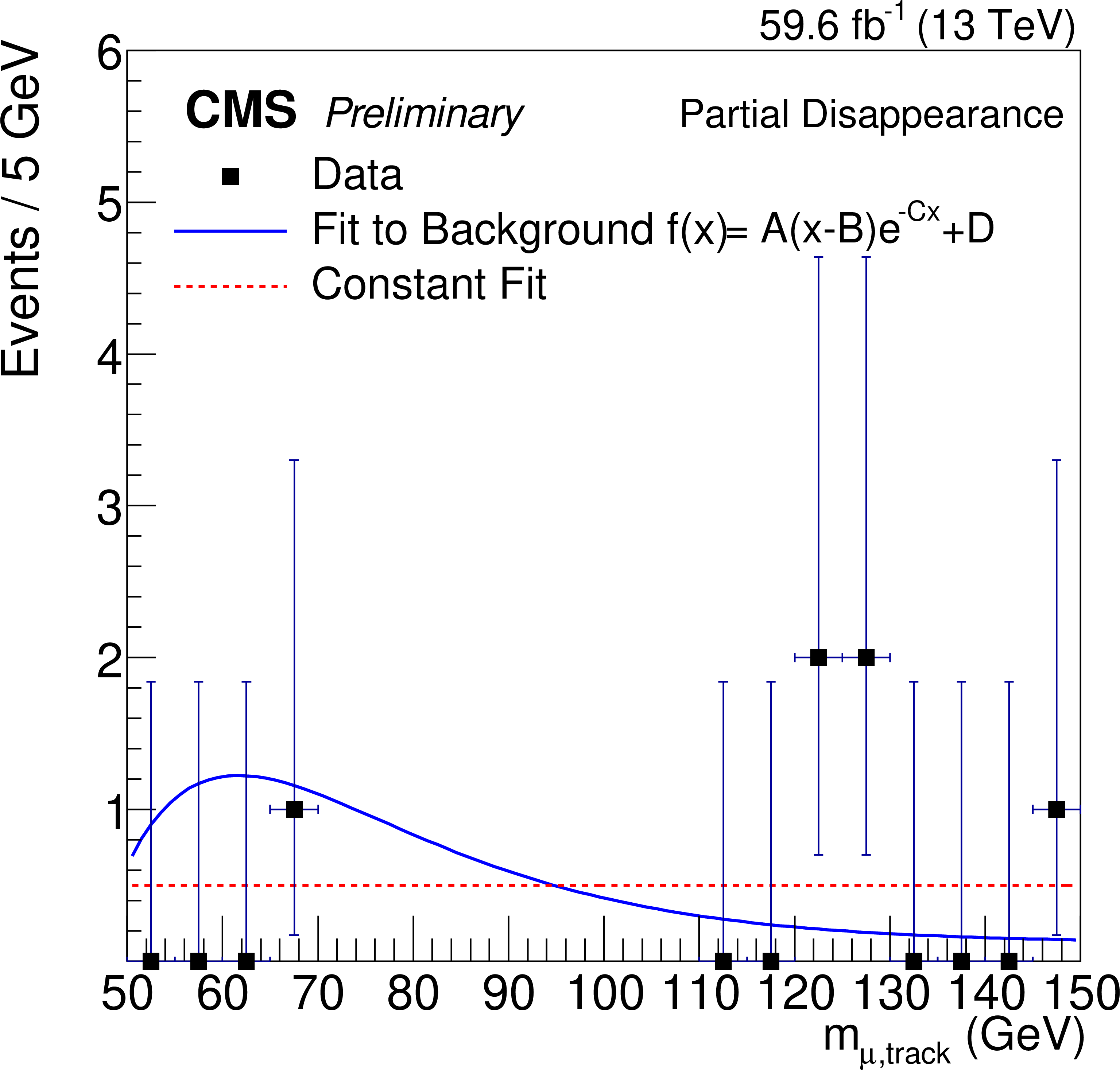
Fits of the non-DY-muon background in the off-peak control regions for complete (left) and partial (right) disappearance categories. The region of invariant mass between 70 and 110 GeV is excluded from the control region as well as the fit. |
png pdf |
Figure 4-a:
Fits of the non-DY-muon background in the off-peak control regions for complete (left) and partial (right) disappearance categories. The region of invariant mass between 70 and 110 GeV is excluded from the control region as well as the fit. |
png pdf |
Figure 4-b:
Fits of the non-DY-muon background in the off-peak control regions for complete (left) and partial (right) disappearance categories. The region of invariant mass between 70 and 110 GeV is excluded from the control region as well as the fit. |
png pdf |
Figure 5:
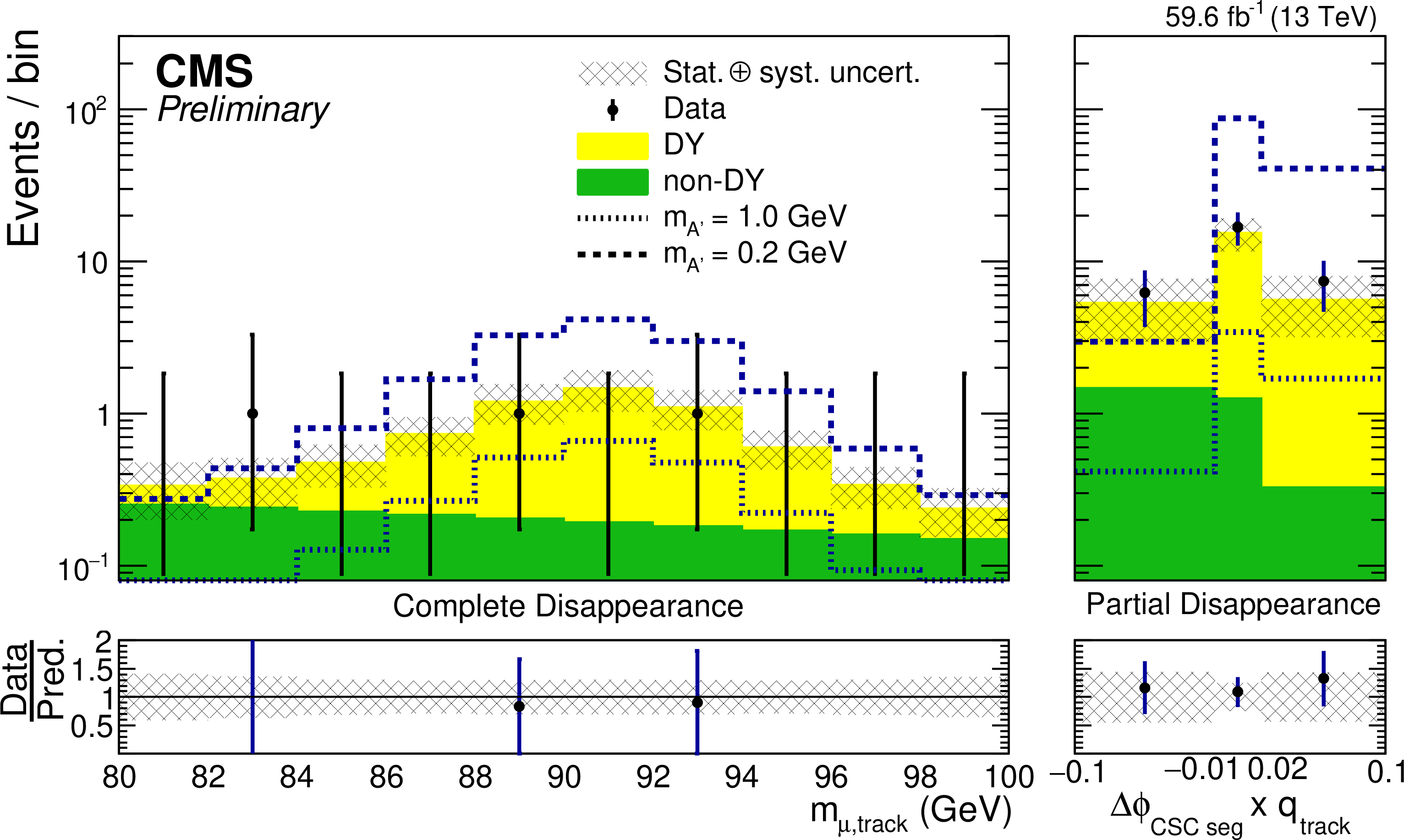
The invariant mass distributions of the tag and probe muon pair in the complete disappearance signal region (left), and the distributions of the $ \Delta\phi $ between the probe track and the nearest CSC segment multiplied by the track charge in the partial disappearance signal region (right). Statistical and systematic uncertainties in the expected background yields are represented by the hatched band. Background distributions are shown after the fit, and the DY and non-DY backgrounds are stacked with the uncertainty for the full background distribution shown as a hatched area centered on the sum of the background components. The lower panels show the ratio between the observed data and the total background expectation. The expected signal distributions for $ m({A} ^{\prime})= $ 0.2 GeV and $ m({A} ^{\prime})= $ 1.0 GeV are normalized to their cross sections with $ \epsilon^{2} = $ 1. |
png pdf |
Figure 6:
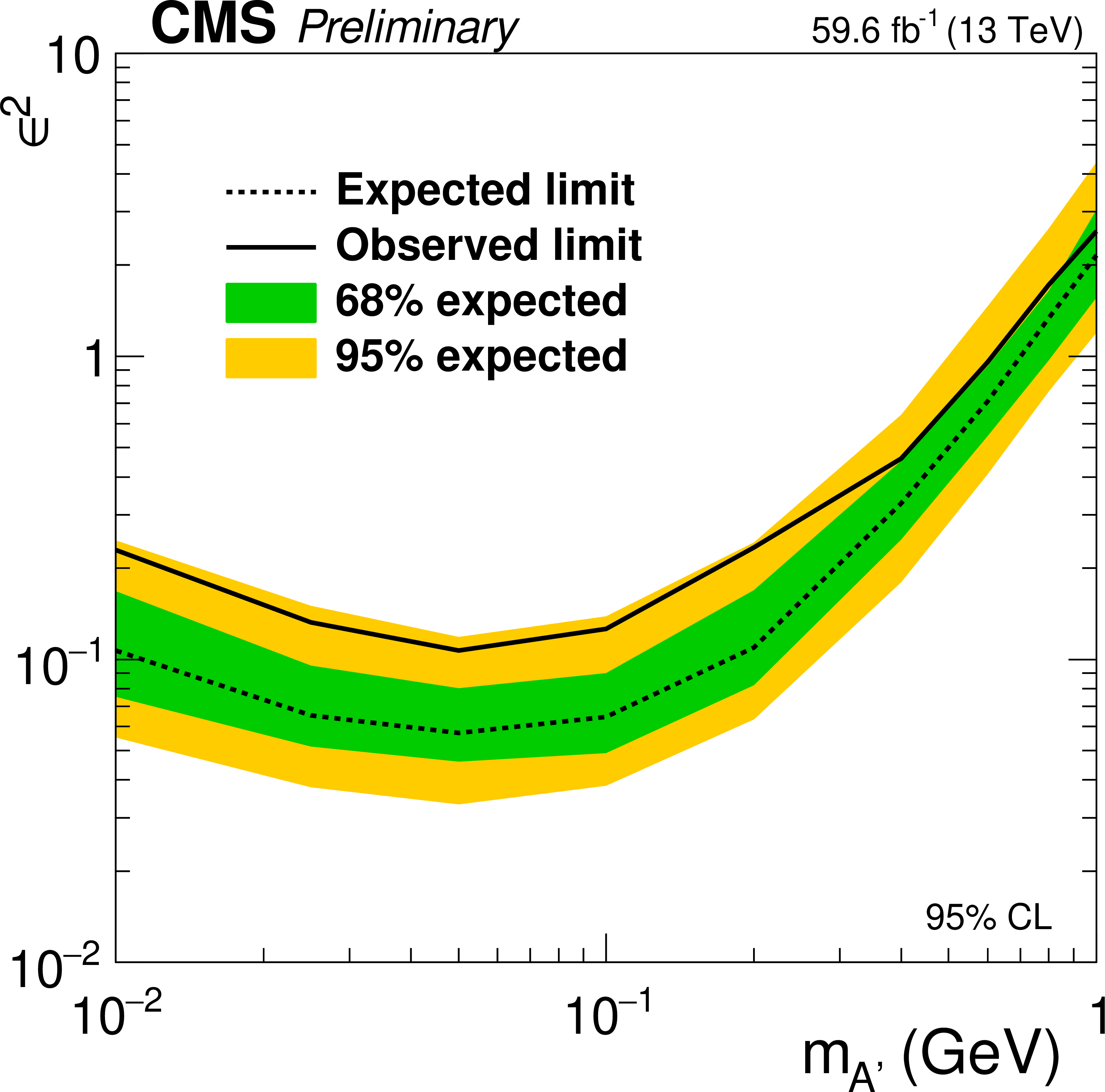
The observed (solid) and expected (dashed) 95% CL upper limits on the kinetic mixing $ \epsilon^{2} $ are shown for the combined analysis of both search categories. The 68 and 95% confidence intervals on the expected limit are shown in the green and yellow bands, respectively. |
| Tables | |
png pdf |
Table 1:
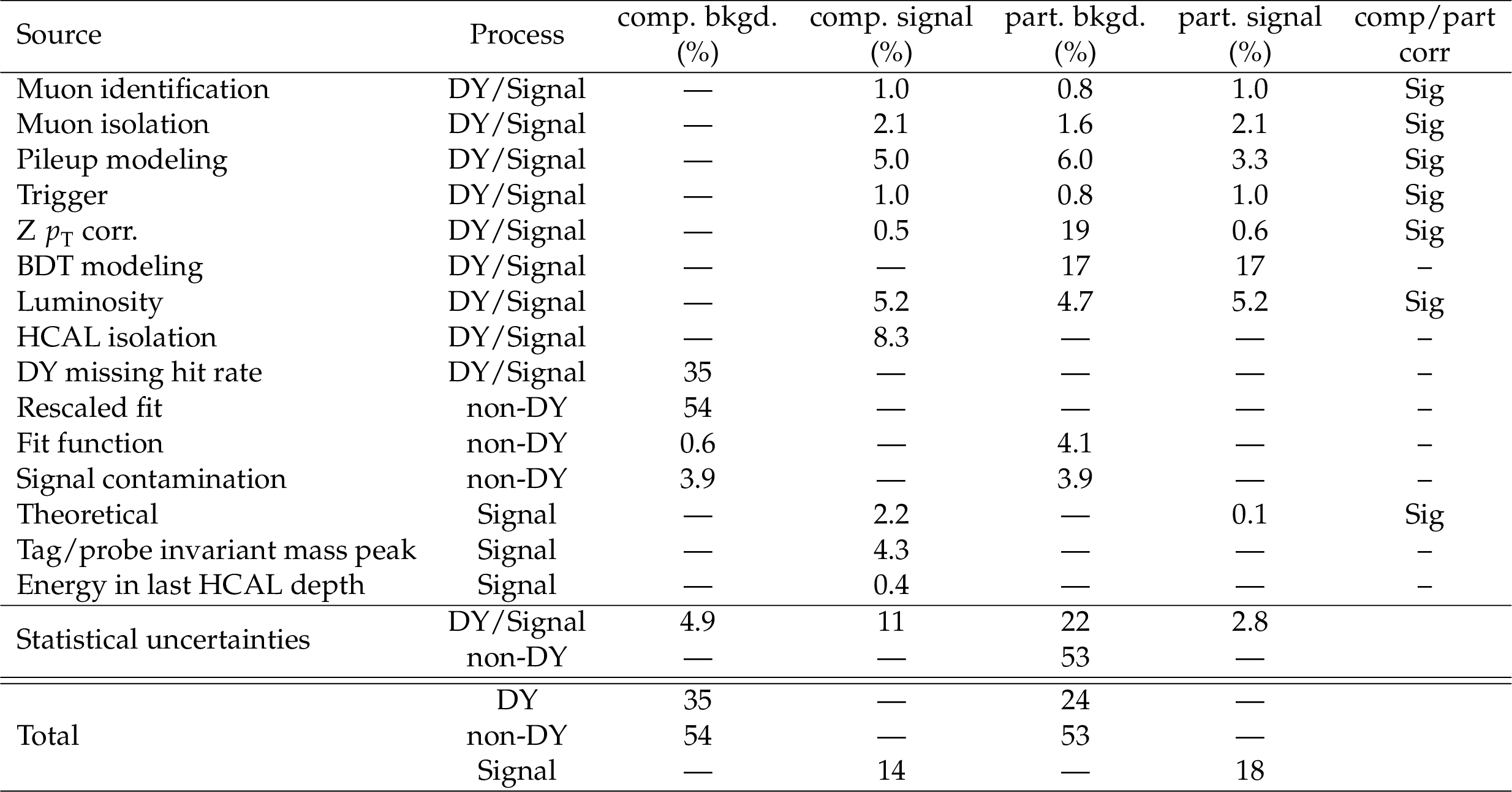
Summary of the systematic and statistical uncertainties and the relative effect on the total yields of events. The uncertainties are shown for both the complete (comp.) and partial (part.) disappearance region. The uncertainty on the signal yield is calculated for the $ \mathrm{m}_{{A} ^{\prime}}= $ 0.2 GeV signal point. The other signal points have matching uncertainties within the statistical uncertainty on the simulation samples. The set of systematic uncertainties which are considered correlated between categories are indicated; all correlations are for signal, none for background. |

png pdf |
Table 2:
The number of background events, as determined during the fit, compared to the observed data events. |
| Summary |
| A novel search for dark matter production via dark bremsstrahlung from muons interacting with calorimeter material in the CMS detector is described. Events are selected to isolate candidate muon pairs arising from decays of Z bosons by finding probe tracks that match with fully reconstructed muons to produce an invariant mass near the Z boson mass. The probe tracks are then extrapolated into the calorimeters and muon chambers to search for missing transverse momentum. Because of the strong dependence on the hadron calorimeter (HCAL) resolution for rejecting backgrounds, tracks are required to pass through the upgraded HCAL endcap and selected from a sample of proton-proton collisions at $ \sqrt{s}= $ 13 TeV corresponding to an integrated luminosity of 59.6 fb$ ^{-1} $ collected in 2018. Two categories of event are considered, one where the muon is not observed in the CMS muon systems or the last layers of the HCAL endcap (``complete disappearance'') and a second where the muon is observed with a large decrease in momentum (``partial disappearance''). The Drell--Yan (DY) background in the complete disappearance category is estimated using a dedicated control region where energy is required in the last layer of the HCAL endcap traversed by the probe track. The DY background in the partial disappearance category is estimated using simulation, with corrections derived from control regions in data that provide information about the HCAL energy deposits and individual muon chamber hits of a typical muon. The non-DY backgrounds are evaluated from data by fitting the non-peaking invariant mass distribution in regions away from the Z peak. No excess is observed, so the results are interpreted as limits on the mixing parameter for a minimal light dark matter model, using the effective fixed target luminosity of the CMS calorimeter volumes and the number of selected tracks. The upper limits placed on the mixing parameter $ \epsilon^2 $ range from 0.45--1.0 as the mass of the dark photon ranges from 0.01--1.0 GeV. These results are the first time a search for a dark photon has been performed through interactions between muons and a fixed target using a collider as a source of muons. |
| References | ||||
| 1 | V. C. Rubin, N. Thonnard, and W. K. Ford, Jr. | Rotational properties of 21 SC galaxies with a large range of luminosities and radii, from NGC 4605 (R = 4kpc) to UGC 2885 (R = 122 kpc) | Astrophys. J. 238 (1980) 471 | |
| 2 | D. Clowe, A. Gonzalez, and M. Markevitch | Weak lensing mass reconstruction of the interacting cluster 1E0657-558: Direct evidence for the existence of dark matter | Astrophys. J. 604 (2004) 596--603 | astro-ph/0312273 |
| 3 | Planck Collaboration | Planck 2015 results. XIII. Cosmological parameters | Astron. Astrophys. 594 (2016) A13 | 1502.01589 |
| 4 | J. Billard et al. | Direct detection of dark matter\textemdashAPPEC committee report | Rept. Prog. Phys. 85 (2022) 056201 | 2104.07634 |
| 5 | D. S. Akerib et al. | Snowmass2021 Cosmic Frontier Dark Matter Direct Detection to the Neutrino Fog | in. 3, 2022 Snowmass 202 (2022) 1 |
2203.08084 |
| 6 | LZ Collaboration | Dark Matter Search Results from 4.2 Tonne-Years of Exposure of the LUX-ZEPLIN (LZ) Experiment | 2410.17036 | |
| 7 | G. Arcadi et al. | The waning of the WIMP? A review of models, searches, and constraints | EPJC 78 (2018) 203 | 1703.07364 |
| 8 | M. Battaglieri et al. | US Cosmic Visions: New Ideas in Dark Matter 2017: Community Report | in U.S. Cosmic Visions: New Ideas in Dark Matter. 7, 2017 | 1707.04591 |
| 9 | B. W. Lee and S. Weinberg | Cosmological Lower Bound on Heavy Neutrino Masses | PRL 39 (1977) 165 | |
| 10 | C. Boehm, T. A. Ensslin, and J. Silk | Can Annihilating dark matter be lighter than a few GeVs? | JPG 30 (2004) 279 | astro-ph/0208458 |
| 11 | M. Pospelov, A. Ritz, and M. B. Voloshin | Secluded WIMP Dark Matter | PLB 662 (2008) 53 | 0711.4866 |
| 12 | B. Batell, A. Freitas, A. Ismail, and D. Mckeen | Flavor-specific scalar mediators | PRD 98 (2018) 055026 | 1712.10022 |
| 13 | E. Izaguirre, G. Krnjaic, P. Schuster, and N. Toro | Analyzing the Discovery Potential for Light Dark Matter | PRL 115 (2015) 251301 | 1505.00011 |
| 14 | NA64 Collaboration | Search for Light Dark Matter with NA64 at CERN | PRL 131 (2023) 161801 | 2307.02404 |
| 15 | Y. Kahn, G. Krnjaic, N. Tran, and A. Whitbeck | M3: a new muon missing momentum experiment to probe $ (g - 2)\mu $ and dark matter at Fermilab | Journal of High Energy Physics 2018 (2018) | |
| 16 | CMS Collaboration | The CMS experiment at the CERN LHC | JINST 3 (2008) S08004 | |
| 17 | CMS Collaboration | Performance of the CMS Level-1 trigger in proton-proton collisions at $ \sqrt{s} = $ 13 TeV | JINST 15 (2020) P10017 | CMS-TRG-17-001 2006.10165 |
| 18 | CMS Collaboration | The CMS trigger system | JINST 12 (2017) P01020 | CMS-TRG-12-001 1609.02366 |
| 19 | CMS Collaboration | Electron and photon reconstruction and identification with the CMS experiment at the CERN LHC | JINST 16 (2021) P05014 | CMS-EGM-17-001 2012.06888 |
| 20 | CMS Collaboration | Performance of the CMS muon detector and muon reconstruction with proton-proton collisions at $ \sqrt{s}= $ 13 TeV | JINST 13 (2018) P06015 | CMS-MUO-16-001 1804.04528 |
| 21 | CMS Collaboration | Description and performance of track and primary-vertex reconstruction with the CMS tracker | JINST 9 (2014) P10009 | CMS-TRK-11-001 1405.6569 |
| 22 | CMS Collaboration | Particle-flow reconstruction and global event description with the CMS detector | JINST 12 (2017) P10003 | CMS-PRF-14-001 1706.04965 |
| 23 | CMS Collaboration | CMS Technical Design Report for the Phase 1 Upgrade of the Hadron Calorimeter | link | |
| 24 | CMS Tracker Group Collaboration | The CMS phase-1 pixel detector upgrade | JINST 16 (2021) P02027 | 2012.14304 |
| 25 | CMS Collaboration | Track impact parameter resolution for the full pseudo rapidity coverage in the 2017 dataset with the CMS phase-1 pixel detector | cms detector performance summary, 2020 CDS |
|
| 26 | CMS Collaboration | Local reconstruction algorithms in the cathode strip chambers of CMS | EPJ Web Conf. 214 (2019) 02014 | |
| 27 | J. Alwall et al. | The automated computation of tree-level and next-to-leading order differential cross sections, and their matching to parton shower simulations | JHEP 07 (2014) 079 | 1405.0301 |
| 28 | J. Alwall et al. | Comparative study of various algorithms for the merging of parton showers and matrix elements in hadronic collisions | EPJC 53 (2008) 473 | 0706.2569 |
| 29 | T. Sjostrand et al. | An introduction to PYTHIA 8.2 | Comput. Phys. Commun. 191 (2015) 159 | 1410.3012 |
| 30 | CMS Collaboration | Extraction and validation of a new set of CMS PYTHIA8 tunes from underlying-event measurements | EPJC 80 (2020) 4 | CMS-GEN-17-001 1903.12179 |
| 31 | NNPDF Collaboration | Parton distributions from high-precision collider data | EPJC 77 (2017) 663 | 1706.00428 |
| 32 | GEANT4 Collaboration | GEANT 4---a simulation toolkit | NIM A 506 (2003) 250 | |
| 33 | T. Eichlersmith et al. | Simulation of dark bremsstrahlung in Geant4 | Comput. Phys. Commun. 287 (2023) 108690 | 2211.03873 |
| 34 | J. D. Bjorken, R. Essig, P. Schuster, and N. Toro | New fixed-target experiments to search for dark gauge forces | PRD 8 (2009) 80 075018 | |
| 35 | CMS Collaboration | Technical proposal for the Phase-II upgrade of the Compact Muon Solenoid | CMS Technical Proposal CERN-LHCC-2015-010, CMS-TDR-15-02, 2015 CDS |
|
| 36 | A. L. Read | Presentation of search results: the $ \text{CL}_\text{s} $ technique | JPG 28 (2002) 2693 | |
| 37 | T. Junk | Confidence level computation for combining searches with small statistics | NIM A 434 (1999) 435 | hep-ex/9902006 |
| 38 | G. Cowan, K. Cranmer, E. Gross, and O. Vitells | Asymptotic formulae for likelihood-based tests of new physics | EPJC 71 (2011) 1554 | 1007.1727 |
| 39 | CMS Collaboration | The CMS Statistical Analysis and Combination Tool: Combine | Comput. Softw. Big Sci. 8 (2024) 19 | CMS-CAT-23-001 2404.06614 |
|
|
Compact Muon Solenoid LHC, CERN |

|
|
|
|
|
|